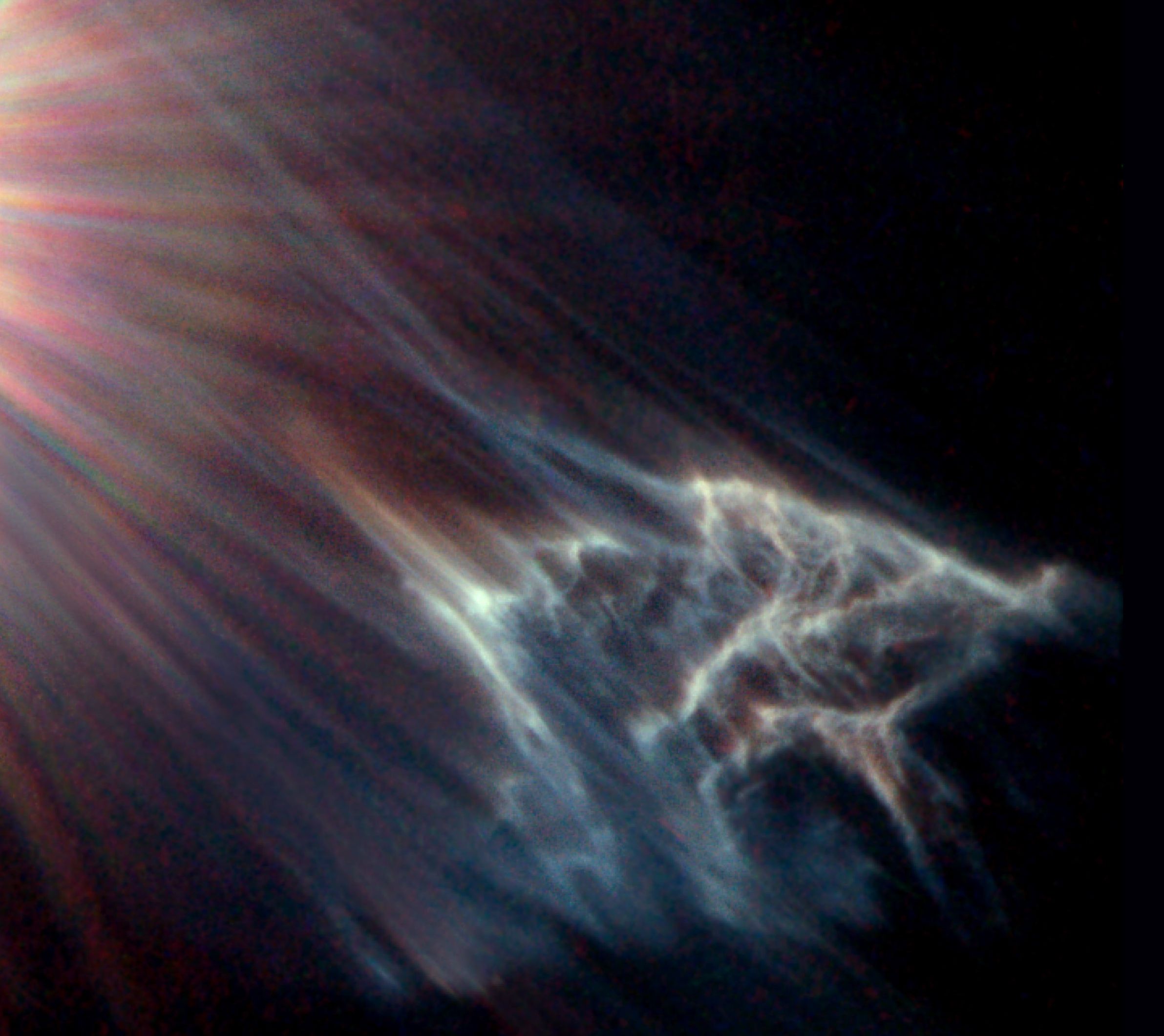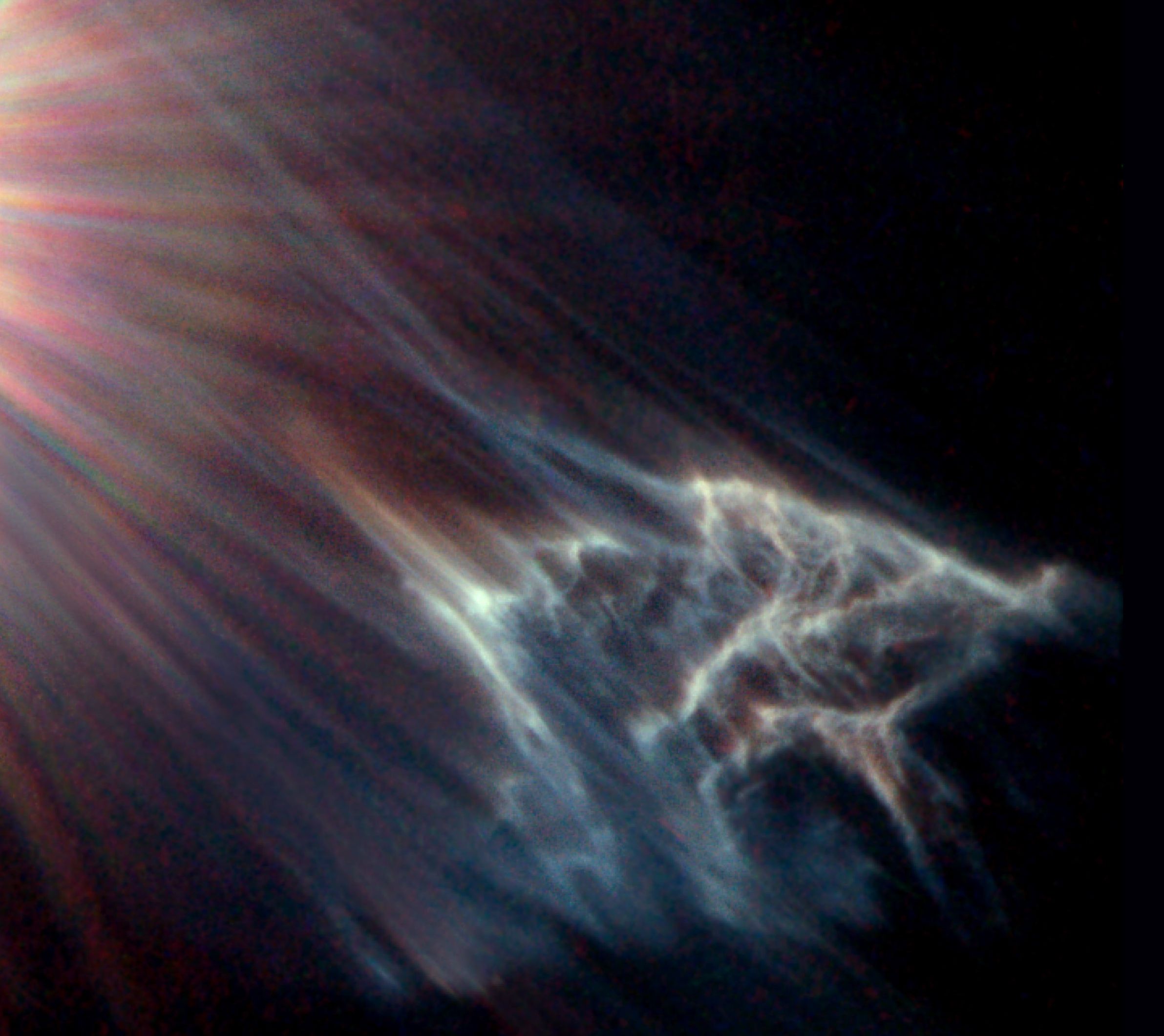
In the well known Pleiades star cluster, a star's light is slowly destroying this wandering cloud of gas and dust. Above, the star Merope lies just off the upper left edge of this picture from the Hubble Space Telescope. The cloud, known as IC 349, and the star have been in existence for millions of years. In the past 100,000 years, however, part of the cloud has by chance moved so close to the star - only 3,500 times the Earth-Sun distance - that the starlight itself is having a very dramatic effect. Pressure of the star's light significantly repels the dust in the reflection nebula with smaller dust particles being repelled more strongly. Eventually parts of the dust cloud have become stratified and point toward Merope, with the closest particles being the most massive and so the least affected by the radiation pressure. A longer-term result will be the general destruction of the dust by the energetic starlight.
En el conocido cúmulo de estrellas de las Pléyades, la luz de una estrella está destruyendo lentamente esta nube errante de gas y polvo. Arriba, la estrella Merope se encuentra justo fuera del borde superior izquierdo de esta imagen del Telescopio Espacial Hubble. La nube, conocida como IC 349, y la estrella han existido durante millones de años. Sin embargo, en los últimos 100,000 años, parte de la nube se ha acercado por casualidad tanto a la estrella —solo 3,500 veces la distancia Tierra-Sol— que la luz estelar en sí está teniendo un efecto muy dramático. La presión de la luz de la estrella repele significativamente el polvo en la nebulosa de reflexión, siendo repelidas las partículas de polvo más pequeñas con mayor fuerza. Eventualmente, partes de la nube de polvo se han estratificado y apuntan hacia Merope, siendo las partículas más cercanas las más masivas y por lo tanto las menos afectadas por la presión de radiación. Un resultado a largo plazo será la destrucción general del polvo por la luz estelar energética.