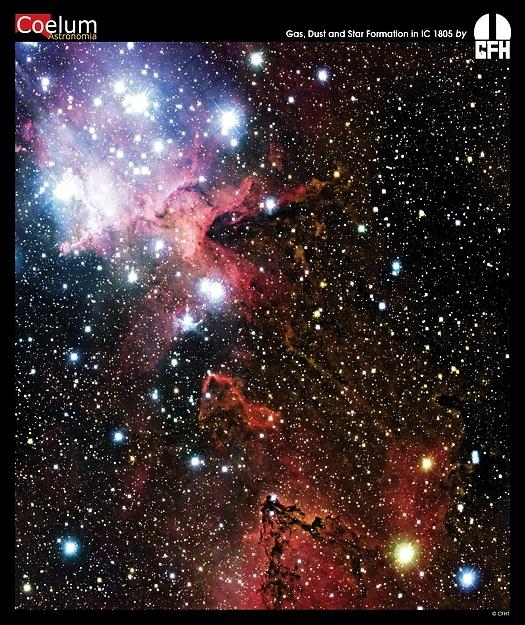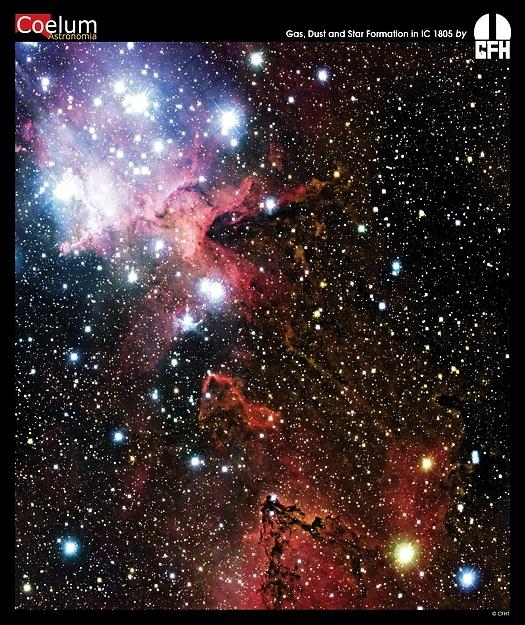
What powers the Heart Nebula? The large emission nebula dubbed IC 1805 looks, in whole, like a human heart. The nebula glows brightly in red light emitted by its most prominent element: hydrogen. The red glow and the larger shape are all created by a small group of stars near the nebula's center. A close up spanning about 30 light years contains many of these stars is shown above in a recent image taken by the Canada France Hawaii Telescope. This open cluster of stars contains a few bright stars nearly 50 times the mass of our Sun, many dim stars only a fraction of the mass of our Sun, and an absent microquasar that was expelled millions of years ago. The Heart Nebula is located about 7,500 light years away toward the constellation of Cassiopeia. News: The answer to Lewin's Challenge APOD can be found here.
¿Qué alimenta la Nebulosa del Corazón? La gran nebulosa de emisión conocida como IC 1805 tiene, en conjunto, la apariencia de un corazón humano. La nebulosa brilla intensamente en luz roja emitida por su elemento más prominente: el hidrógeno. El brillo rojo y la forma más grande son creados por un pequeño grupo de estrellas cerca del centro de la nebulosa. Una imagen detallada que abarca aproximadamente 30 años luz y contiene muchas de estas estrellas se muestra arriba en una imagen reciente tomada por el Telescopio Canadá-Francia-Hawái. Este cúmulo abierto de estrellas contiene algunas estrellas brillantes con casi 50 veces la masa de nuestro Sol, muchas estrellas débiles con solo una fracción de la masa de nuestro Sol, y un microcuásar ausente que fue expulsado hace millones de años. La Nebulosa del Corazón se encuentra a aproximadamente 7,500 años luz de distancia en dirección de la constelación de Casiopea.