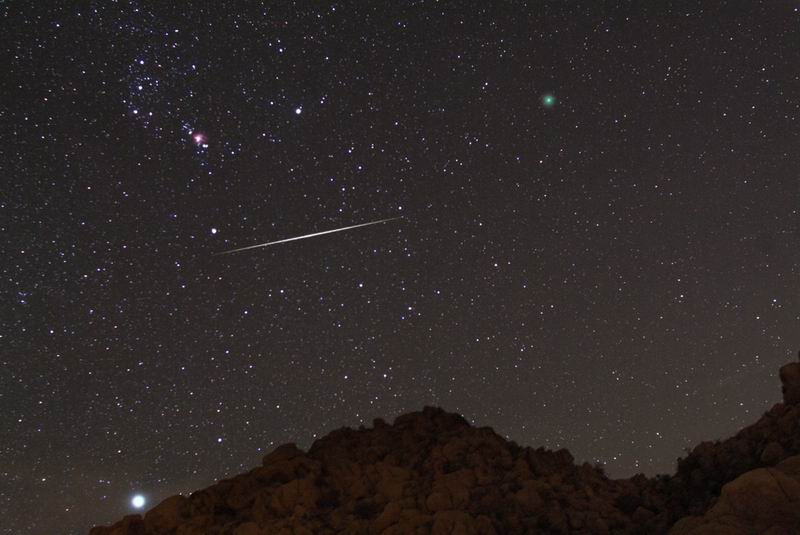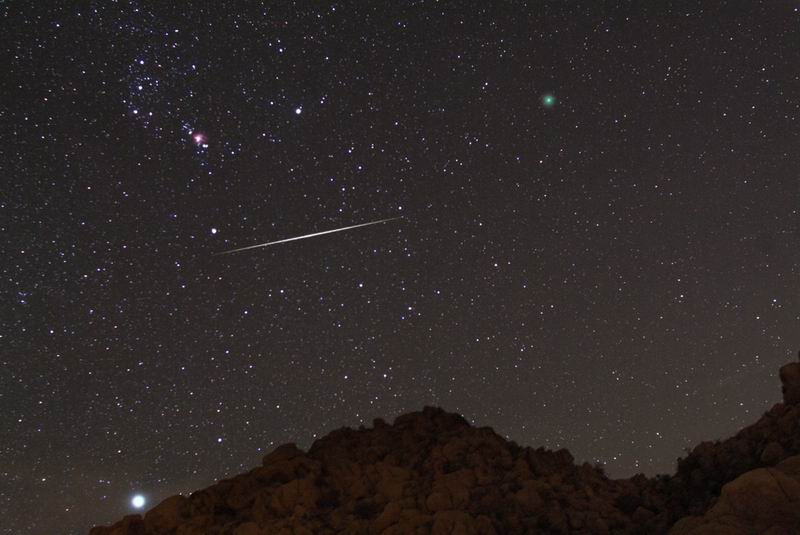
Several wonders of the late-year northern sky appeared together for a few fleeting moments on December 13. On the bottom left, just above the hill, is blue Sirius, the brightest star in the sky. Above Sirius and slightly to the right of the belt of Orion is the red Orion Nebula, one of the most famous nebulas on the sky. Below and to the right of the Orion Nebula streaks a yellow meteor, although moving in the wrong direction to be from the Geminids meteor shower that peaked the night. Finally, above and to the right of the meteor is Comet Machholz, whose coma appears here relatively green. Since the time since this image was taken over a Californian hill, the Geminid meteor has long since evaporated. Comet Machholz has brightened and moved to the north. Sirius, however, will remain in the constellation of Canis Major indefinitely.
Varios espectáculos del cielo septentrional de finales de año aparecieron juntos durante unos breves momentos el 13 de diciembre. En la parte inferior izquierda, justo encima de la colina, se encuentra Sirio de color azul, la estrella más brillante del cielo. Encima de Sirio y ligeramente a la derecha del cinturón de Orión se localiza la Nebulosa de Orión roja, una de las nebulosas más famosas del cielo. Debajo y a la derecha de la Nebulosa de Orión se desplaza un meteoro amarillo, aunque moviéndose en la dirección incorrecta para proceder de la lluvia de meteoros de las Gemínidas que alcanzó su máximo esa noche. Finalmente, encima y a la derecha del meteoro se encuentra el Cometa Machholz, cuya coma aparece aquí de color relativamente verdoso. Desde el momento en que se tomó esta imagen sobre una colina de California, el meteoro de las Gemínidas hace mucho tiempo que se ha desvanecido. El Cometa Machholz se ha hecho más brillante y se ha desplazado hacia el norte. Sin embargo, Sirio permanecerá en la constelación del Can Mayor indefinidamente.