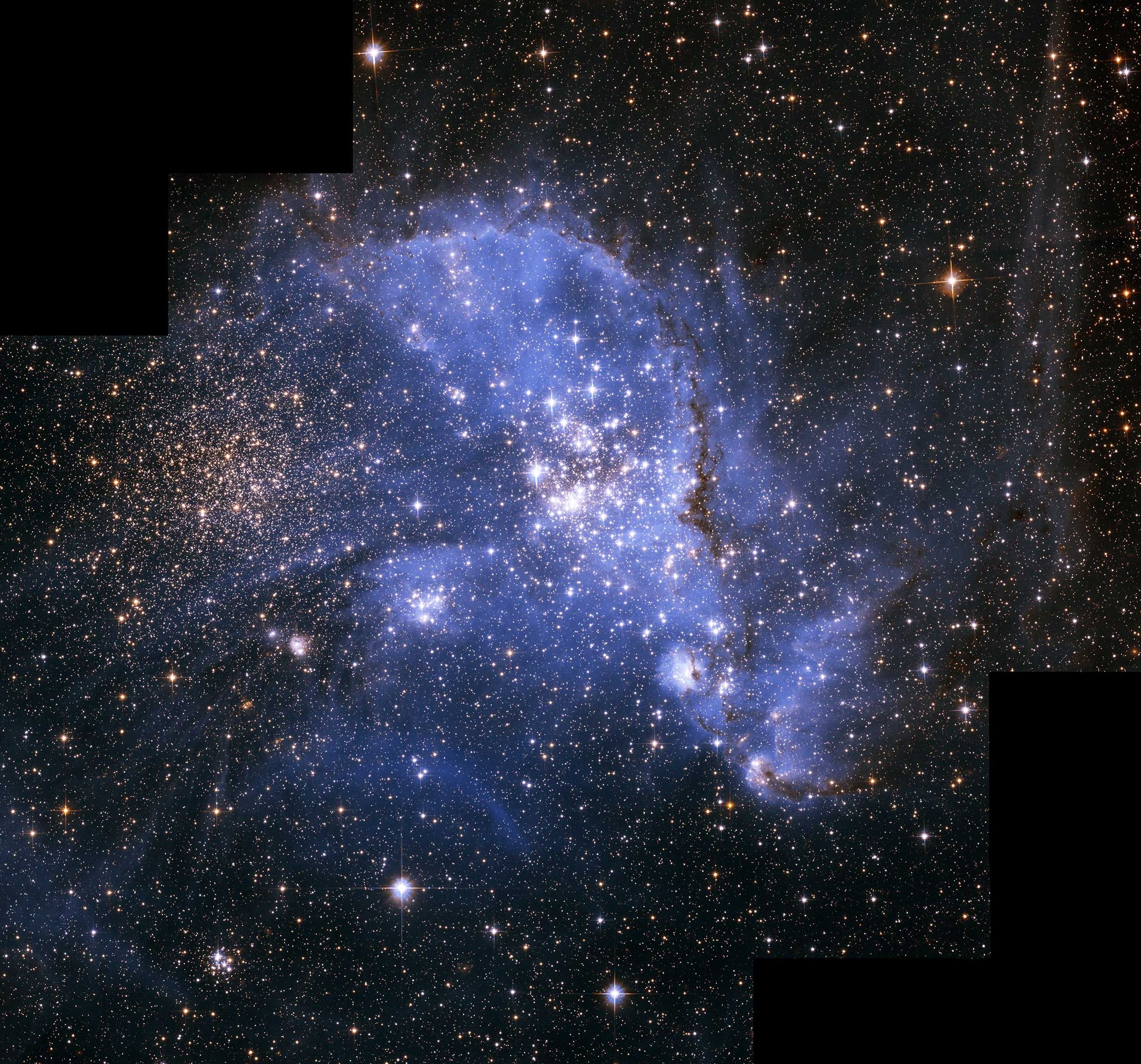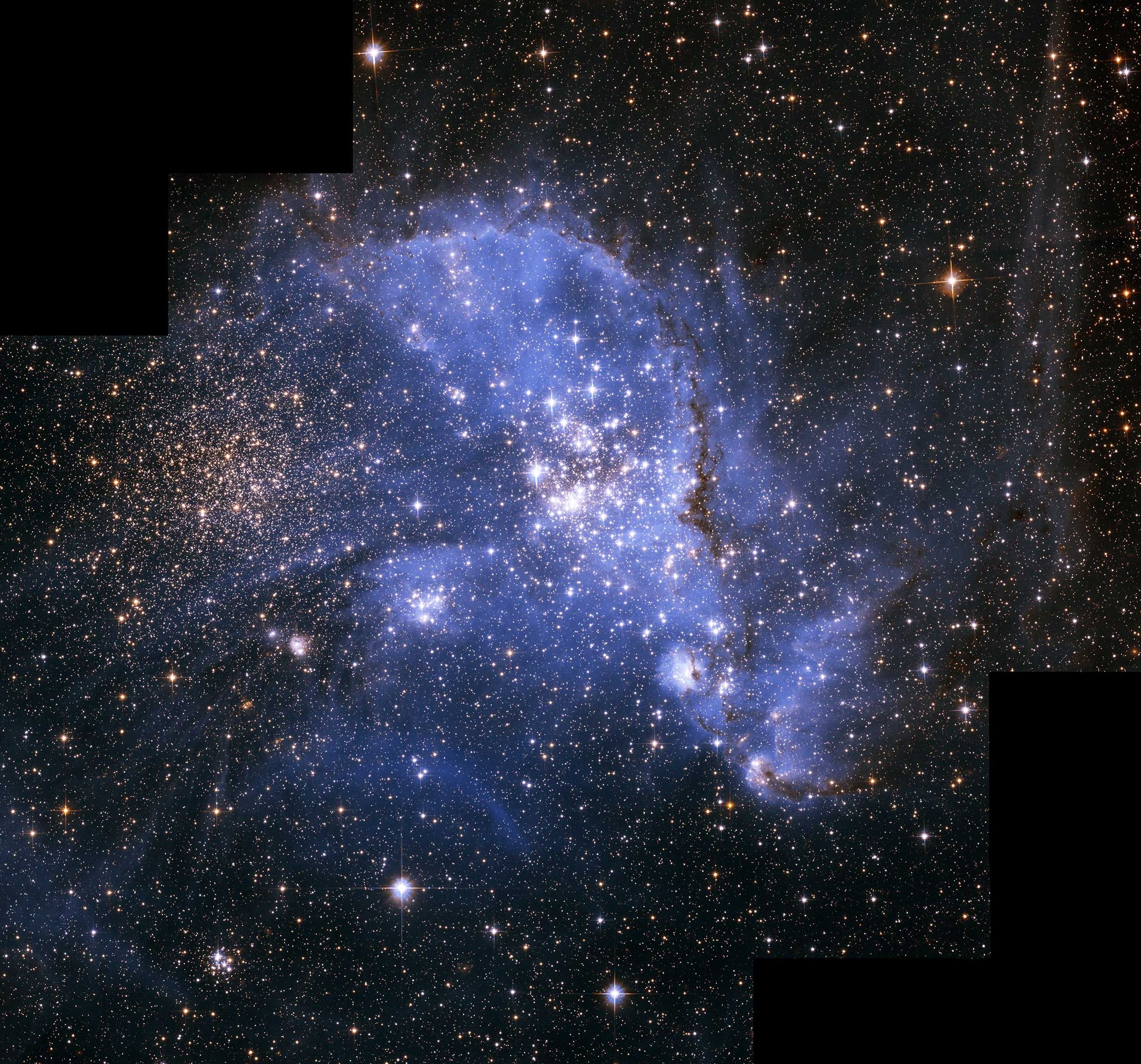
A satellite galaxy of the Milky Way, the Small Magellanic Cloud (SMC) is a wonder of the southern sky, a mere 210,000 light-years distant in the constellation Tucana. Found among the SMC's clusters and nebulae NGC 346 is a star forming region about 200 light-years across, pictured above by the Hubble Space Telescope. Exploring NGC 346, astronomers have identified a population of embryonic stars strung along the dark, intersecting dust lanes visible here on the right. Still collapsing within their natal clouds, the stellar infants' light is reddened by the intervening dust. A small, irregular galaxy, the SMC itself represents a type of galaxy more common in the early Universe. But these small galaxies are thought to be a building blocks for the larger galaxies present today. Within the SMC, stellar nurseries like NGC 346 are also thought to be similar to those found in the early Universe.
Galaxia satélite de la Vía Láctea, la Nube Menor de Magalanes (NMM) es una maravilla del cielo del hemisferio sur, ubicada a apenas 210 000 años luz de distancia en la constelación de Tucana. Entre los cúmulos y nebulosas de la NMM se encuentra NGC 346, una región de formación estelar de aproximadamente 200 años luz de diámetro, fotografiada arriba por el Telescopio Espacial Hubble. Al explorar NGC 346, los astrónomos han identificado una población de estrellas embrionarias alineadas a lo largo de los oscuros carriles de polvo que se entrecruzan, visibles aquí a la derecha. Todavía en colapso dentro de sus nubes natales, la luz de estos infantes estelares se ve enrojecida por el polvo interpuesto. Siendo una pequeña galaxia irregular, la NMM en sí representa un tipo de galaxia más común en el Universo temprano. Sin embargo, se cree que estas galaxias pequeñas son los bloques de construcción de las galaxias más grandes presentes hoy en día. Dentro de la NMM, guardererías estelares como NGC 346 también se cree que son similares a las encontradas en el Universo temprano.