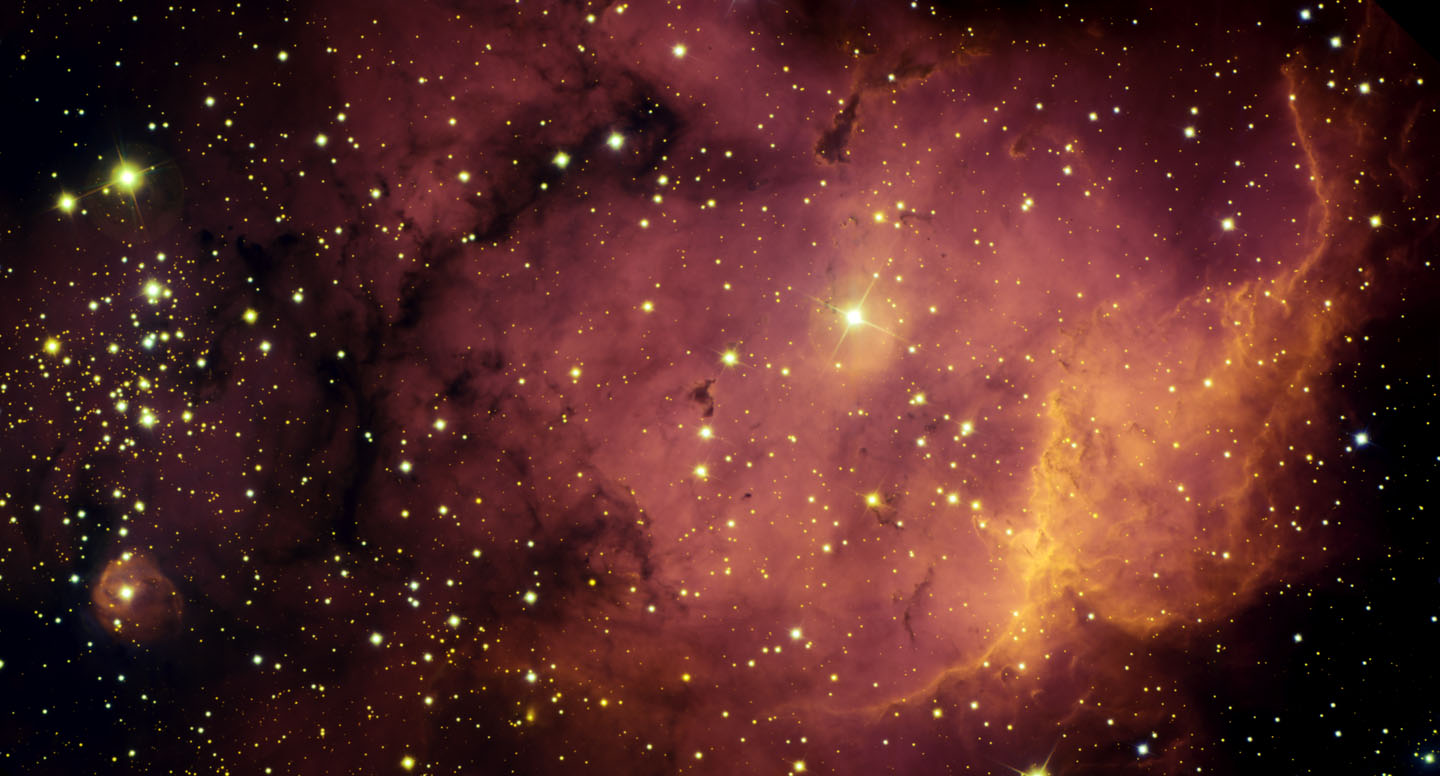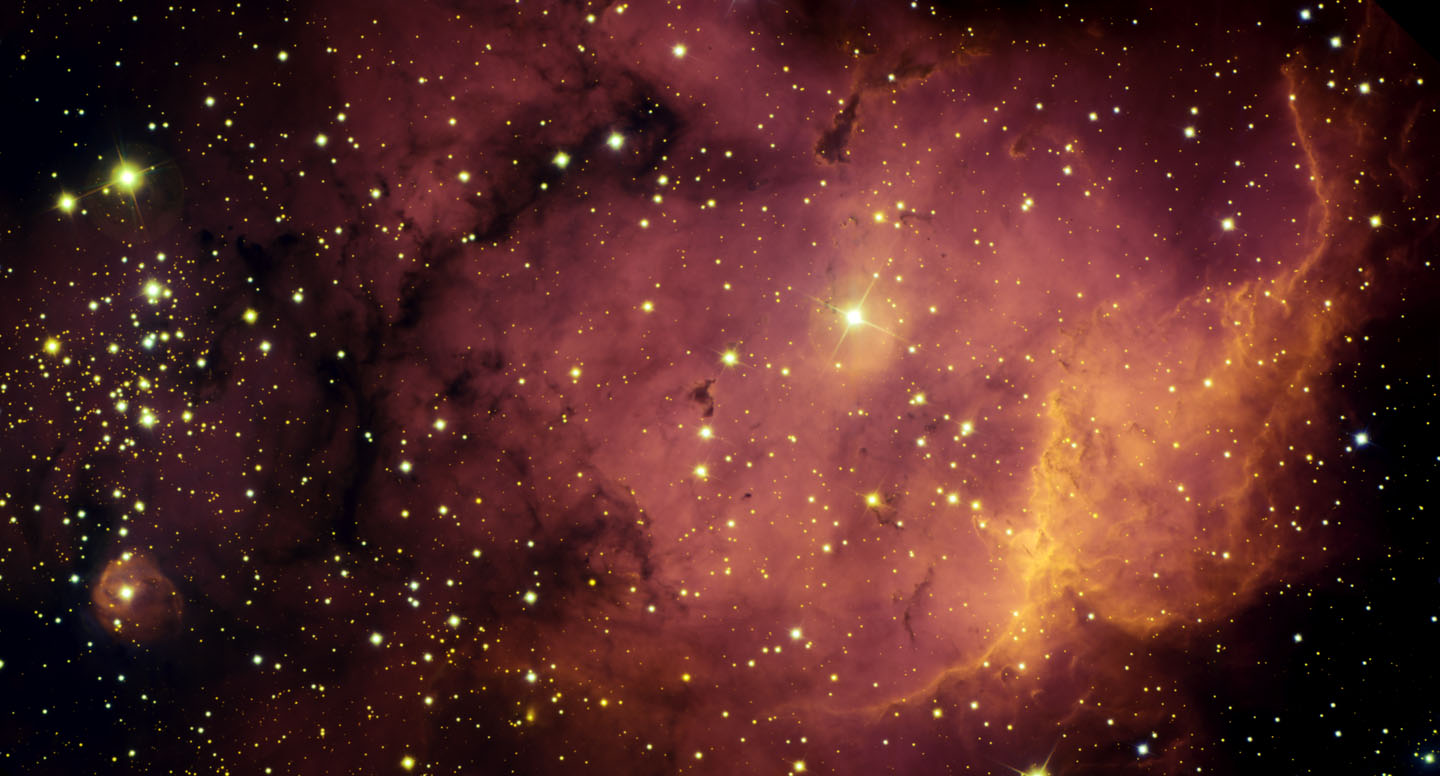
One might guess that the group of stars on the left is responsible for shaping the gas cloud on the right -- but it probably is not. Observations of many of the stars in the NGC 2467 show them to be more a superposition of loose groups of stars at different distances than a coherent open cluster of stars energizing the nebula. Still, the above image captures various stages of star formation. The stars at the far left have already formed and their birth nebulae have already dispersed. At the lower left lies a very young star that is breaking free of its surrounding birth cocoon of gas. On the right of the above image, a bright wall of bright gas glows as it evaporates from the energy of many newly formed bright stars. Toward the center, deep dark lanes of dust hide parts of the nebula that surely are forming new stars. The 8-meter Gemini South Telescope, perched on a mountaintop in Cerro Pachon, Chile, took the above image. NGC 2467 lies toward the southern constellation of Puppis, with many of the stars being about 17,000 light years distant.
Uno podría suponer que el grupo de estrellas en la izquierda es responsable de dar forma a la nube de gas en la derecha, pero probablemente no es así. Las observaciones de muchas de las estrellas en NGC 2467 muestran que se trata más bien de una superposición de grupos sueltos de estrellas a diferentes distancias que de un cúmulo abierto coherente de estrellas que energicen la nebulosa. Sin embargo, la imagen anterior captura varias etapas de formación estelar. Las estrellas en el extremo izquierdo ya se han formado y sus nebulosas de nacimiento ya se han dispersado. En la parte inferior izquierda se encuentra una estrella muy joven que se está liberando de su envoltura de gas de nacimiento. En la derecha de la imagen, un muro brillante de gas resplandece mientras se evapora por la energía de muchas estrellas nuevas y brillantes. Hacia el centro, profundos carriles oscuros de polvo ocultan partes de la nebulosa que ciertamente están formando nuevas estrellas. El Telescopio Gemini South de 8 metros, ubicado en la cima de una montaña en Cerro Pachón, Chile, tomó la imagen anterior. NGC 2467 se localiza hacia la constelación meridional de Puppis, estando muchas de las estrellas a unos 17.000 años luz de distancia.