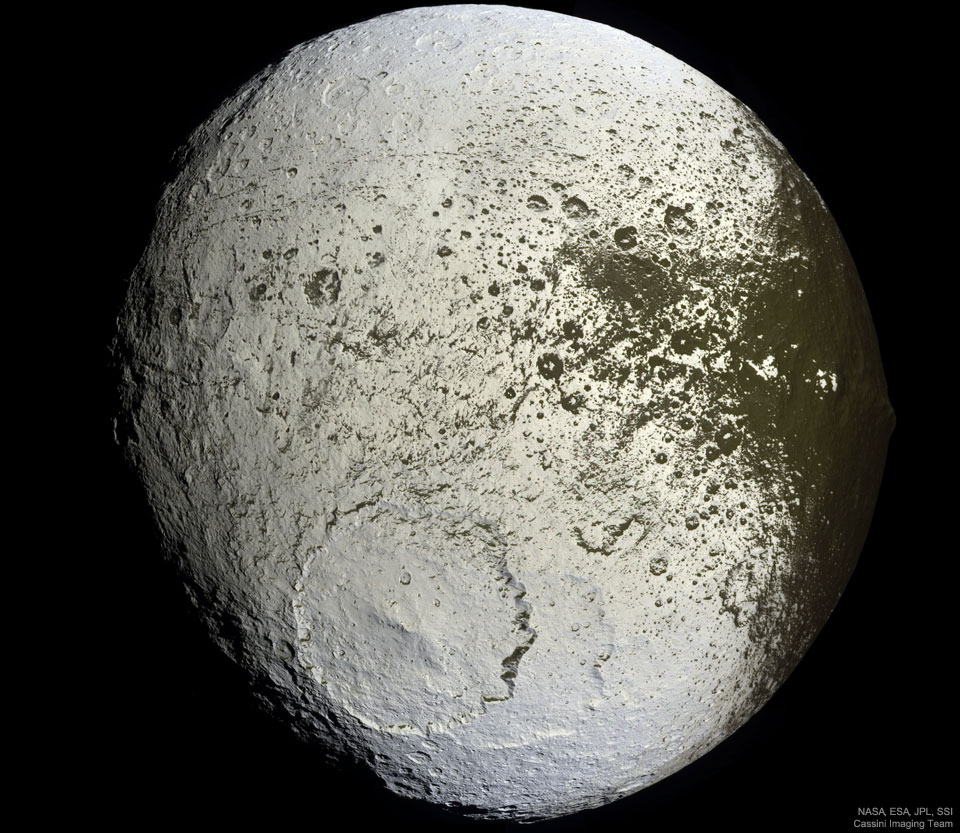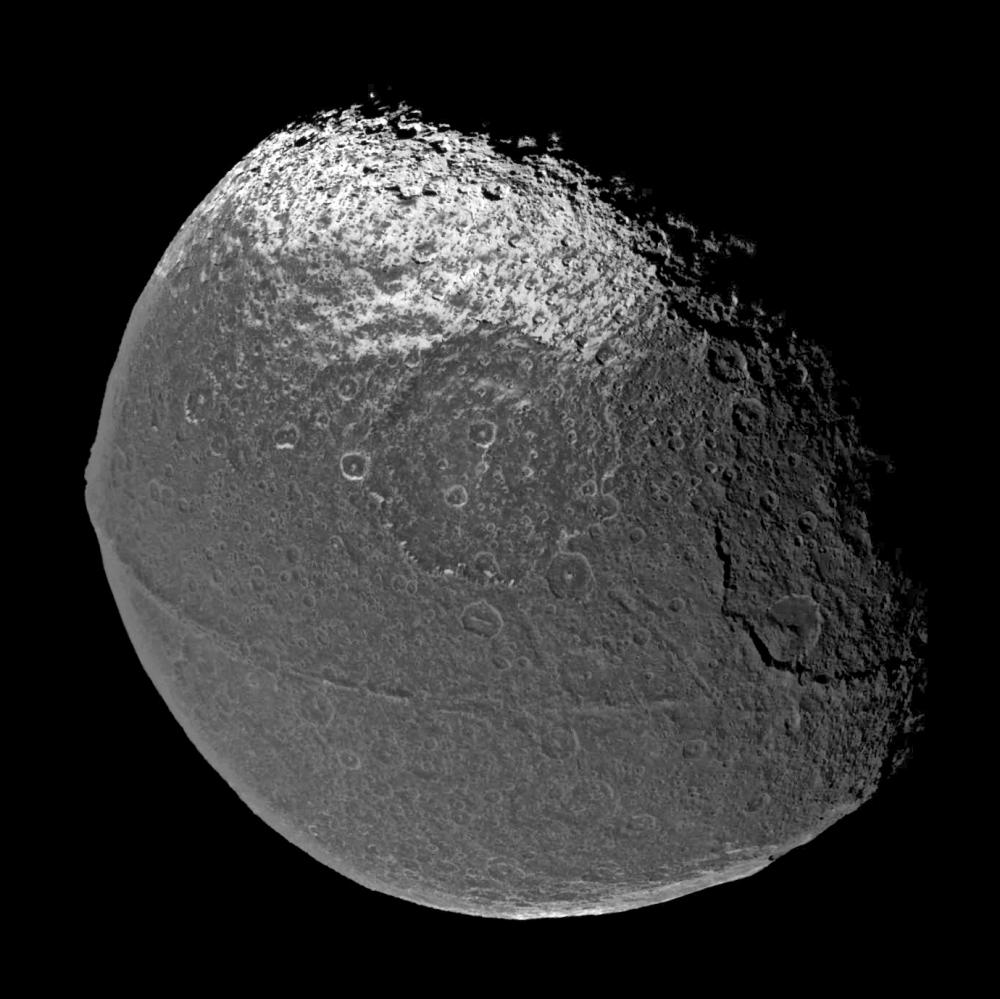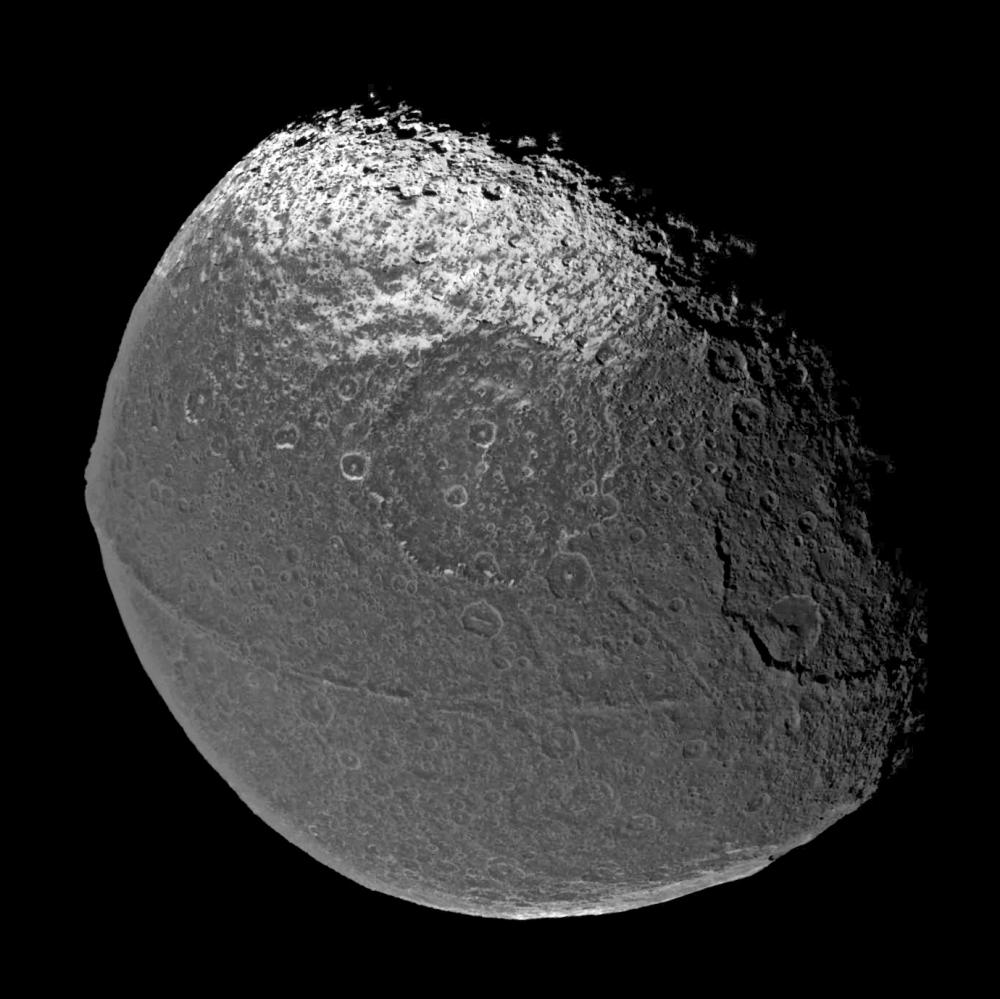
What has happened to Saturn's moon Iapetus? A strange ridge crosses the moon near the equator, visible near the bottom of the above image, making Iapetus appear similar to the pit of a peach. Half of Iapetus is so dark that it can nearly disappear when viewed from Earth. Recent observations show that the degree of darkness of the terrain is strangely uniform, like a dark coating was somehow recently applied to an ancient and highly cratered surface. The other half of Iapetus is relatively bright but oddly covered with long and thin streaks of dark. A 400-kilometer wide impact basin is visible near the image center, delineated by deep scarps that drop sharply to the crater floor. The above image was taken by the Saturn-orbiting Cassini spacecraft during a flyby of Iapetus at the end of last year.
¿Qué ha ocurrido en la luna Jápeto de Saturno? Una cresta extraña cruza la luna cerca del ecuador, visible cerca de la parte inferior de la imagen anterior, haciendo que Jápeto parezca similar a la semilla de un melocotón. La mitad de Jápeto es tan oscura que puede desaparecer casi completamente cuando se observa desde la Tierra. Las observaciones recientes muestran que el grado de oscuridad del terreno es extrañamente uniforme, como si un revestimiento oscuro se hubiera aplicado recientemente a una superficie antigua y muy craterizada. La otra mitad de Jápeto es relativamente brillante pero curiosamente cubierta con largas y delgadas vetas oscuras. Una cuenca de impacto de 400 kilómetros de ancho es visible cerca del centro de la imagen, delimitada por escarpes profundos que caen abruptamente hacia el piso del cráter. La imagen anterior fue tomada por la nave espacial Cassini que orbita Saturno durante un sobrevuelo de Jápeto a finales del año pasado.