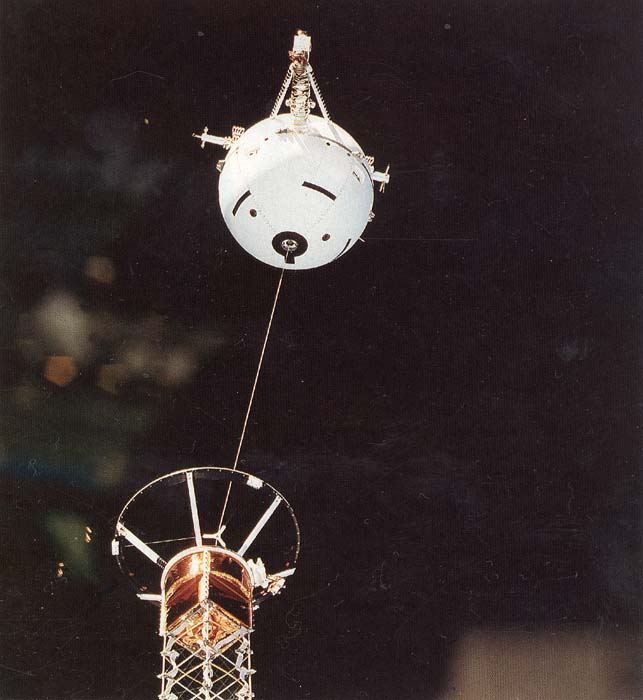
One of the greatest unrequited legends of outer space is the tether. Tethers, long strands of material, hold the promise of stabilizing satellites, generating electricity, and allowing easy transportation. Possibly the most extreme vision of the space tether is the space elevator popularized by Arthur C. Clarke, where a tether is constructed that connects the ground to geosynchronous orbit. One problem is strength - it is difficult to make a long useful tether that does not snap. To help realize more of the tremendous potential of space tethers, NASA and the SpaceWard Foundation have issued the Centennial Tether Challenge, promising a monetary reward for the best space tether that exceeds a minimum standard. Pictured above is the deployment of the Tethered Satellite System 1 (TSS-1) by the space shuttle Altantis in 1992. Like other tested tethers, TSS-1 failed to live up to its promise, although many valuable lessons were learned.
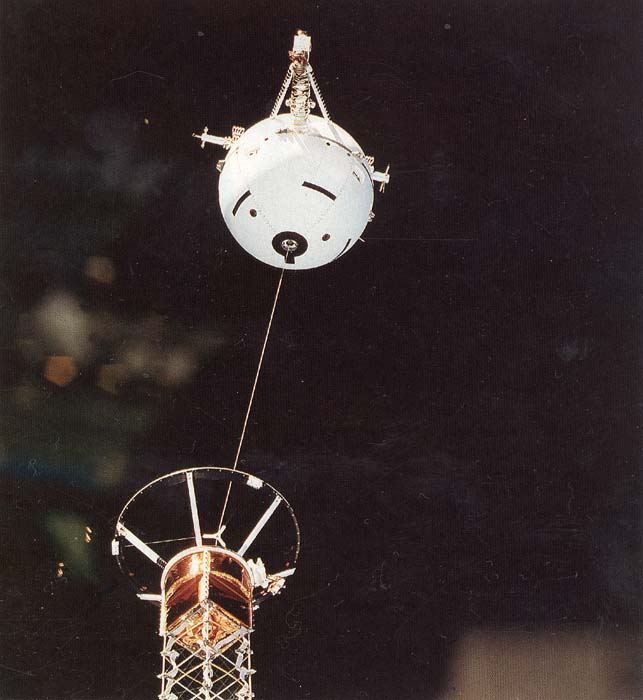
Una de las leyendas más grandes e incumplidas del espacio exterior es el cable espacial. Los cables, hebras largas de material, prometen estabilizar satélites, generar electricidad y permitir transporte fácil. Posiblemente la visión más extrema del cable espacial sea el ascensor espacial popularizado por Arthur C. Clarke, donde se construye un cable que conecta la tierra con la órbita geoestacionaria. Un problema es la resistencia: es difícil hacer un cable largo y útil que no se rompa. Para ayudar a realizar más del tremendo potencial de los cables espaciales, la NASA y la Fundación SpaceWard han emitido el Desafío Centinela del Cable, prometiendo una recompensa monetaria por el mejor cable espacial que supere un estándar mínimo. La imagen superior muestra el despliegue del Sistema de Satélite Conectado 1 (TSS-1) por el transbordador espacial Atlantis en 1992. Como otros cables probados, el TSS-1 no cumplió con sus promesas, aunque se aprendieron muchas lecciones valiosas.