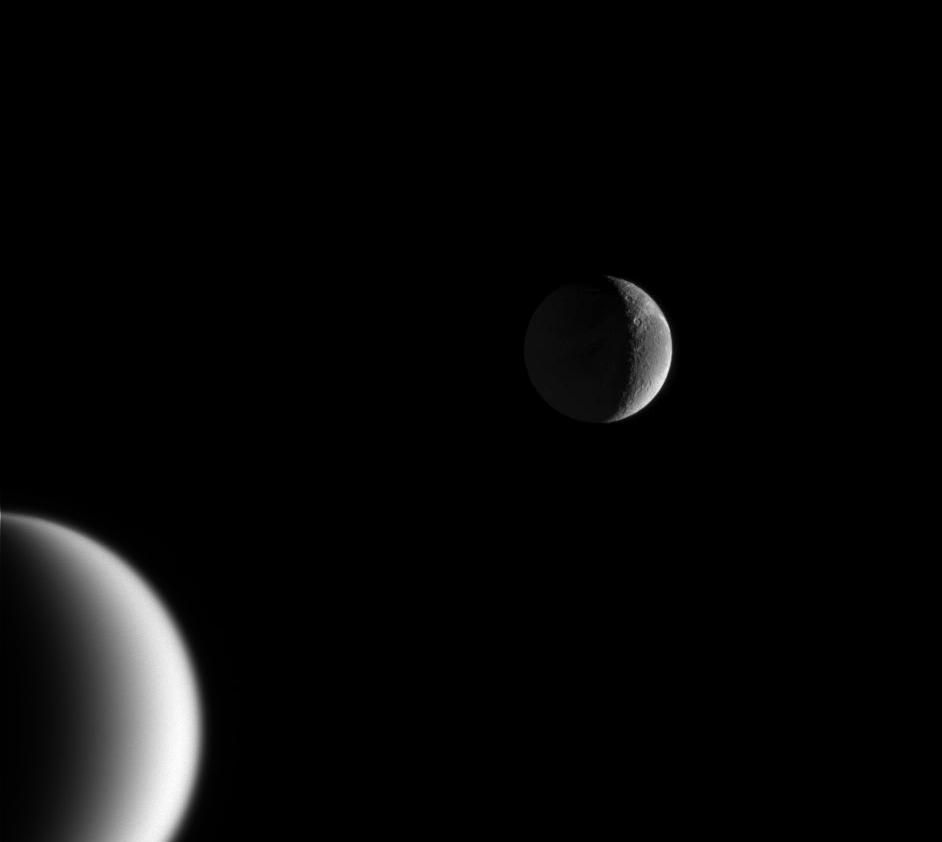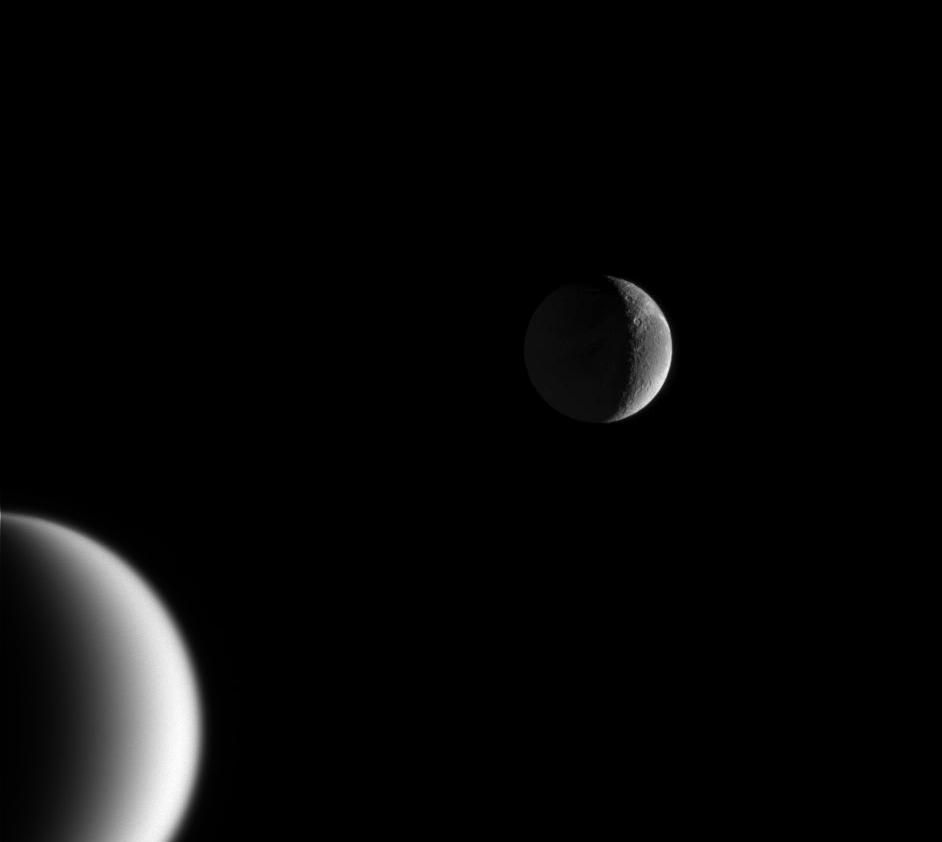
What would it be like to see a sky with many moons? Such is the sky above Saturn. When appearing close to each other, moons will show a similar phase. A view with two of the more famous moons of Saturn in crescent phase was captured last month by the robot spacecraft Cassini now orbiting Saturn. Titan, on the lower left, is among the largest moons in the Solar System and is perpetually shrouded in clouds. Recently, the Huygens probe landed on Titan and gave humanity its first view of its unusual surface. Dione, on the upper right, has less than a quarter of Titan's diameter and has no significant atmosphere. Dione, although appearing smaller, was only half the distance to Titan when the above image was taken.
¿Cómo sería ver un cielo con muchas lunas? Así es el cielo sobre Saturno. Cuando aparecen cerca una de la otra, las lunas mostrarán una fase similar. Una vista con dos de las lunas más famosas de Saturno en fase de creciente fue capturada el mes pasado por la nave espacial robótica Cassini, que actualmente orbita Saturno. Titán, en la parte inferior izquierda, se encuentra entre las lunas más grandes del Sistema Solar y está perpetuamente envuelta en nubes. Recientemente, la sonda Huygens aterrizó en Titán y le dio a la humanidad su primera vista de su superficie inusual. Dione, en la parte superior derecha, tiene menos de un cuarto del diámetro de Titán y no posee una atmósfera significativa. Dione, aunque aparenta ser más pequeña, estaba a solo la mitad de la distancia a Titán cuando se tomó la imagen anterior.