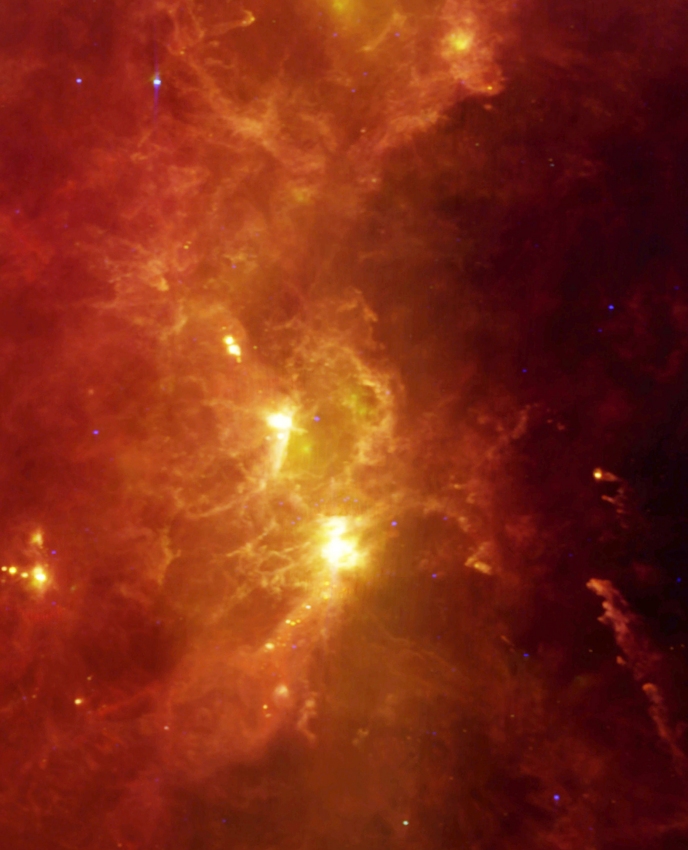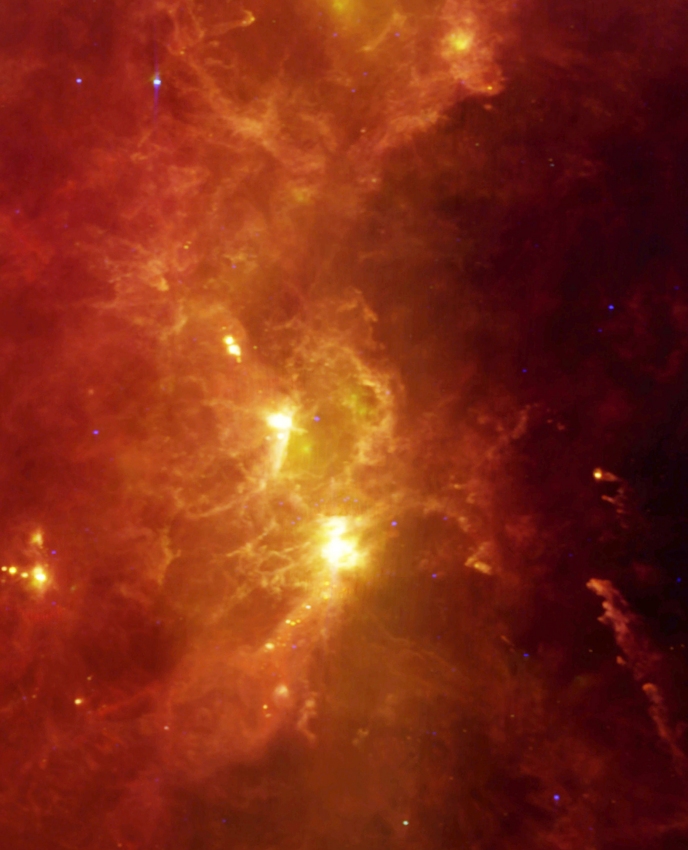
Do you recognize the constellation Orion? This striking but unfamiliar looking picture of the familiar Orion region of the sky was produced using survey data from the now-defunct InfraRed Astronomical Satellite (IRAS). The above image combines information recorded at three different invisible infrared wavelengths and covers about 30x24 degrees on the sky. Most of Orion's visually impressive stars don't stand out, but bright Betelgeuse does appear as a small bright purplish dot on the lower left. The bright region on the right contains the Great Nebula in Orion, while the bright region just above the image bottom is the Rosette Nebula. Surrounding these regions are a jumble of chaotic glowing gas and dark dust jettisoned by stars forming and exploding over millions of years.
¿Reconoces la constelación de Orión? Esta imagen llamativa pero inusual de la familiar región de Orión en el cielo fue producida utilizando datos de sondeo del Satélite Astronómico Infrarrojo (IRAS, por sus siglas en inglés), ahora desaparecido. La imagen anterior combina información registrada a tres longitudes de onda infrarroja diferentes e invisibles, y cubre aproximadamente 30x24 grados en el cielo. La mayoría de las estrellas visualmente impresionantes de Orión no destacan, pero Betelgeuse, brillante, aparece como un pequeño punto brillante de color púrpura en la parte inferior izquierda. La región brillante de la derecha contiene la Gran Nebulosa de Orión, mientras que la región brillante justo encima del borde inferior de la imagen es la Nebulosa de la Roseta. Rodeando estas regiones hay una maraña caótica de gas incandescente y polvo oscuro expulsados por estrellas que se han formado y explotado durante millones de años.