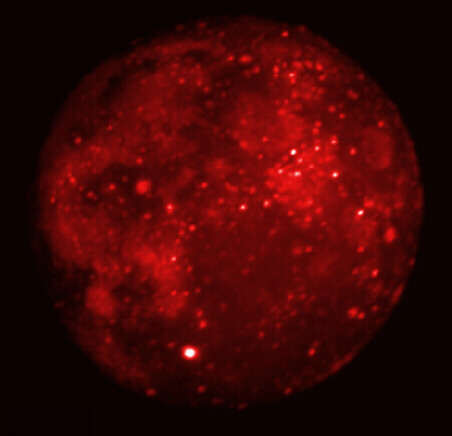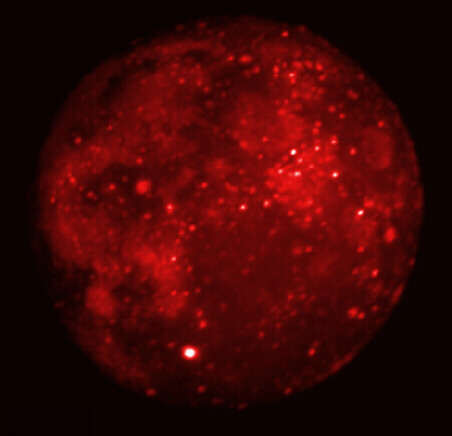
In September of 1996, the Midcourse Space Experiment (MSX) satellite had a spectacular view of a total lunar eclipse from Earth orbit. SPIRIT III, an on board infrared telescope, was used to repeatedly image the moon during the eclipse. Above is one of the images taken during the 70 minute totality, the Moon completely immersed in the Earth's shadow. Infrared light has wavelengths longer than visible light - humans can not see it but feel it as heat. So, the bright spots correspond to the warm areas on the lunar surface, and dark areas are cooler. The brightest spot below and left of center is the crater Tycho, while the dark region at the upper right is the Mare Crisium. Of course, this Sunday's lunar eclipse will not be a total, or even a partial one. Instead, the Moon will glide through the subtle outer portion of the Earth's shadow in a penumbral eclipse of the Moon.
En septiembre de 1996, el satélite Midcourse Space Experiment (MSX) tuvo una vista espectacular de un eclipse lunar total desde la órbita terrestre. SPIRIT III, un telescopio infrarrojo a bordo, fue utilizado para obtener imágenes repetidas de la Luna durante el eclipse. La imagen anterior fue tomada durante los 70 minutos de totalidad, con la Luna completamente inmersa en la sombra de la Tierra. La luz infrarroja tiene longitudes de onda mayores que la luz visible —los humanos no pueden verla pero la sienten como calor. Por lo tanto, las manchas brillantes corresponden a las áreas cálidas en la superficie lunar, y las áreas oscuras son más frías. La mancha más brillante por debajo y a la izquierda del centro es el cráter Tycho, mientras que la región oscura en la parte superior derecha es el Mare Crisium. Por supuesto, el eclipse lunar de este domingo no será total, ni siquiera parcial. En cambio, la Luna se deslizará a través de la sutil porción exterior de la sombra de la Tierra en un eclipse penumbral de la Luna.