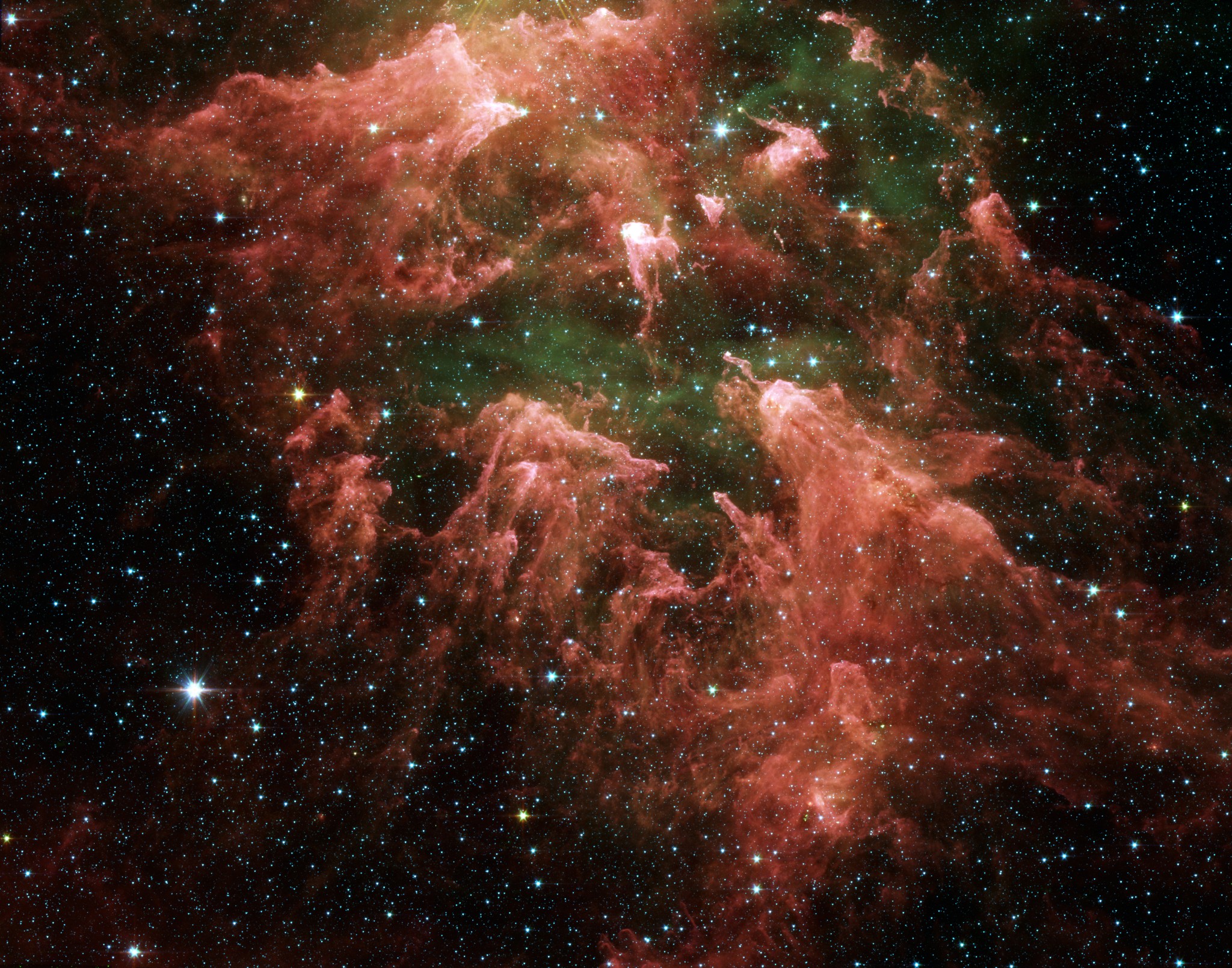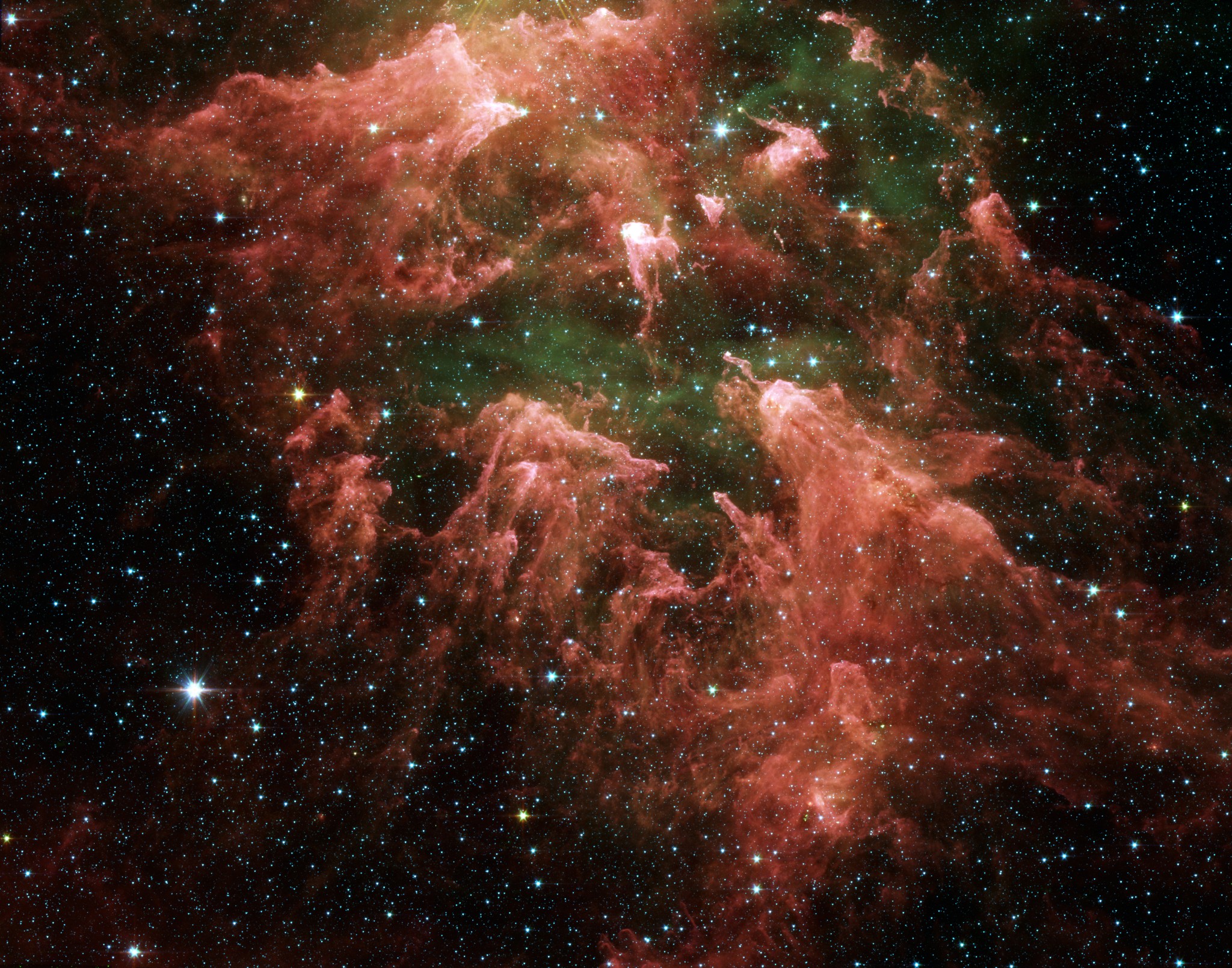
Carinae, one of the most massive and unstable stars in the Milky Way Galaxy, has a profound effect on its environment. Found in the the South Pillar region of the Carina Nebula, these fantastic pillars of glowing dust and gas with embedded newborn stars were sculpted by the intense wind and radiation from Eta Carinae and other massive stars. Glowing brightly in planet Earth's southern sky, the expansive Eta Carinae Nebula is a mere 10,000 light-years distant. Still, this remarkable cosmic vista is largely obscured by nebular dust and only revealed here in penetrating infrared light by the Spitzer Space Telescope. Eta Carinae itself is off the top left of the false-color image, with the bright-tipped dust pillars pointing suggestively toward the massive star's position. The Spitzer image spans almost 200 light-years at the distance of Eta Carinae.
Eta Carinae, una de las estrellas más masivas e inestables de la Vía Láctea, ejerce un profundo efecto sobre su entorno. Ubicada en la región del Pilar Sur de la Nebulosa de Carina, estos fantásticos pilares de polvo y gas incandescente con estrellas recién nacidas incrustadas fueron esculpidos por el intenso viento y la radiación de Eta Carinae y otras estrellas masivas. Brillando intensamente en el cielo meridional de la Tierra, la expansiva Nebulosa de Eta Carinae se encuentra a apenas 10.000 años luz de distancia. Sin embargo, esta notable vista cósmica está en gran medida oscurecida por el polvo nebular y solo se revela aquí a través de la penetrante luz infrarroja del Telescopio Espacial Spitzer. Eta Carinae en sí se encuentra fuera del borde superior izquierdo de la imagen en falso color, con los pilares de polvo de punta brillante apuntando sugestivamente hacia la posición de la estrella masiva. La imagen de Spitzer abarca casi 200 años luz a la distancia de Eta Carinae.