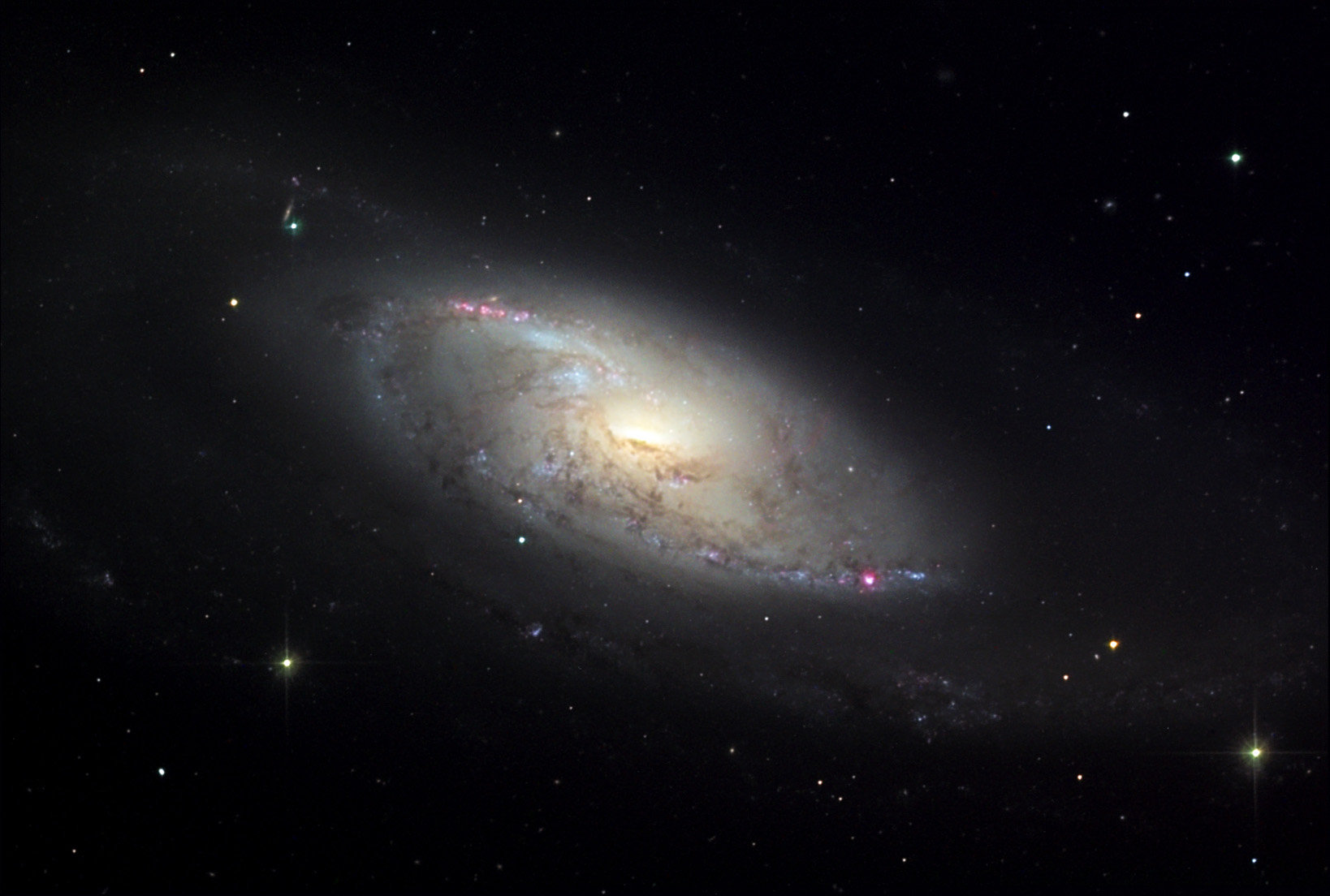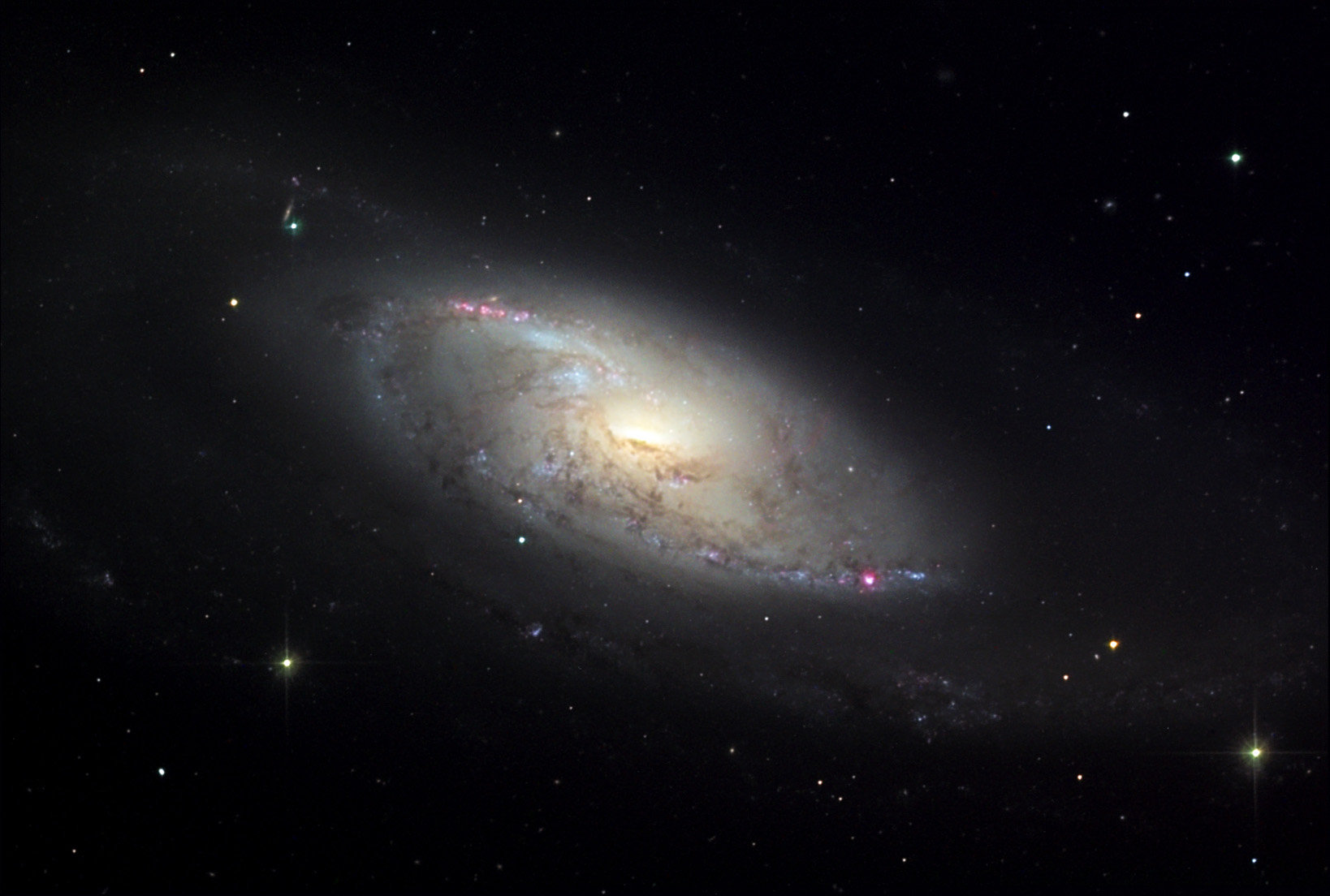
Close to the Great Bear (Ursa Major) and surrounded by the stars of the Hunting Dogs (Canes Venatici), this celestial nebula was discovered in 1781 by the metric French astronomer Pierre Mechain. Later, it was added to the catalog of his friend and colleague Charles Messier as M106. Modern deep telescopic views reveal it to be an island universe -- a spiral galaxy around 30 thousand light-years across located only about 21 million light-years beyond the stars of the Milky Way. Youthful blue star clusters and reddish stellar nurseries trace the striking spiral arms of M106. Seen so clearly in this beautiful image, the galaxy's bright core is also visible across the spectrum from radio to x-rays, making M106 a nearby example of the Seyfert class of active galaxies. The bright core of a Seyfert galaxy is believed to be powered by matter falling into a massive central black hole. News Flash: Object Larger than Pluto Discovered in Distant Solar System
Cercana a la Osa Mayor (Ursa Major) y rodeada por las estrellas de los Perros de Caza (Canes Venatici), esta nebulosa celeste fue descubierta en 1781 por el astrónomo francés Pierre Mechain. Posteriormente, fue añadida al catálogo de su amigo y colega Charles Messier como M106. Las observaciones telescópicas profundas modernas revelan que se trata de un universo isla — una galaxia espiral de aproximadamente 30 mil años luz de diámetro situada apenas a unos 21 millones de años luz más allá de las estrellas de la Vía Láctea. Cúmulos de estrellas azules jóvenes y viveros estelares rojizos trazan los brazos espirales llamativos de M106. Claramente visible en esta hermosa imagen, el núcleo brillante de la galaxia también es observable en todo el espectro, desde las ondas de radio hasta los rayos X, lo que convierte a M106 en un ejemplo cercano de la clase de galaxias activas de Seyfert. Se cree que el núcleo brillante de una galaxia de Seyfert es alimentado por materia que cae en un agujero negro central masivo.