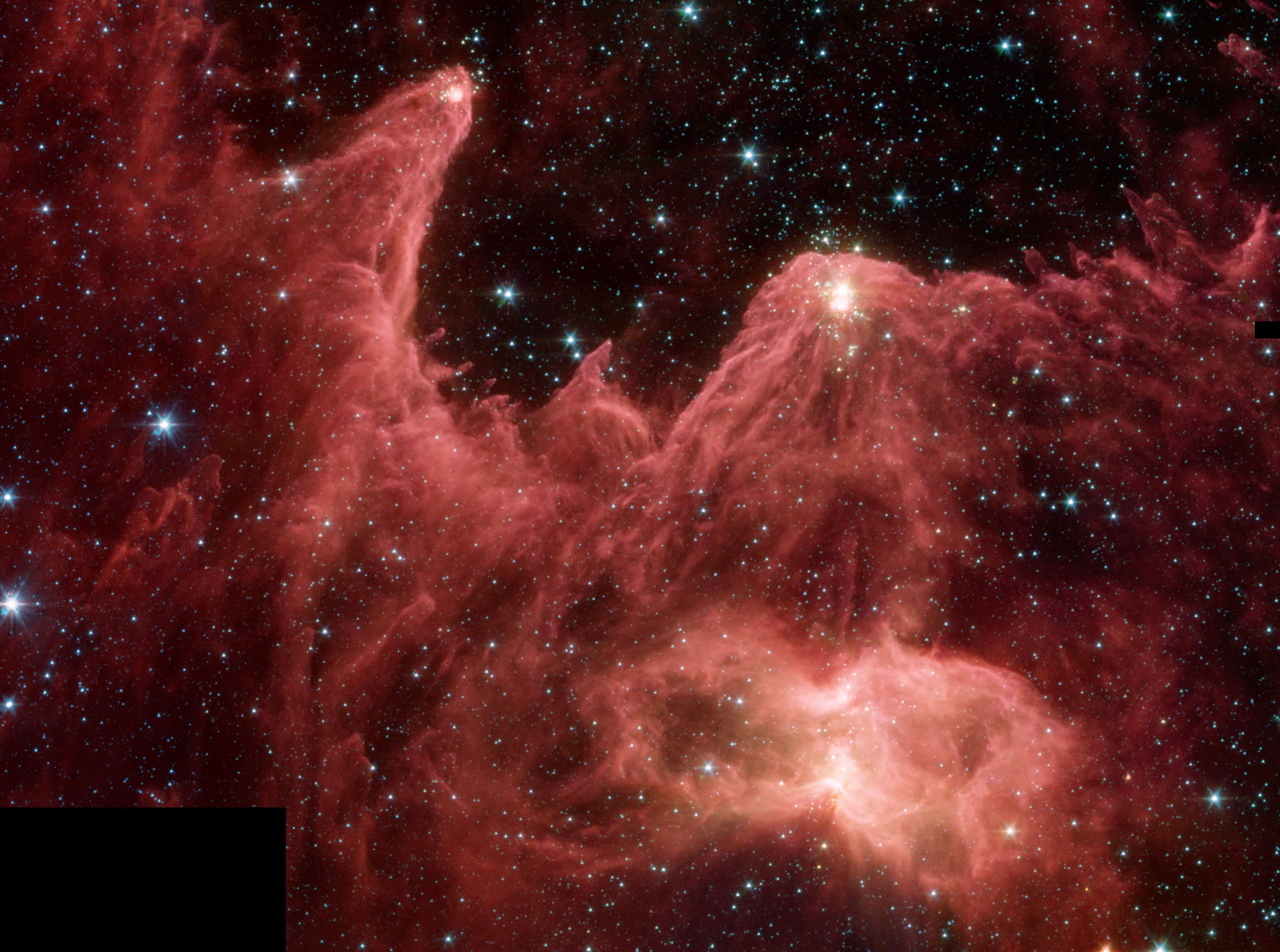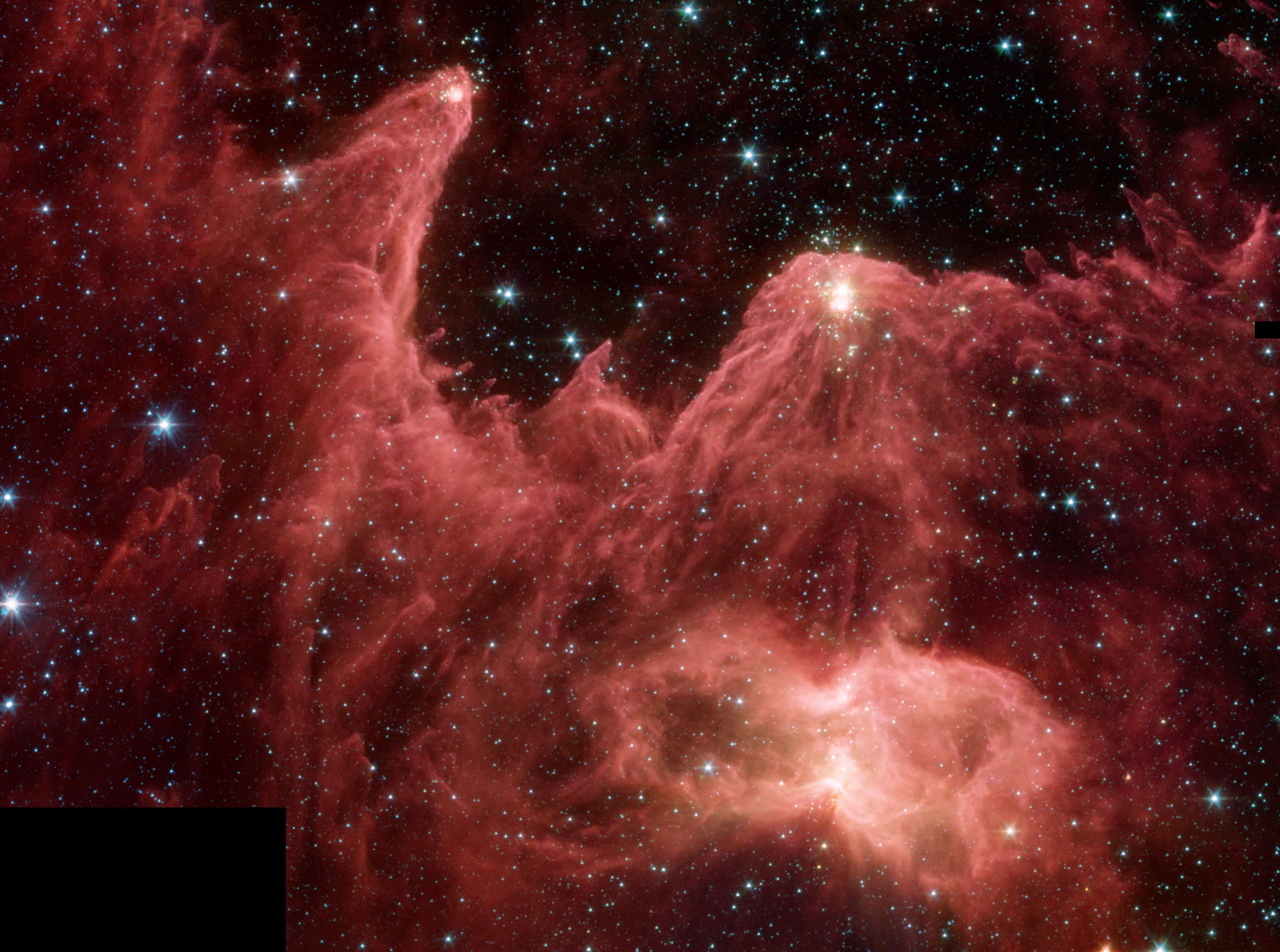
This fantastic skyscape lies at the eastern edge of giant stellar nursery W5, about 7,000 light-years away in the constellation Cassiopeia. An infrared view from the Spitzer Space Telescope, it features interstellar clouds of cold gas and dust sculpted by winds and radiation from a hot, massive star outside the picture (just above and to the right). Still swaddled within the cosmic clouds, newborn stars are revealed by Spitzer's penetrating gaze, their formation also triggered by the massive star. Fittingly dubbed "Mountains of Creation", these interstellar clouds are about 10 times the size of the analogous Pillars of Creation in M16, made famous in a 1995 Hubble Space Telescope view. W5 is also known as IC 1848 and together with IC 1805 it is part of a complex region popularly dubbed the Heart and Soul Nebulae. The Spitzer image spans about 70 light-years at the distance of W5.
Este fantástico panorama celeste se encuentra en el borde oriental de la gigantesca guardería estelar W5, a aproximadamente 7,000 años luz de distancia en la constelación de Casiopea. Una vista infrarroja del Telescopio Espacial Spitzer, presenta nubes interestelares de gas frío y polvo esculpidas por los vientos y la radiación de una estrella masiva y caliente ubicada fuera del cuadro (justo arriba y a la derecha). Aún envueltas dentro de las nubes cósmicas, las estrellas recién nacidas se revelan gracias a la penetrante visión del Spitzer, cuya formación también fue desencadenada por la estrella masiva. Apropiadamente denominadas "Montañas de la Creación", estas nubes interestelares son aproximadamente 10 veces el tamaño de los análogos Pilares de la Creación en M16, famosos por una observación del Telescopio Espacial Hubble de 1995. W5 también se conoce como IC 1848 y, junto con IC 1805, forma parte de una región compleja popularmente denominada las Nebulosas del Corazón y el Alma. La imagen de Spitzer abarca aproximadamente 70 años luz a la distancia de W5.