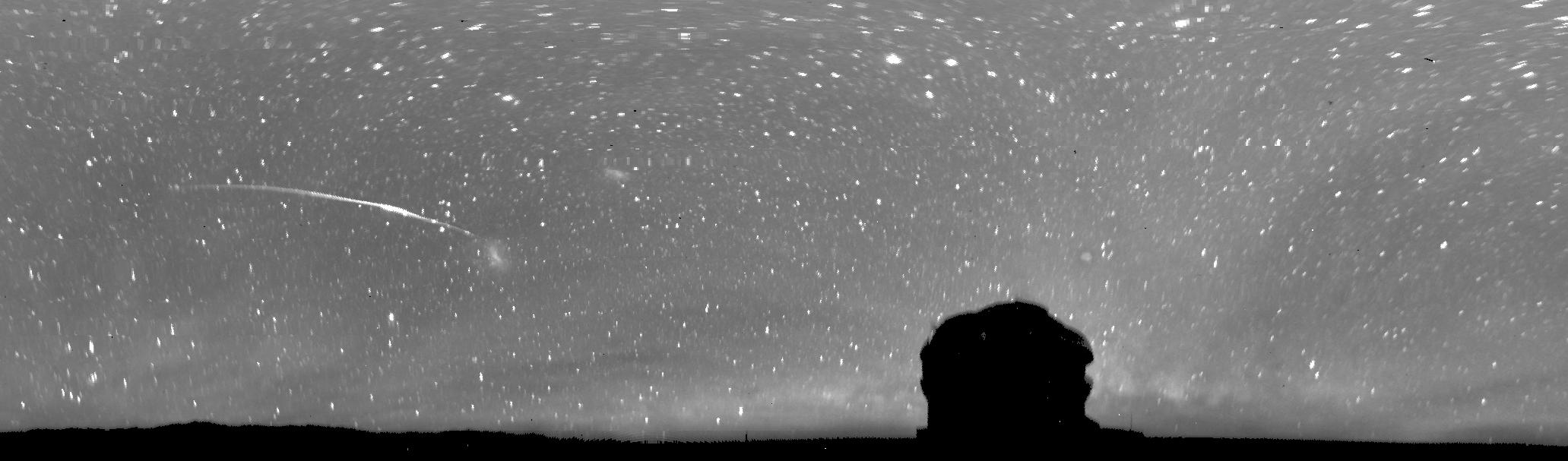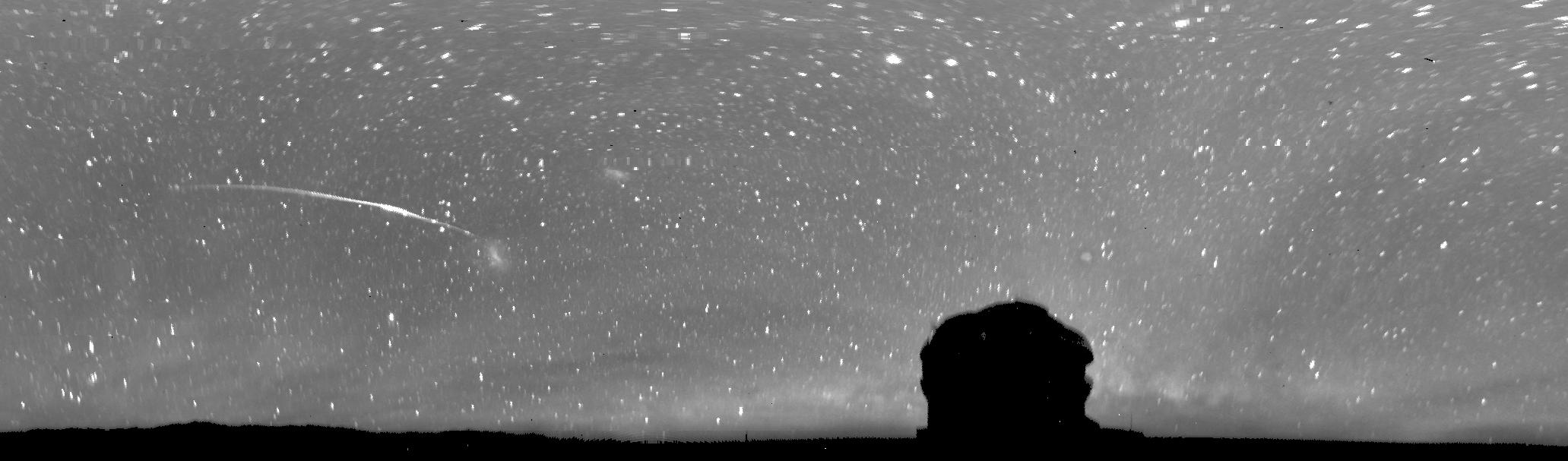
Have you ever seen a very bright meteor? Unexpected, this year's Taurid meteor shower resulted in numerous reports of very bright fireballs during the nights surrounding Halloween. Pictured above, a fireball that momentarily rivaled the brightness of the full Moon was caught over Cerro Pachon, Chile by a continuous sky monitor on November 1. Several bright Taurid fireballs are identifiable on the sky movie for that night. The above image is a digitally rectangled version of a circular fisheye frame and shows the entire sky, horizon to horizon. The bright meteor was seen swooping between the directions of the Large and Small Magellanic Clouds. The band of the Milky Way Galaxy crosses the horizon behind the dome of the 8-meter Gemini South Telescope. Taurid meteor fireballs are likely pebble sized debris left by Comet Encke. Over the next week the Leonids meteor shower will peak, although they will need to be seen through the glare of a nearly full Moon. [Disclosure: Robert Nemiroff collaborates on both the Astronomy Picture of the Day and the Night Sky Live projects.]
¿Ha visto alguna vez un meteoro extraordinariamente brillante? De manera inesperada, la lluvia de meteoros de las Táuridas de este año produjo numerosos reportes de bólidos muy brillantes durante las noches que rodearon Halloween. En la imagen superior, se capturó un bólido que rivalizó momentáneamente con el brillo de la Luna llena sobre Cerro Pachón, Chile, mediante un monitor continuo del cielo el 1 de noviembre. Varios bólidos brillantes de las Táuridas son identificables en la película del cielo para esa noche. La imagen anterior es una versión rectangularizada digitalmente de un fotograma circular de ojo de pez y muestra el cielo completo, de horizonte a horizonte. El meteoro brillante fue visto pasando entre las direcciones de las Nubes de Magallanes Mayor y Menor. La banda de la Vía Láctea cruza el horizonte detrás de la cúpula del Telescopio Gemini South de 8 metros. Los bólidos meteóricos de las Táuridas son probablemente escombros del tamaño de guijarros dejados por el Cometa Encke. Durante la próxima semana, la lluvia de meteoros de las Leónidas alcanzará su máximo, aunque será necesario observarlas a través del resplandor de una Luna casi llena.