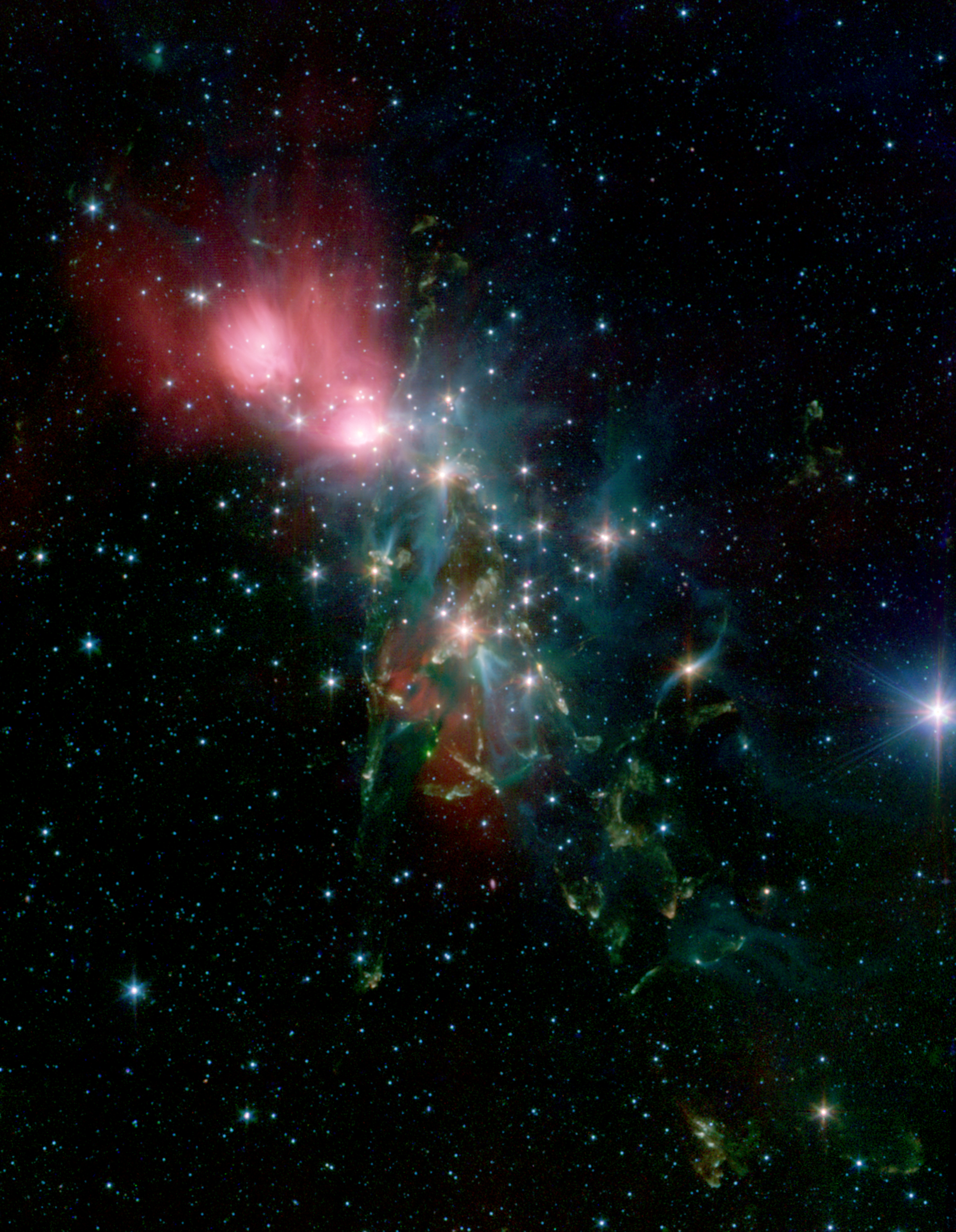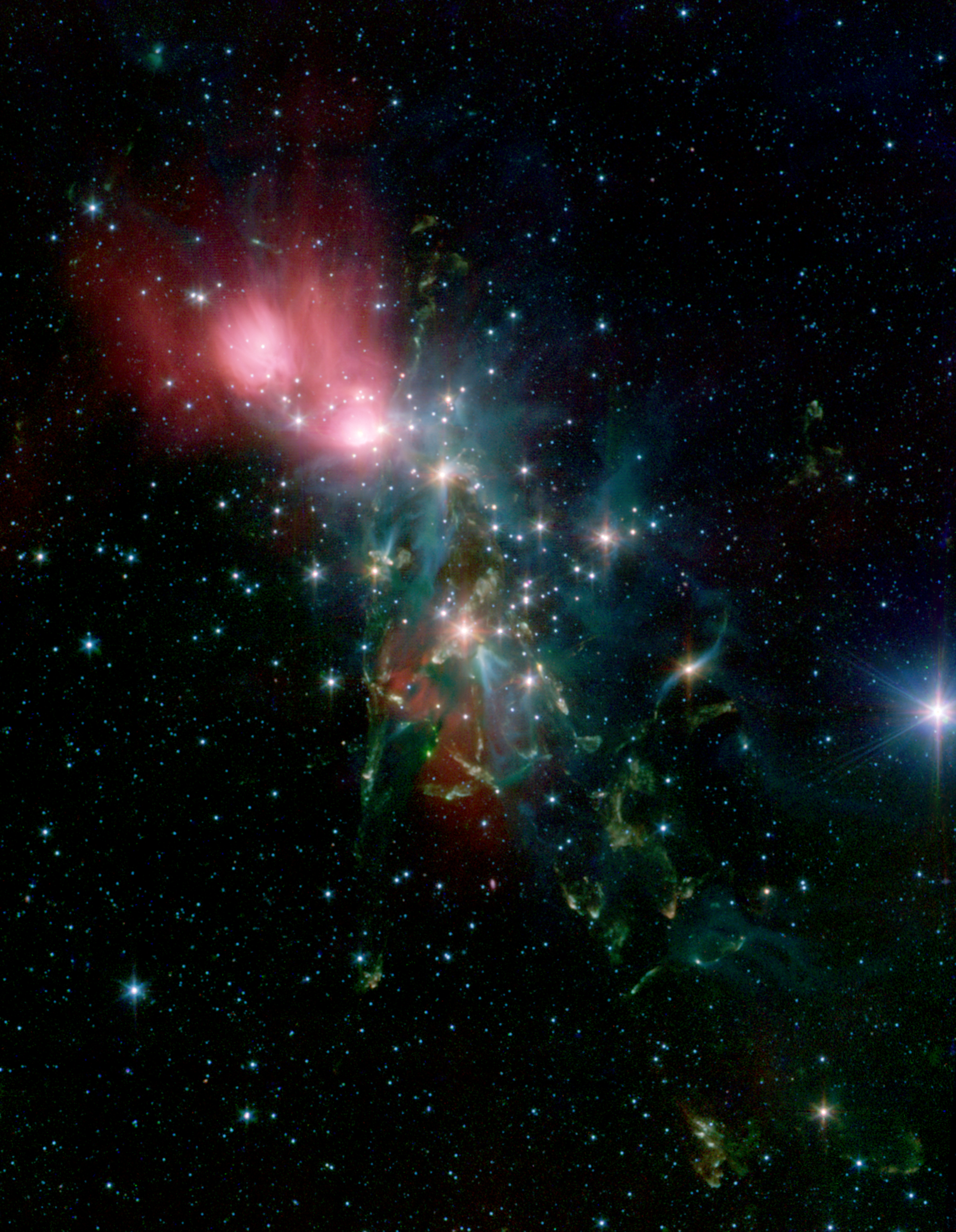
Dusty NGC 1333 is seen as a reflection nebula in visible light images, sporting bluish hues characteristic of starlight reflected by dust. But at longer infrared wavelengths, the interstellar dust itself glows - shown in red in this false-color Spitzer Space Telescope image. The penetrating infrared view also shows youthful stars that would otherwise still be obscured by the dusty clouds which formed them. Notably, greenish streaks and splotches that seem to litter the region trace the glow of cosmic jets blasting away from emerging young stellar objects as the jets plow into the cold cloud material. In all, the chaotic scene likely resembles one in which our own Sun formed over 4.5 billion years ago. NGC 1333 is a mere 1,000 light-years distant in the constellation Perseus.
La nebulosa polvorienta NGC 1333 se observa como una nebulosa de reflexión en las imágenes de luz visible, presentando tonalidades azuladas características de la luz estelar reflejada por el polvo. Pero a longitudes de onda infrarrojas más largas, el propio polvo interestelar brilla—mostrado en rojo en esta imagen en falso color del Telescopio Espacial Spitzer. La penetrante vista infrarroja también revela estrellas jóvenes que de otro modo permanecerían oscurecidas por las nubes polvorienta que las formaron. Notablemente, los trazos y manchas verdosas que parecen dispersos en la región trazan el brillo de chorros cósmicos que se disparan desde objetos estelares jóvenes emergentes mientras los chorros se abren paso hacia el material de nube fría. En conjunto, la escena caótica probablemente se asemeja a aquella en la que nuestro propio Sol se formó hace más de 4.500 millones de años. NGC 1333 se encuentra a tan solo 1.000 años luz de distancia en la constelación de Perseo.