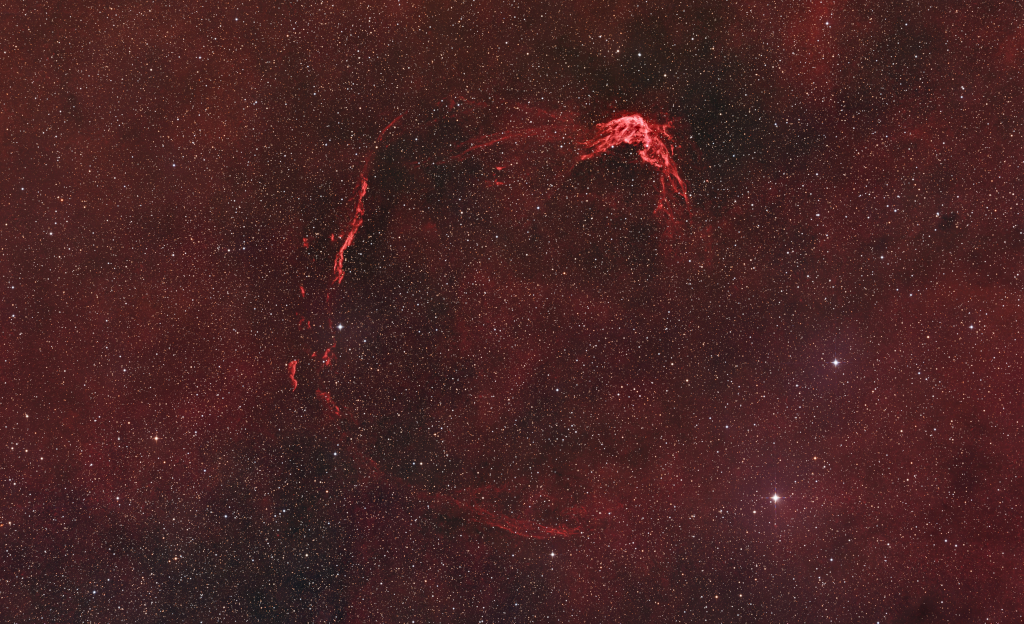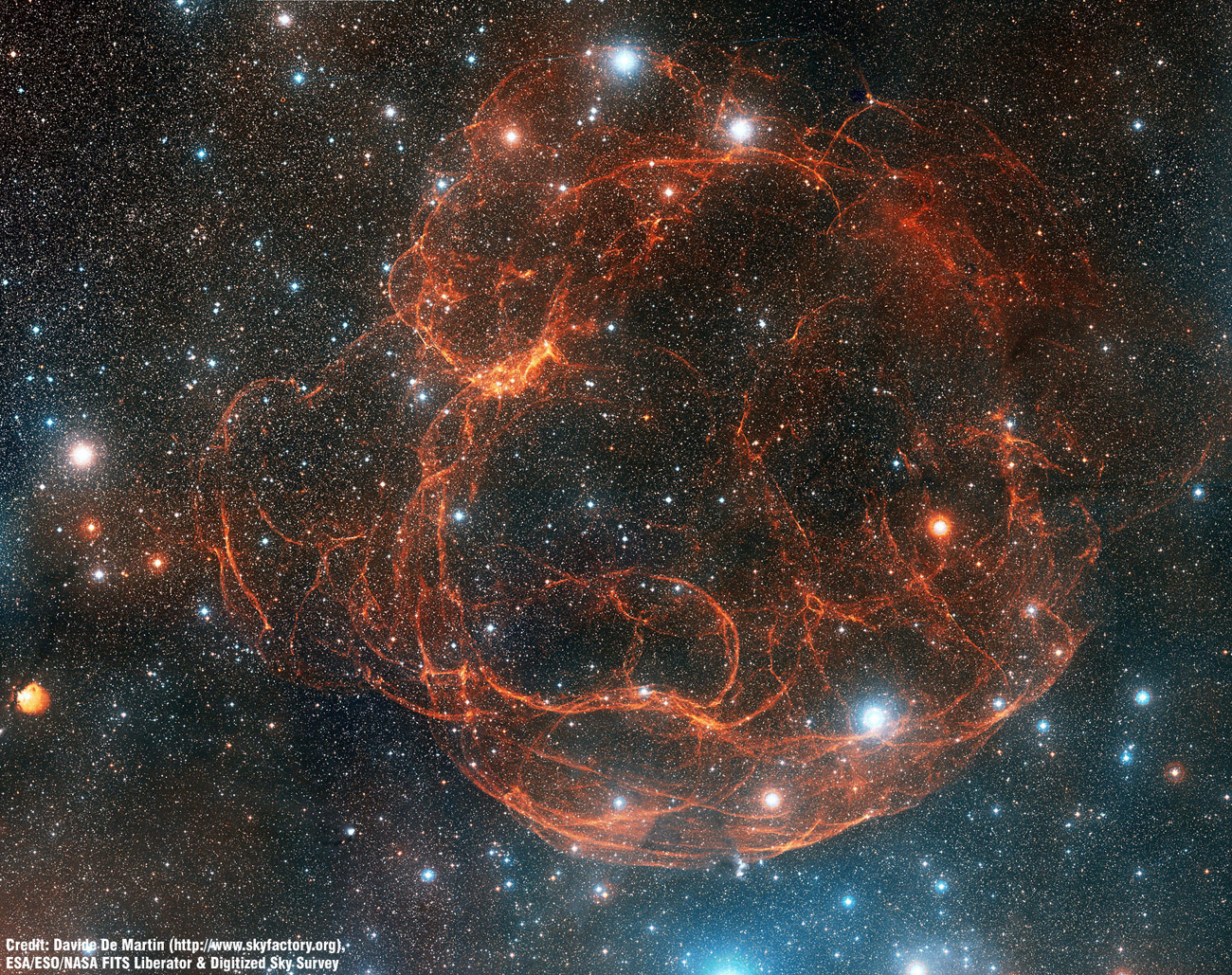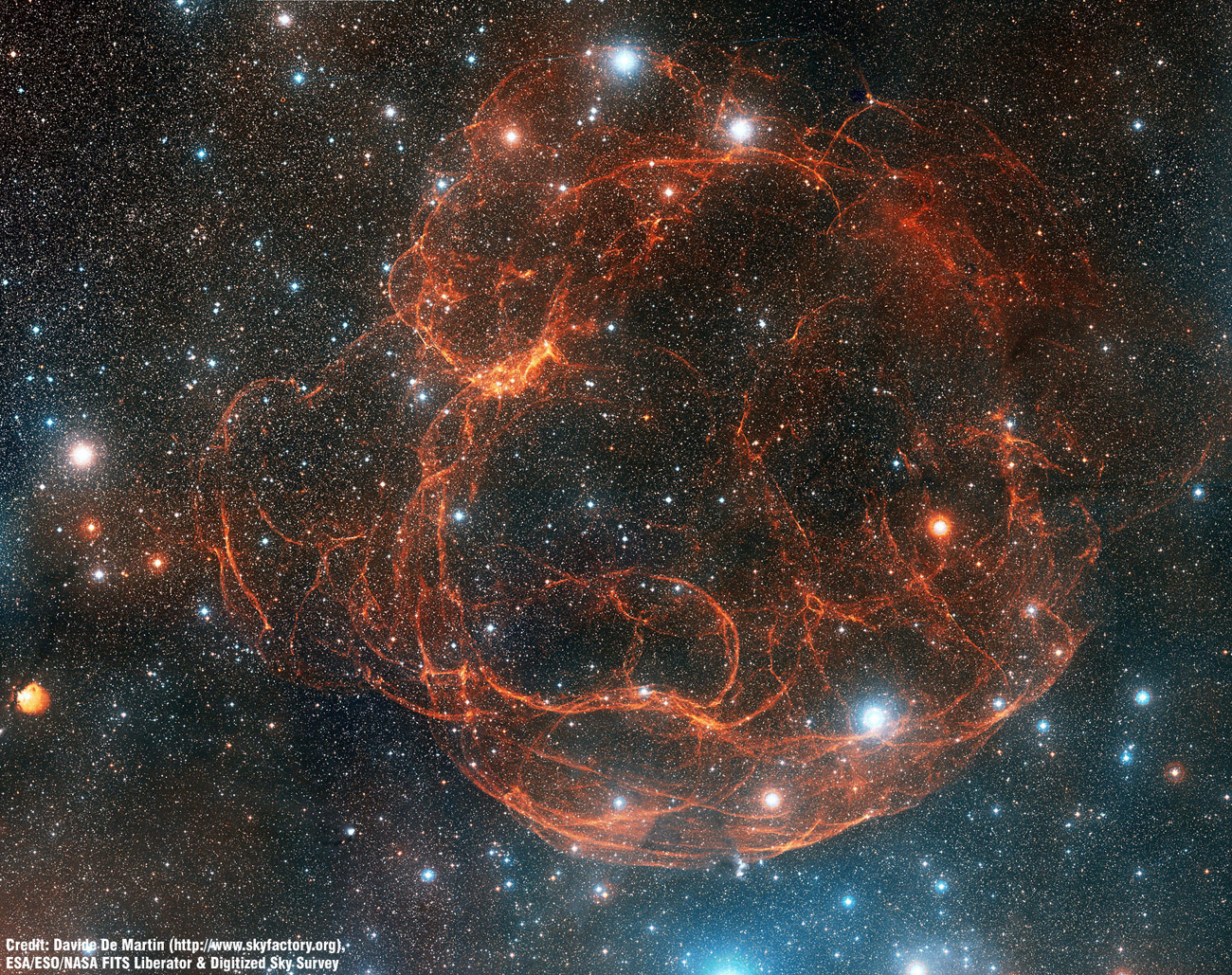
It's easy to get lost following the intricate filaments in this detailed image of faint supernova remnant Simeis 147. Seen towards the constellation Taurus it covers nearly 3 degrees (6 full moons) on the sky corresponding to a width of 150 light-years at the stellar debris cloud's estimated distance of 3,000 light-years. The above image is a color composite of 66 blue and red color band images from the National Geographic Palomar Observatory Sky Survey taken with the wide field Samuel Oschin 48-inch Telescope. The area of the sky shown covers over 70 times the area of the full Moon. This supernova remnant has an apparent age of about 100,000 years - meaning light from the massive stellar explosion first reached Earth 100,000 years ago - but this expanding remnant is not the only aftermath. The cosmic catastrophe also left behind a spinning neutron star or pulsar, all that remains of the original star's core.
Es fácil perderse siguiendo los intrincados filamentos en esta imagen detallada del débil remanente de supernova Simeis 147. Visto hacia la constelación de Tauro, cubre casi 3 grados (6 lunas llenas) en el cielo, correspondiendo a una anchura de 150 años luz en la nube de escombros estelares a una distancia estimada de 3,000 años luz. La imagen anterior es un compuesto de color de 66 imágenes de bandas de color azul y rojo del National Geographic Palomar Observatory Sky Survey, tomadas con el telescopio Samuel Oschin de 48 pulgadas de gran campo. El área del cielo mostrada cubre más de 70 veces el área de la Luna llena. Este remanente de supernova tiene una edad aparente de aproximadamente 100,000 años, lo que significa que la luz de la explosión estelar masiva llegó por primera vez a la Tierra hace 100,000 años; pero este remanente en expansión no es el único resultado. La catástrofe cósmica también dejó atrás una estrella de neutrones giratoria o púlsar, todo lo que permanece del núcleo de la estrella original.