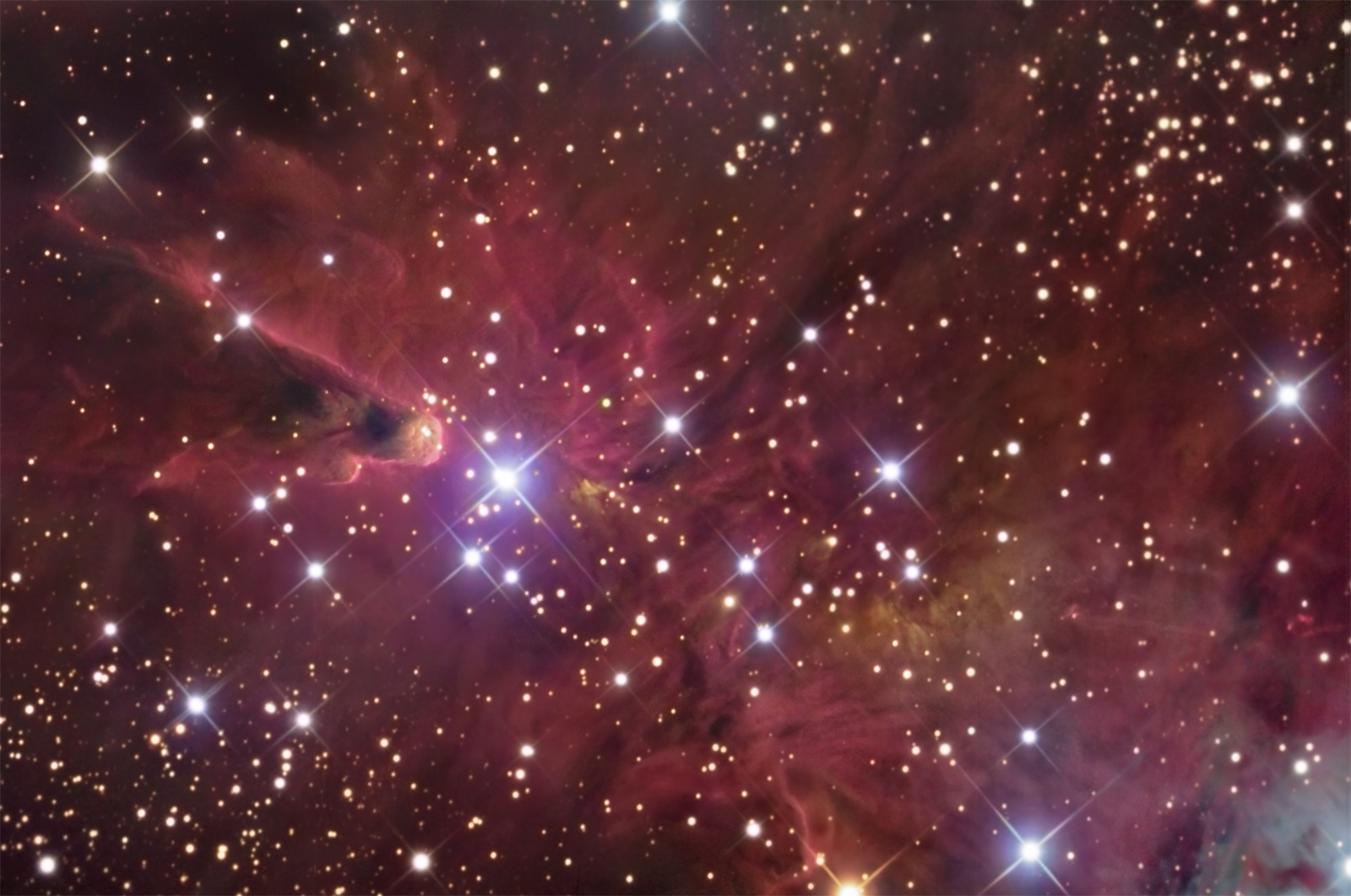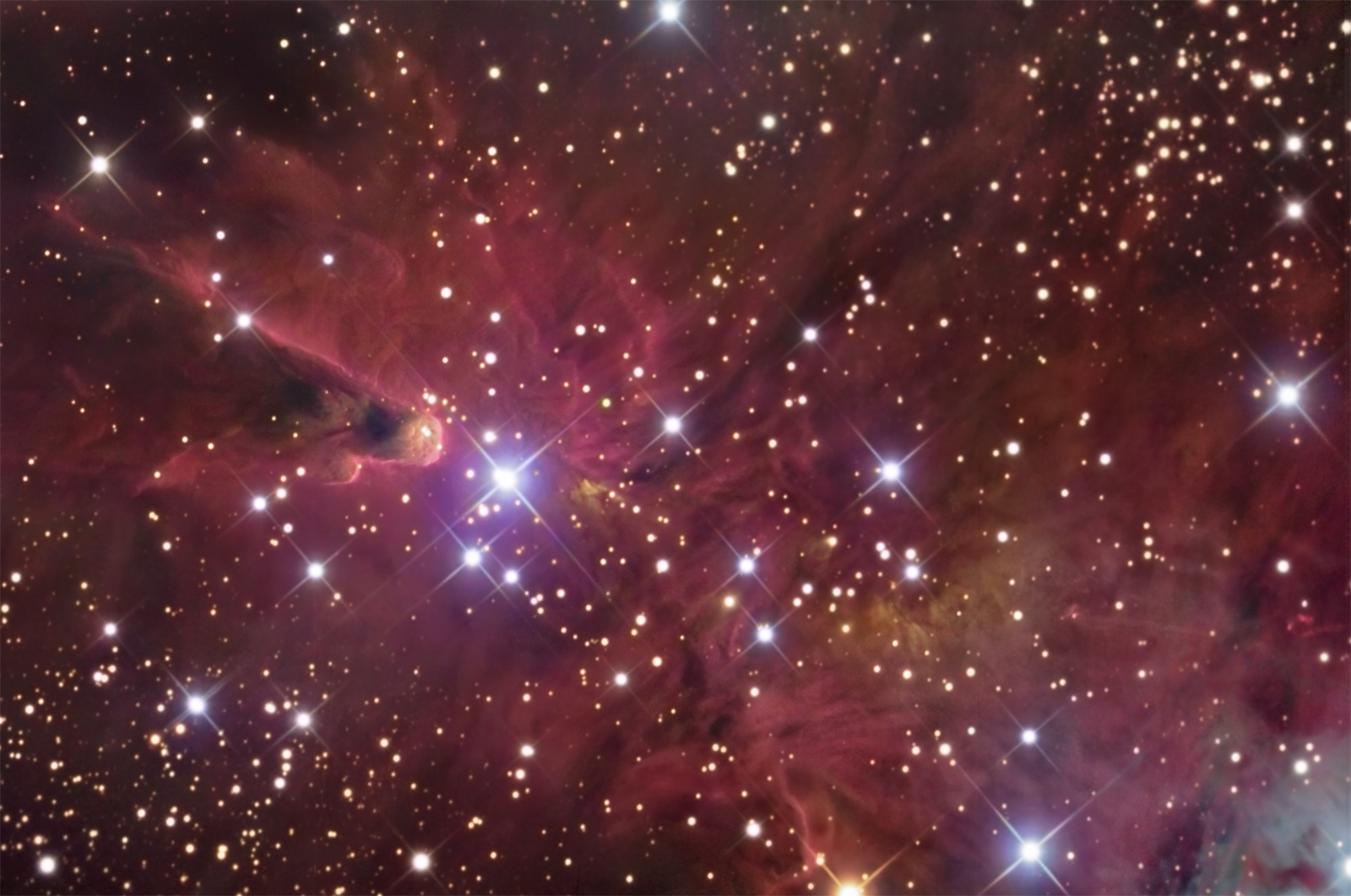
Sometimes the simplest shapes are the hardest to explain. For example, the origin of the mysterious cone-shaped region seen on the far left remains a mystery. The interstellar formation, dubbed the Cone Nebula, is located about 2700 light years away. Other features in the image include red emission from diffuse interstellar hydrogen, wispy filaments of dark dust, and bright star S Monocerotis, visible on the far right. Blue reflection nebulae surround the brighter stars. The dark Cone Nebula region clearly contains much dust which blocks light from the emission nebula and open cluster NGC 2264 behind it. One hypothesis holds that the Cone Nebula is formed by wind particles from an energetic source blowing past the Bok Globule at the head of the cone.
A veces, las formas más simples son las más difíciles de explicar. Por ejemplo, el origen de la región misteriosa en forma de cono visible en el extremo izquierdo sigue siendo un misterio. La formación interestelar, denominada Nebulosa del Cono, se encuentra a aproximadamente 2700 años luz de distancia. Otras características de la imagen incluyen emisión roja del hidrógeno interestelar difuso, filamentos tenues de polvo oscuro y la estrella brillante S Monocerotis, visible en el extremo derecho. Nebulosas de reflexión azules rodean las estrellas más brillantes. La región oscura de la Nebulosa del Cono contiene claramente mucho polvo que bloquea la luz de la nebulosa de emisión y del cúmulo abierto NGC 2264 detrás de ella. Una hipótesis sostiene que la Nebulosa del Cono se forma por partículas de viento procedentes de una fuente energética que soplan alrededor del Glóbulo de Bok en la cabeza del cono.