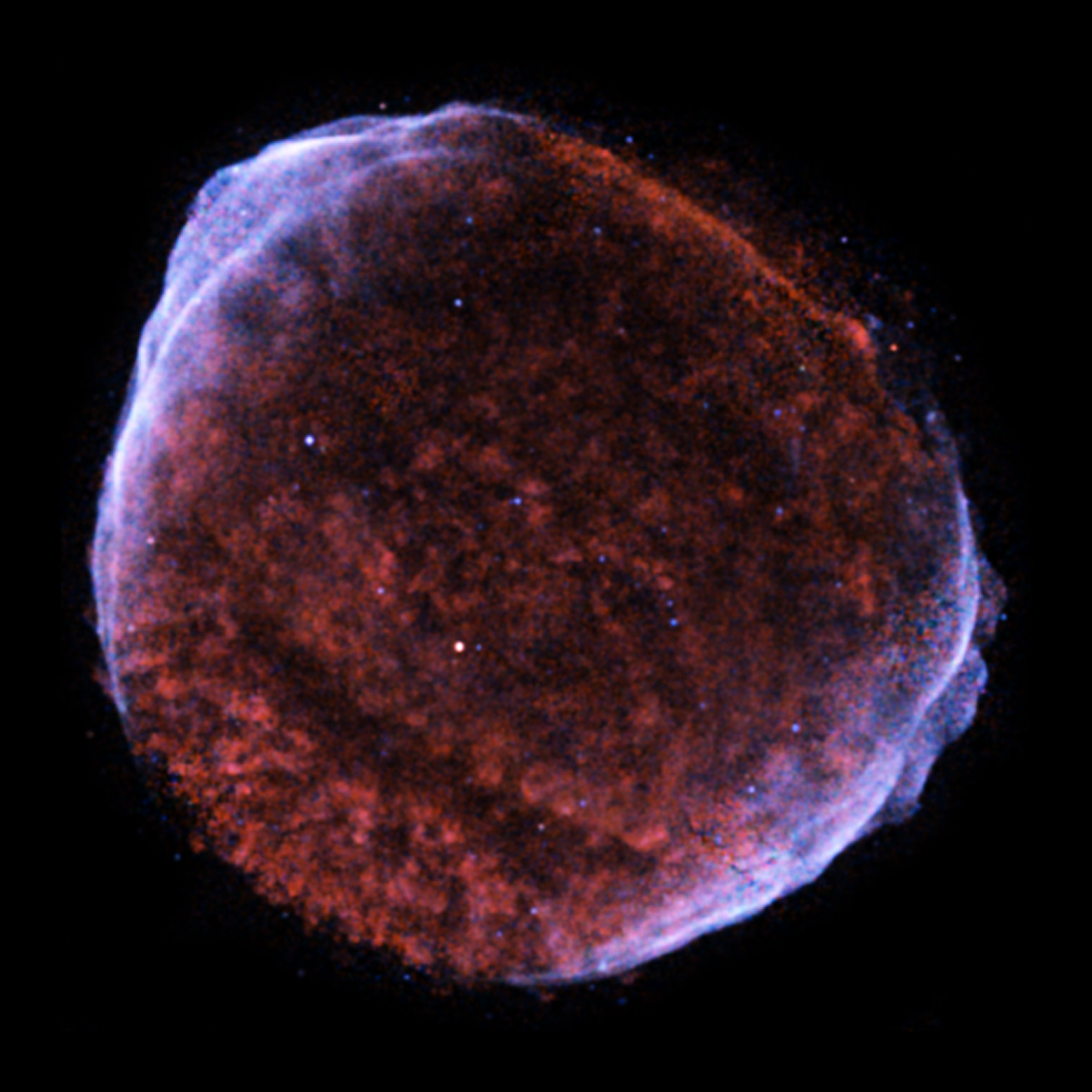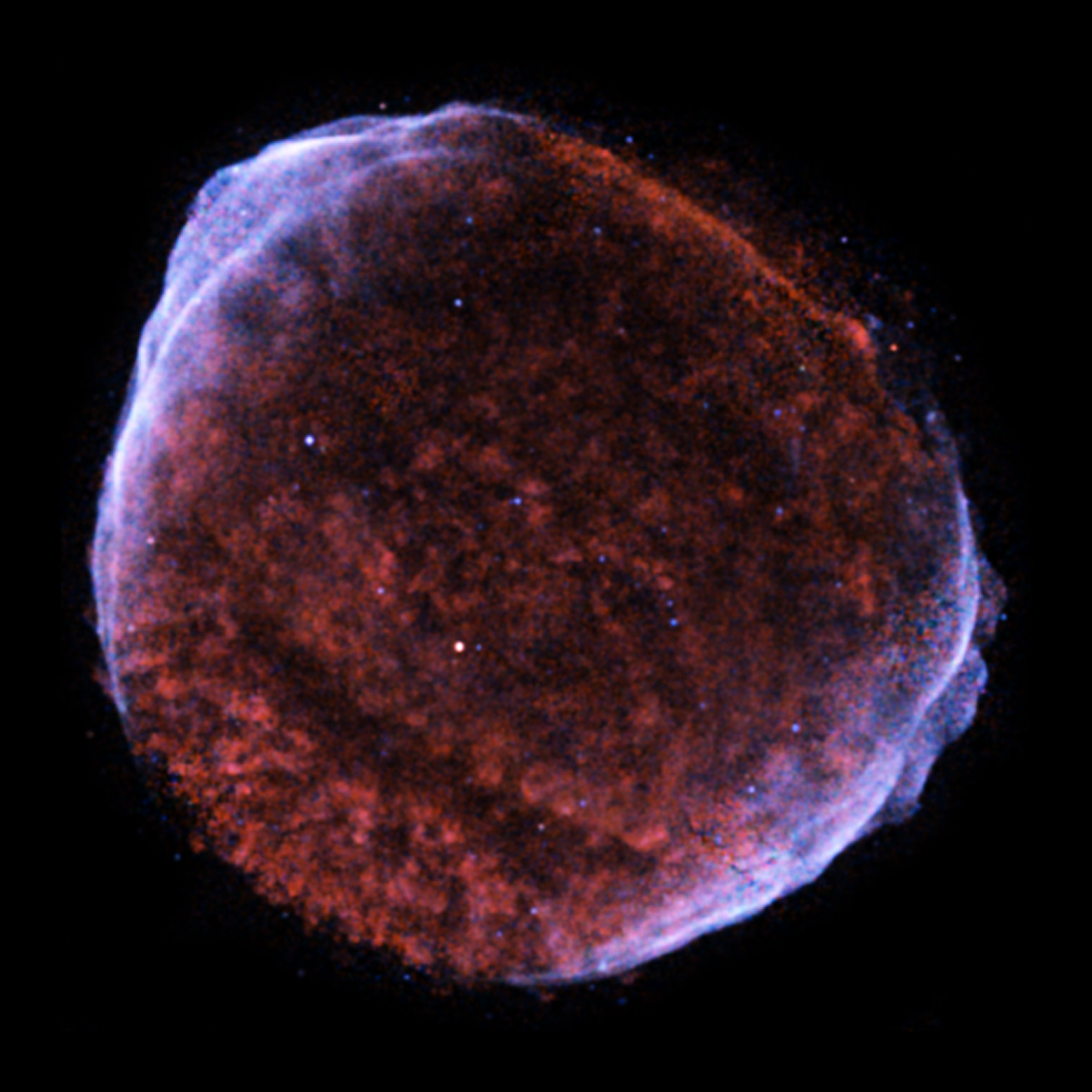
This huge puff ball was once a star. One thousand years ago, in the year 1006, a new star was recorded in the sky that today we know was really an existing star exploding. The resulting expanding gas from the supernova is still visible with telescopes today, continues to expand, and now spans over 70 light years. SN 1006 glows in every type of light. The above image of SN 1006 was captured by the orbiting Chandra Observatory in X-ray light. Even today, not everything about the SN 1006 is understood, for example why particle shocks that produce the bright blue filaments are only visible at some locations. SN 1006 is thought to have once been a white dwarf that exploded when gas being dumped onto it by its binary star companion caused it to go over the Chandrasekhar limit. Foreground stars are visible that have nothing to do with the supernova.
Esta enorme bola de gas fue una vez una estrella. Hace mil años, en el año 1006, se registró una nueva estrella en el cielo que hoy sabemos que era en realidad una estrella existente que explotaba. El gas en expansión resultante de la supernova sigue siendo visible con telescopios hoy en día, continúa expandiéndose y ahora abarca más de 70 años luz. SN 1006 brilla en todos los tipos de luz. La imagen anterior de SN 1006 fue capturada por el Observatorio Chandra en órbita en luz de rayos X. Incluso hoy en día, no todo sobre SN 1006 se entiende, por ejemplo, por qué los choques de partículas que producen los filamentos azules brillantes solo son visibles en algunas ubicaciones. Se cree que SN 1006 fue una vez una enana blanca que explotó cuando el gas depositado en ella por su compañera estrella binaria la hizo exceder el límite de Chandrasekhar. Las estrellas de primer plano son visibles y no tienen nada que ver con la supernova.