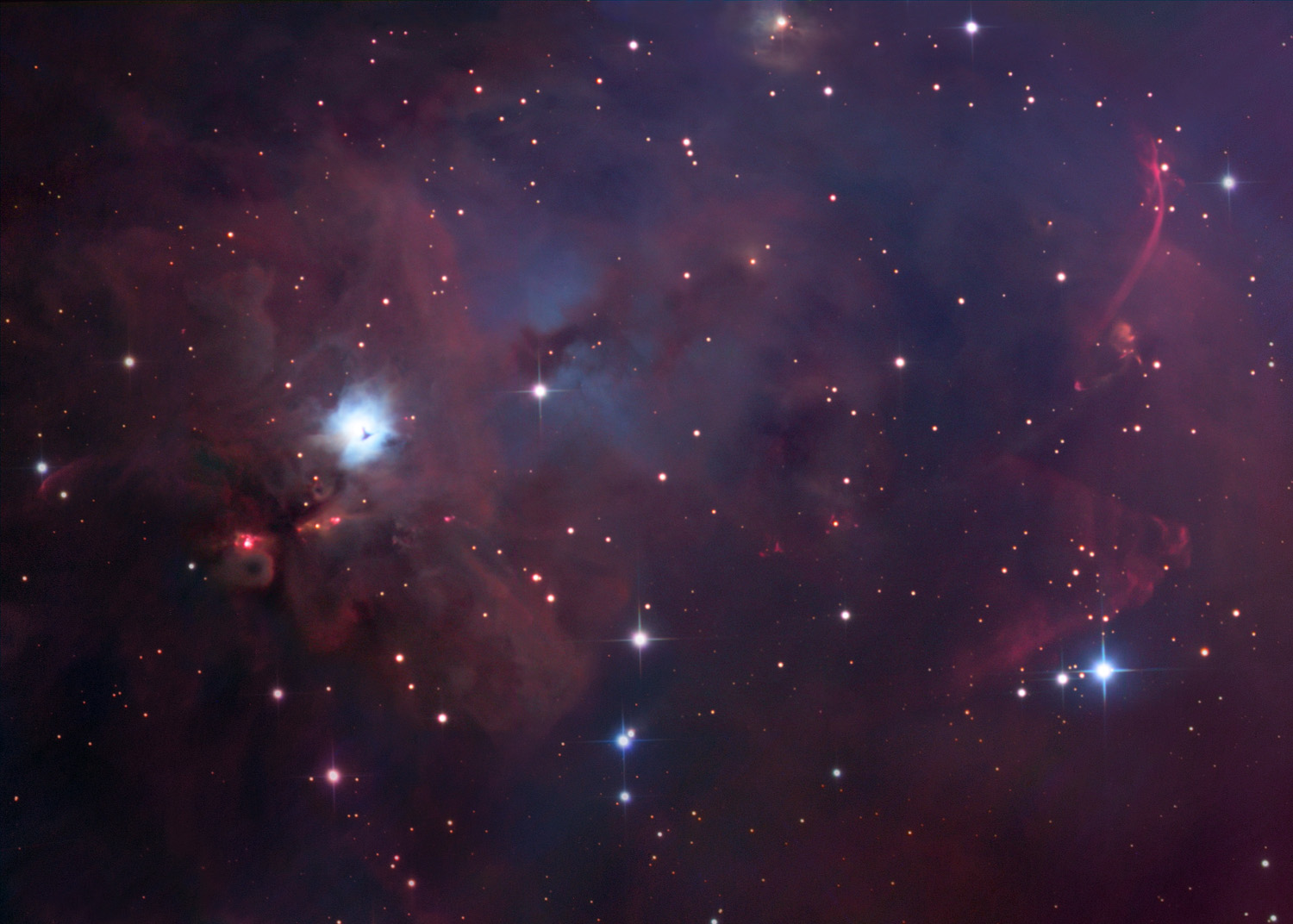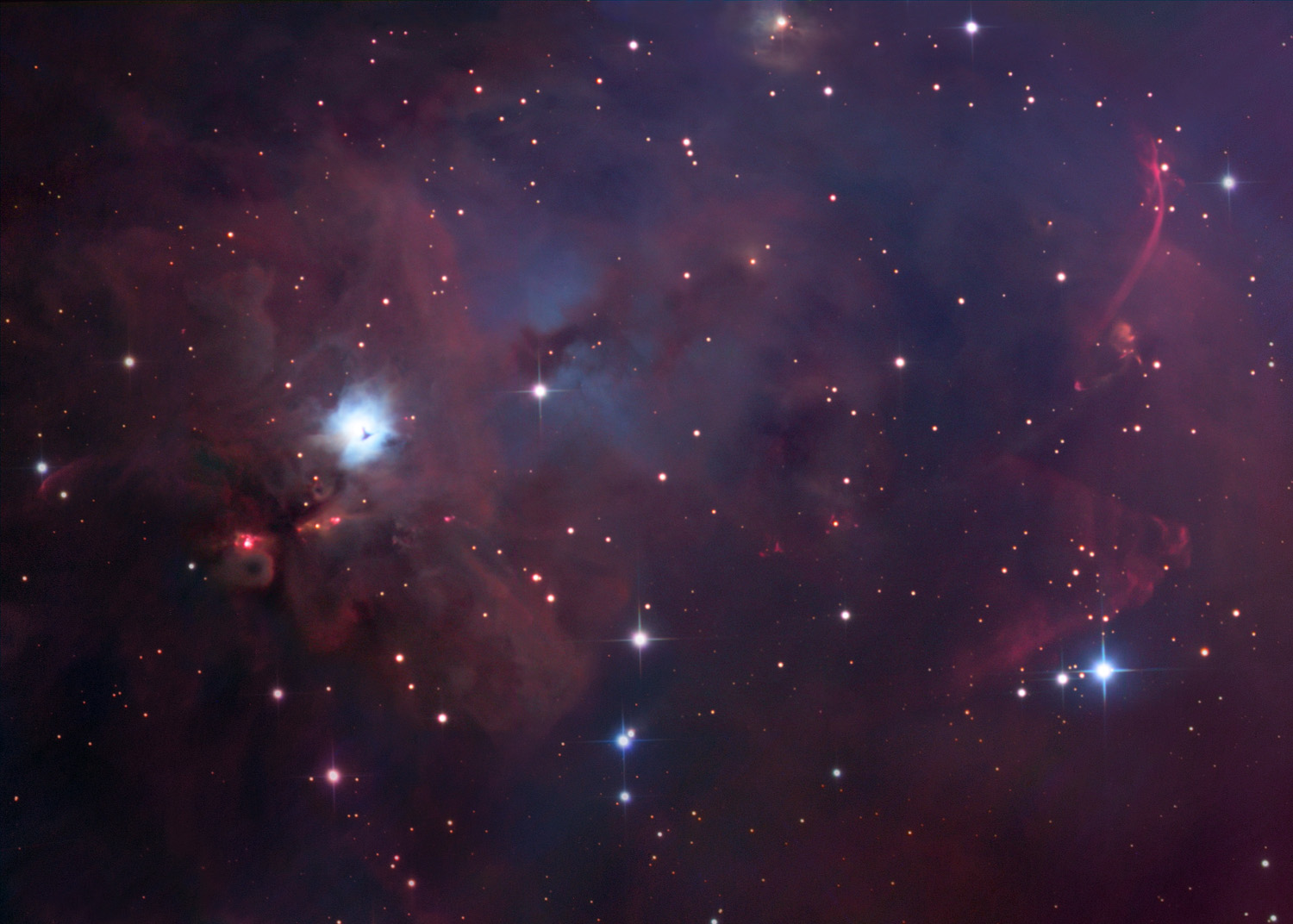
South of the large star-forming region known as the Orion Nebula, lies bright blue reflection nebula NGC 1999. The nebula is marked with a dark inverted T-shape at the lower left in a broad cosmic vista that spans over 10 light-years. The dark shape is a dense gas and dust cloud, or Bok globule, seen in silhouette against the bright nebula, and likely a site of future star formation. At the edge of the Orion molecular cloud complex some 1,500 light-years distant, NGC 1999's illumination is provided by the embedded variable star V380 Orionis. The region abounds with energetic young stars producing jets and outflows that create luminous shock waves, including HH (Herbig-Haro) 1 and 2 just below and left of NGC 1999, and the apparent cascade of reddish arcs and bow shocks beginning at the upper right. The stellar jets and outflows push through the surrounding material at speeds of hundreds of kilometers per second.
Al sur de la gran región de formación estelar conocida como la Nebulosa de Orión, se encuentra la brillante nebulosa de reflexión azul NGC 1999. La nebulosa se caracteriza por una forma de T invertida oscura en la parte inferior izquierda en una vasta panorámica cósmica que abarca más de 10 años luz. La forma oscura es una nube densa de gas y polvo, o glóbulo de Bok, vista en silueta contra la nebulosa brillante, y probable sitio de futura formación estelar. En el borde del complejo de nube molecular de Orión, a unos 1.500 años luz de distancia, la iluminación de NGC 1999 la proporciona la estrella variable integrada V380 Orionis. La región abunda en jóvenes estrellas energéticas que producen jets y flujos que crean ondas de choque luminosas, incluyendo HH (Herbig-Haro) 1 y 2 justo debajo y a la izquierda de NGC 1999, y la aparente cascada de arcos rojizos y ondas de proa que comienzan en la parte superior derecha. Los jets estelares y flujos empujan a través del material circundante a velocidades de cientos de kilómetros por segundo.