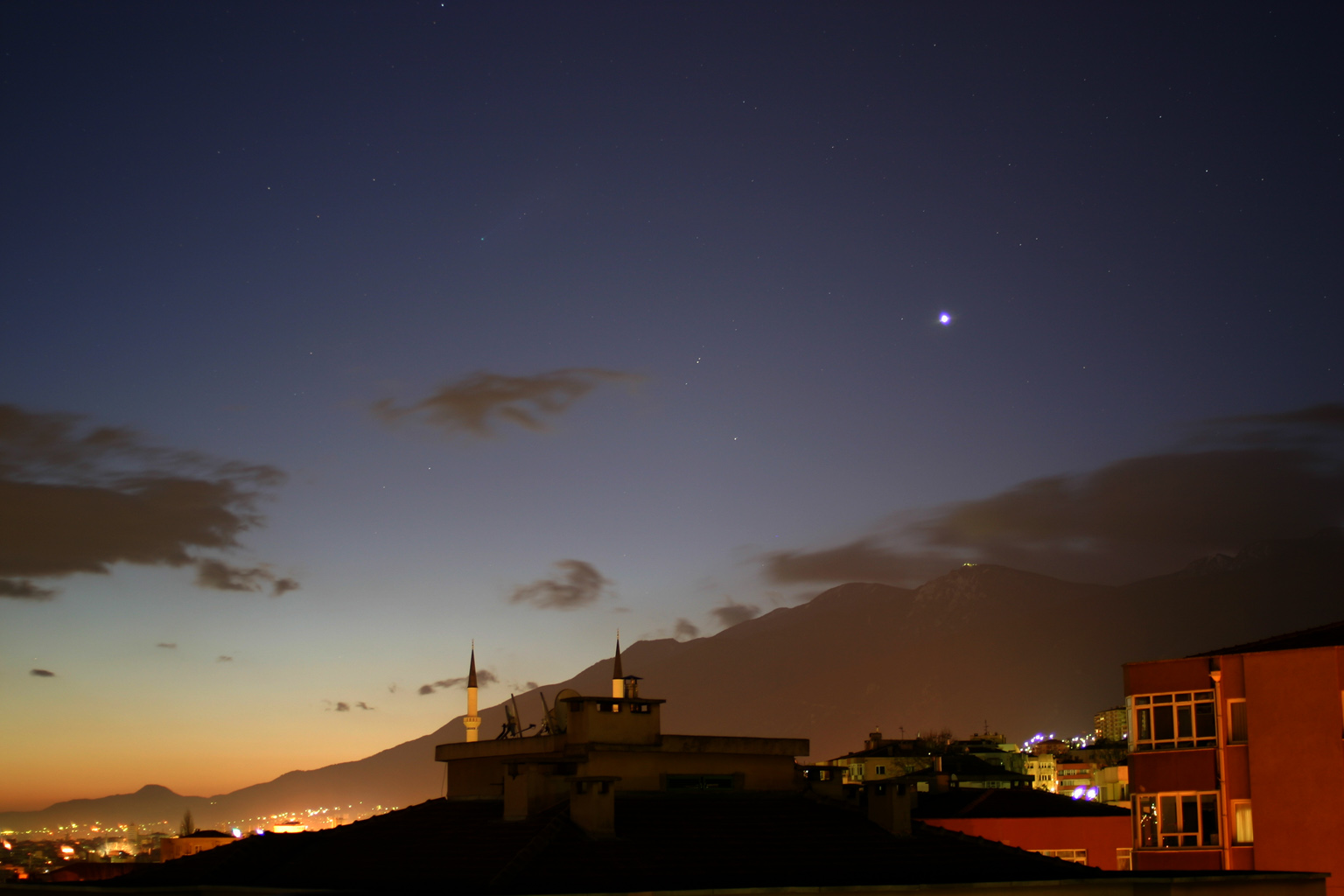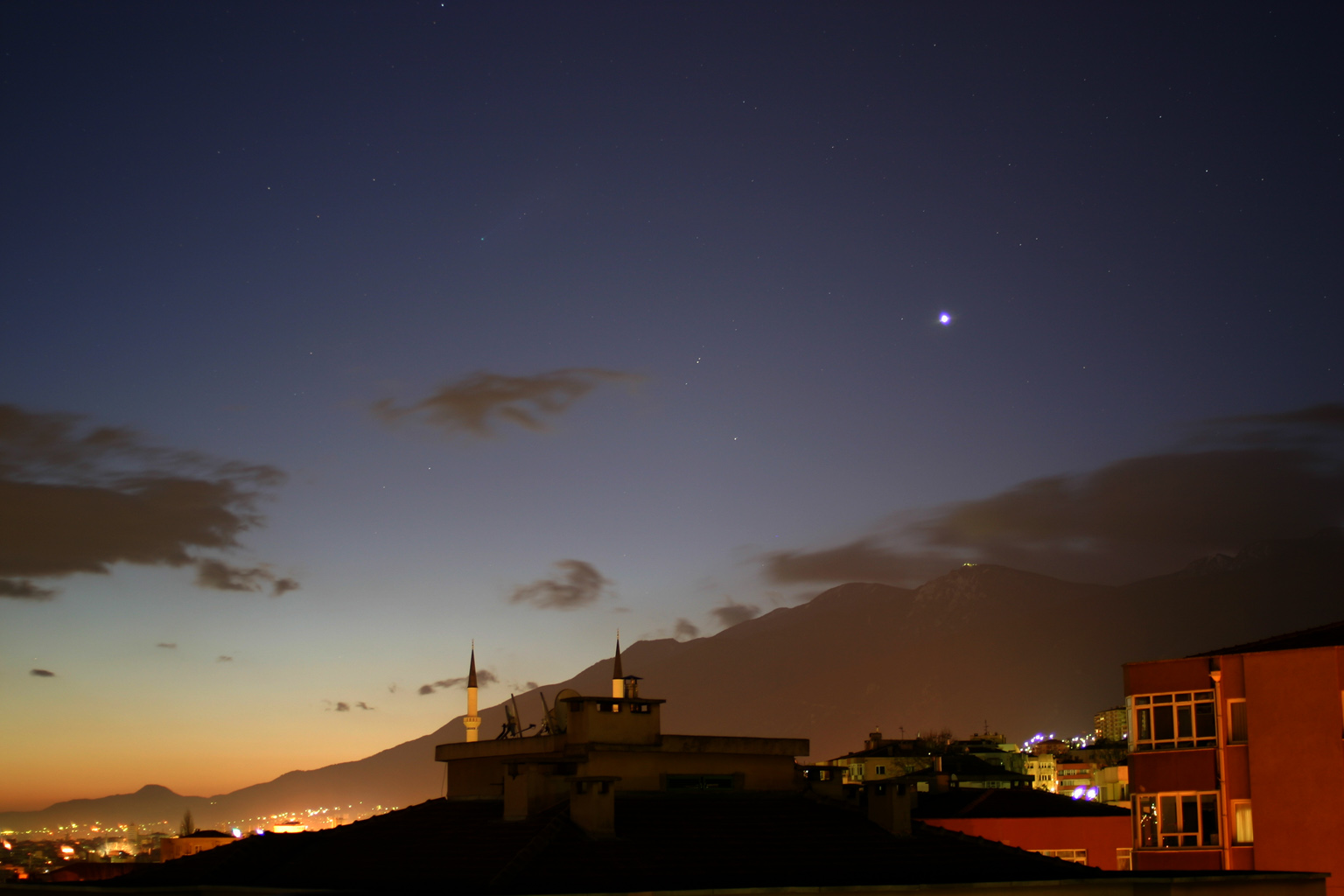
Shining brightly in the east at dawn, Venus dominates the sky in this view over a suburban landscape from Bursa, Turkey. An otherwise familiar scene for astronomer Tunc Tezel, his composite picture of the morning sky recorded on March 2nd also includes a surprise visitor to the inner solar system, Comet Pojmanski. Cataloged as C/2006 A1, the comet was discovered on January 2nd by Grzegorz Pojmanski of Warsaw University Astronomical Observatory in Poland. At the time very faint and tracking through southern skies, the comet has now moved north and grown just bright enough to be a good target for early-rising skygazers with binoculars. Enhanced and framed in this picture, the comet's tail has also grown to a length of several degrees. The comet will be at its closest approach to planet Earth, just over 100 million kilometers away, on March 5. For northern hemisphere observers in the next few days, the beginning of morning twilight really will be the best time to spot Comet Pojmanski.
Brillando intensamente en el este al amanecer, Venus domina el cielo en esta vista sobre un paisaje suburbano de Bursa, Turquía. Una escena por lo demás familiar para el astrónomo Tunc Tezel, su imagen compuesta del cielo matutino registrada el 2 de marzo también incluye un visitante sorpresa del sistema solar interior: el Cometa Pojmanski. Catalogado como C/2006 A1, el cometa fue descubierto el 2 de enero por Grzegorz Pojmanski del Observatorio Astronómico de la Universidad de Varsovia en Polonia. En ese momento muy débil y moviéndose a través de cielos australes, el cometa se ha desplazado hacia el norte y ha aumentado su brillo lo suficiente como para ser un buen objetivo para los observadores madrugadores del hemisferio norte con binoculares. Resaltado y enmarcado en esta imagen, la cola del cometa también ha crecido hasta alcanzar una longitud de varios grados. El cometa estará en su aproximación más cercana al planeta Tierra, poco más de 100 millones de kilómetros de distancia, el 5 de marzo. Para los observadores del hemisferio norte en los próximos días, el comienzo del crepúsculo matutino realmente será el mejor momento para avistar el Cometa Pojmanski.