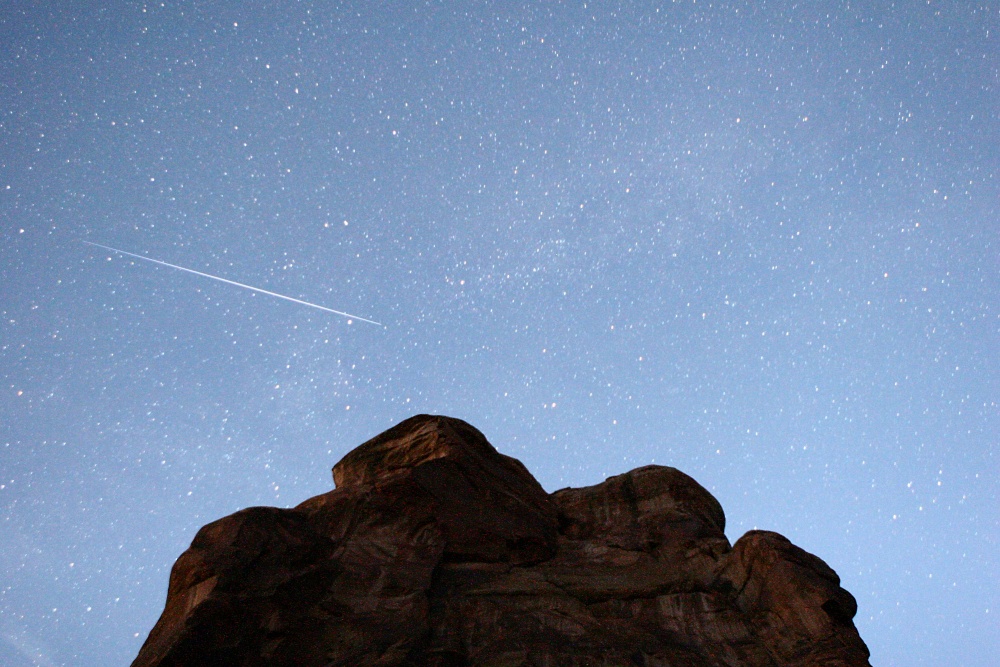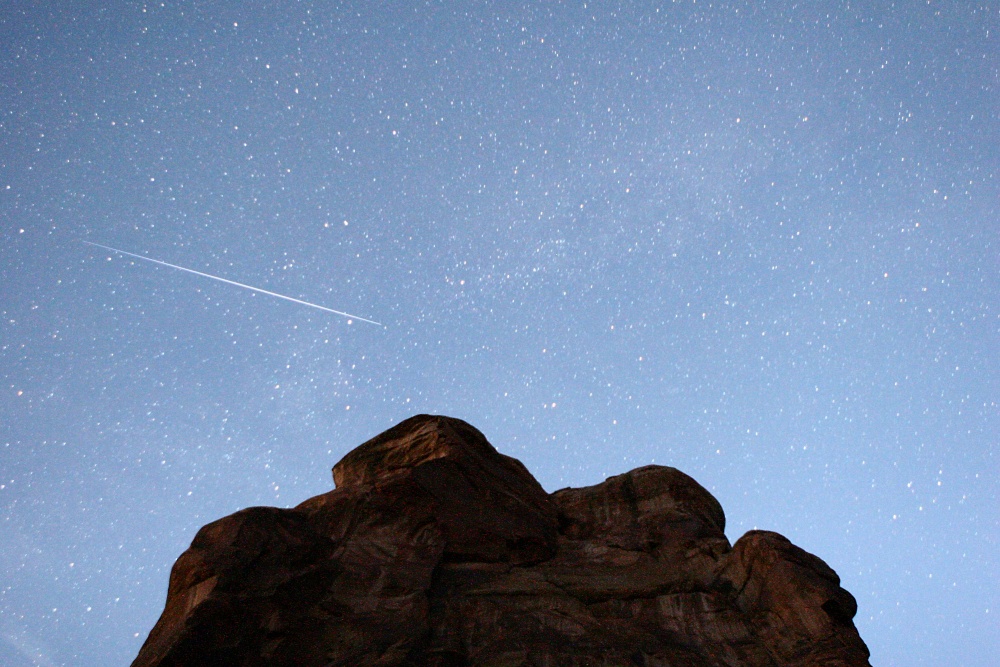
The rock formation in the foreground of this night view was recorded on August 10, illuminated by light from a waning gibbous Moon. Even though the sky above also scatters the bright moonlight, a brilliant meteor was captured as it flashed across the scene during the 30 second long exposure. Of course, the meteor was part of the annual rain of dust from periodic Comet Swift-Tuttle known as the Perseid Meteor Shower. Leaving trails that point back to a radiant in the constellation Perseus, the ancient dust particles are vaporized as they enter the atmosphere at about 60 kilometers per second, their visible streaks beginning at altitudes of around 100 kilometers. And though it looks like the knuckles of a giant hand, the curious rock formation can be found in Colorado National Monument park, USA, planet Earth.
La formación rocosa en primer plano de esta vista nocturna fue registrada el 10 de agosto, iluminada por la luz de una Luna gibosa menguante. Aunque el cielo también dispersa la brillante luz lunar, un meteoro brillante fue capturado mientras destellaba en la escena durante la exposición de 30 segundos. Por supuesto, el meteoro fue parte de la lluvia anual de polvo del Cometa Swift-Tuttle periódico, conocida como la Lluvia de Meteoros Perseidas. Dejando rastros que apuntan hacia un radiante en la constelación de Perseo, las antiguas partículas de polvo se vaporizan al entrar en la atmósfera a aproximadamente 60 kilómetros por segundo, con sus rayas visibles comenzando a altitudes de alrededor de 100 kilómetros. Y aunque parece los nudillos de una mano gigante, la curiosa formación rocosa se puede encontrar en el parque del Monumento Nacional de Colorado, USA, planeta Tierra.