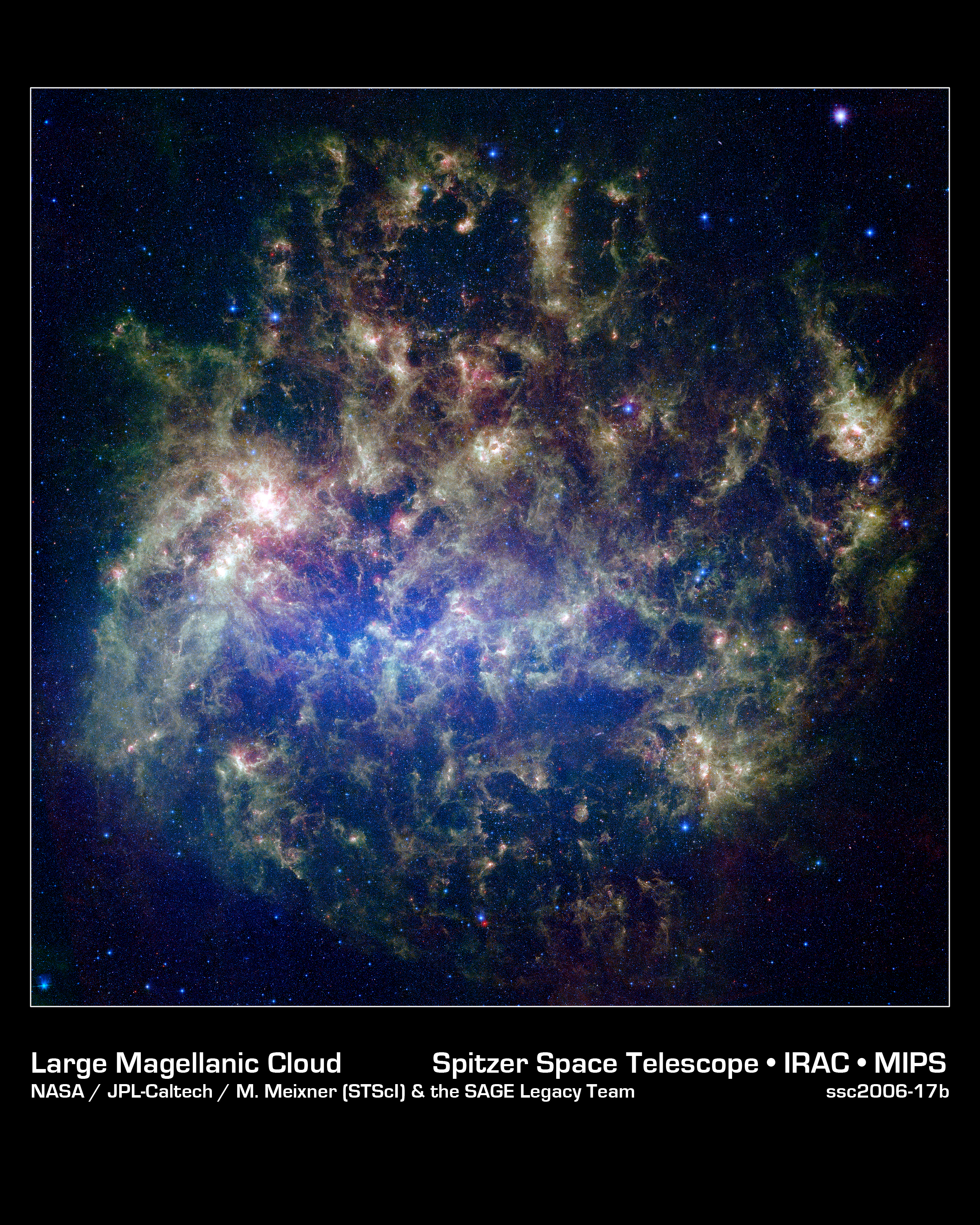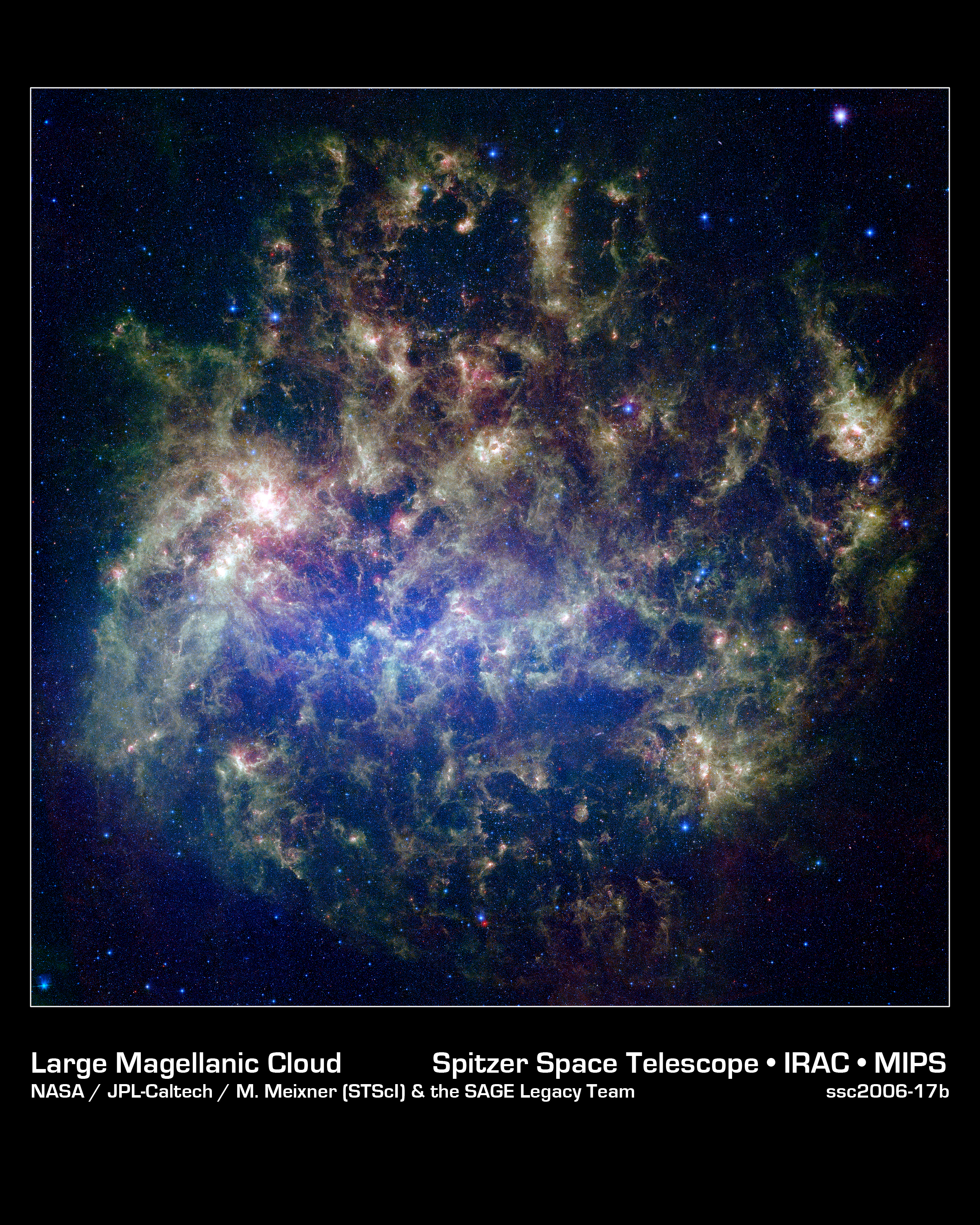
Where does dust collect in galaxies? To help find out, a team of researchers took the most detailed image ever of gas clouds and dust in the neighboring Large Magellanic Cloud (LMC) galaxy. The composite image, shown above, was taken by the Spitzer Space Telescope in infrared light, which highlights the natural glow of the warm materials returned to the interstellar medium by stars. The above mosaic combines 300,000 individual pointings to create a composite 1,000-times sharper than any previous LMC image. Visible are vast clouds of gas and dust, showing in graphic detail that dust prefers regions near young stars (red-tinted bright clouds), scattered unevenly between the stars (green-tinted clouds), and in shells around old stars (small red dots). Also visible are huge caverns cleared away by the energetic outflows of massive former stars. The faint blue (false-color) glow across the bottom is the combined light from the old stars in the central bar of the LMC. The LMC is a satellite galaxy to our own Milky Way Galaxy, spans about 70,000 light years, and lies about 160,000 light years away toward the southern constellation of the Swordfish (Dorado).
¿Dónde se acumula el polvo en las galaxias? Para ayudar a responder esta pregunta, un equipo de investigadores tomó la imagen más detallada jamás realizada de las nubes de gas y polvo en la galaxia vecina conocida como la Gran Nube de Magallanes (LMC). La imagen compuesta mostrada arriba fue capturada por el Telescopio Espacial Spitzer en luz infrarroja, que resalta el brillo natural de los materiales cálidos devueltos al medio interestelar por las estrellas. El mosaico mostrado combina 300,000 observaciones individuales para crear una imagen compuesta 1,000 veces más nítida que cualquier imagen previa de la LMC. Se ven nubes vastas de gas y polvo, mostrando en detalle gráfico que el polvo se acumula preferentemente en regiones cercanas a estrellas jóvenes (nubes brillantes con tono rojizo), disperso de manera desigual entre las estrellas (nubes con tono verde), y en capas alrededor de estrellas viejas (pequeños puntos rojos). También se observan cavernas enormes limpiadas por los flujos energéticos de estrellas antiguas masivas. El tenue brillo azul (en falso color) a lo largo de la parte inferior es la luz combinada de las estrellas viejas en la barra central de la LMC. La LMC es una galaxia satélite de nuestra propia galaxia, la Vía Láctea, tiene un tamaño de aproximadamente 70,000 años luz y se encuentra a unos 160,000 años luz de distancia en dirección a la constelación austral de la Espada (Dorado).