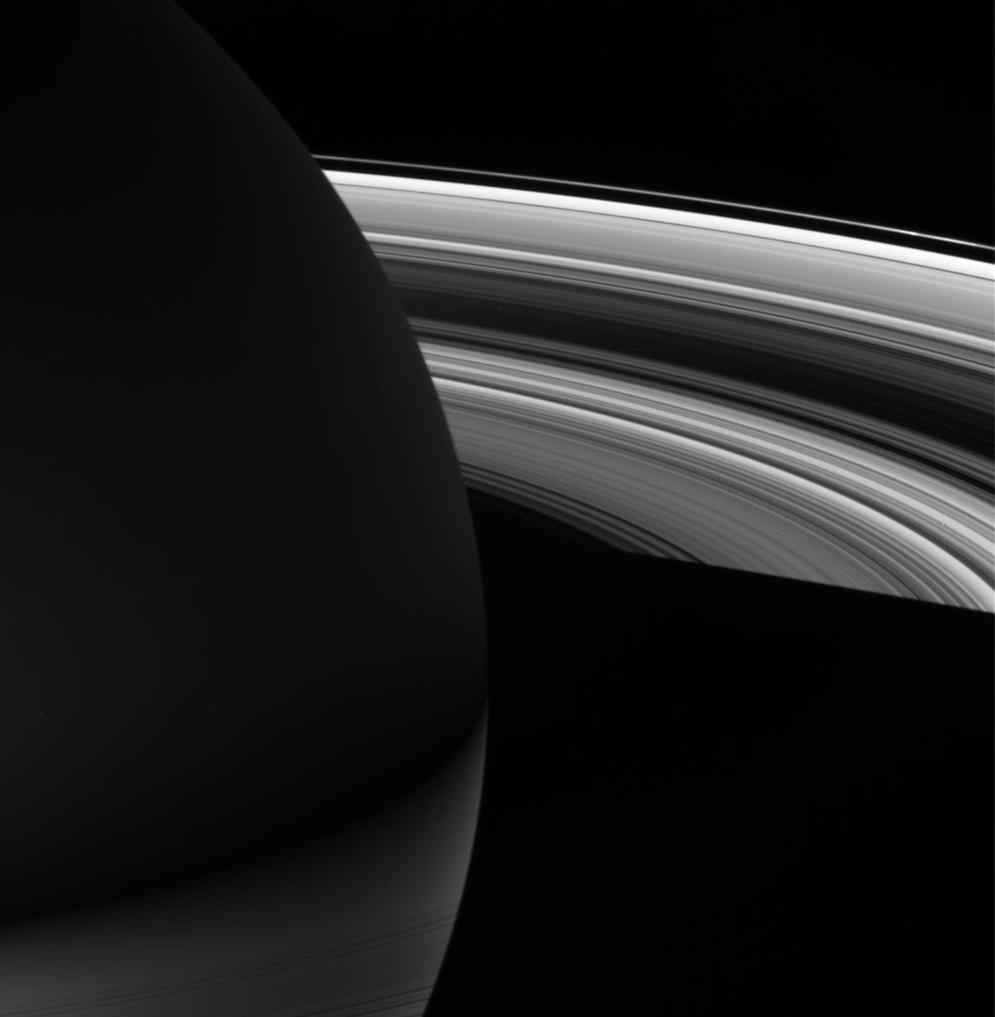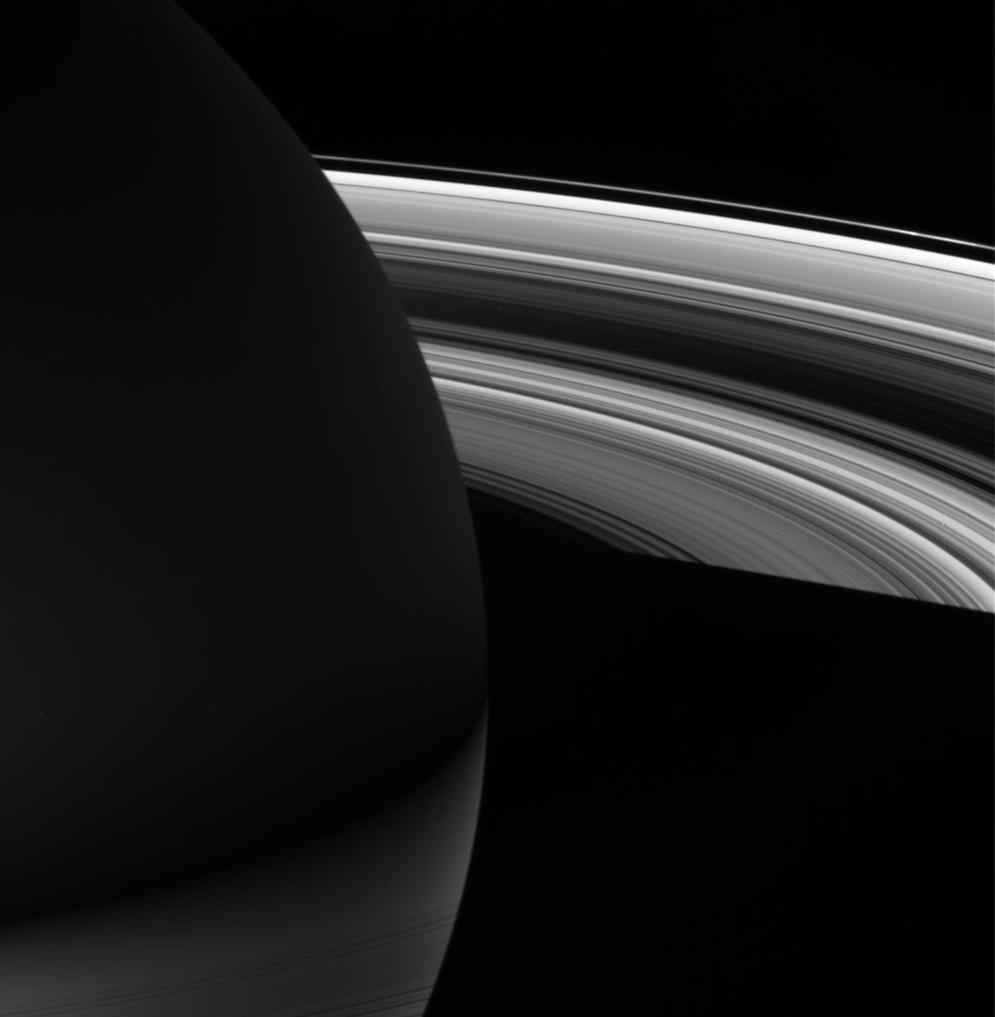
This is what Saturn looks like at night. In contrast to the human-made lights that cause the nighttime side of Earth to glow faintly, Saturn's faint nighttime glow is primarily caused by sunlight reflecting off of its own majestic rings. The above image of Saturn at night was captured in July by the Cassini spacecraft now orbiting Saturn. The above image was taken when the Sun was far in front of the spacecraft. From this vantage point, the northern hemisphere of nighttime Saturn, visible on the left, appears eerily dark. Sunlit rings are visible ahead, but are abruptly cut off by Saturn's shadow. In Saturn's southern hemisphere, visible on the right, the dim reflected glow from the sunlit rings is most apparent. Imprinted on this diffuse glow, though, are thin black stripes not discernable to any Earth telescope -- the silhouetted C ring of Saturn. Cassini has been orbiting Saturn since 2004 and its mission is scheduled to continue until 2008.
Crédito: NASA, JPL, Universidad de Arizona Esta es la apariencia de Saturno de noche. A diferencia de las luces artificiales hechas por el hombre que causan que el lado nocturno de la Tierra brille débilmente, el tenue resplandor nocturno de Saturno se debe principalmente a la luz solar reflejada en sus majestuosos anillos. La imagen de Saturno de noche mostrada arriba fue capturada en julio por la nave espacial Cassini que ahora orbita Saturno. La imagen fue tomada cuando el Sol estaba muy lejos delante de la nave espacial. Desde este punto de observación, el hemisferio norte de Saturno nocturno, visible a la izquierda, aparece inquietantemente oscuro. Los anillos iluminados por el Sol son visibles delante, pero son abruptamente cortados por la sombra de Saturno. En el hemisferio sur de Saturno, visible a la derecha, el tenue resplandor reflejado de los anillos iluminados por el Sol es más evidente. Impresas sobre este resplandor difuso, sin embargo, están finas rayas negras que no son discernibles para ningún telescopio terrestre: el anillo C de Saturno en silueta. Cassini ha estado orbitando Saturno desde 2004 y su misión está programada para continuar hasta 2008.