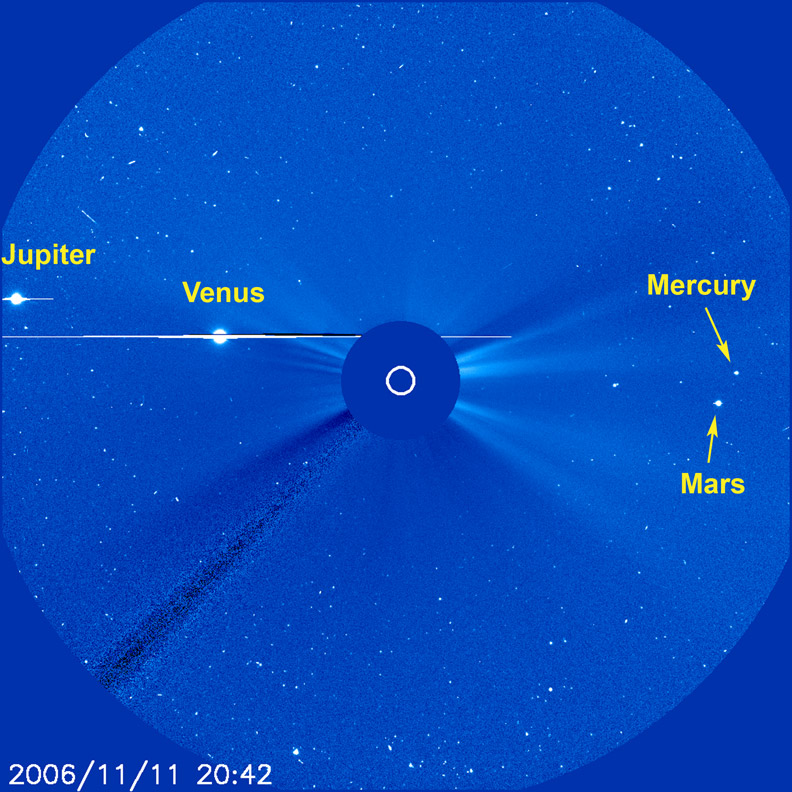
For a moment, planets Jupiter, Venus, Mars, and Mercury all posed near their parent star in this Sun-centered view, recorded on November 11. The picture, from a coronograph onboard the space-based SOlar Heliospheric Observatory, spans 15 degrees with the Sun's size and position indicated by the white circle. Background stars are also visible as the otherwise overwhelming sunlight is blocked by the coronograph's occulting disk. But the planets themselves, in particular Jupiter and Venus, are still bright enough to cause significant horizontal streaks in the image. Mercury is actually moving most rapidly (left to right) through the field and days earlier was seen to cross in front of the solar disk. So what's that bright double star to the left of Mars? Zubenelgenubi, of course.
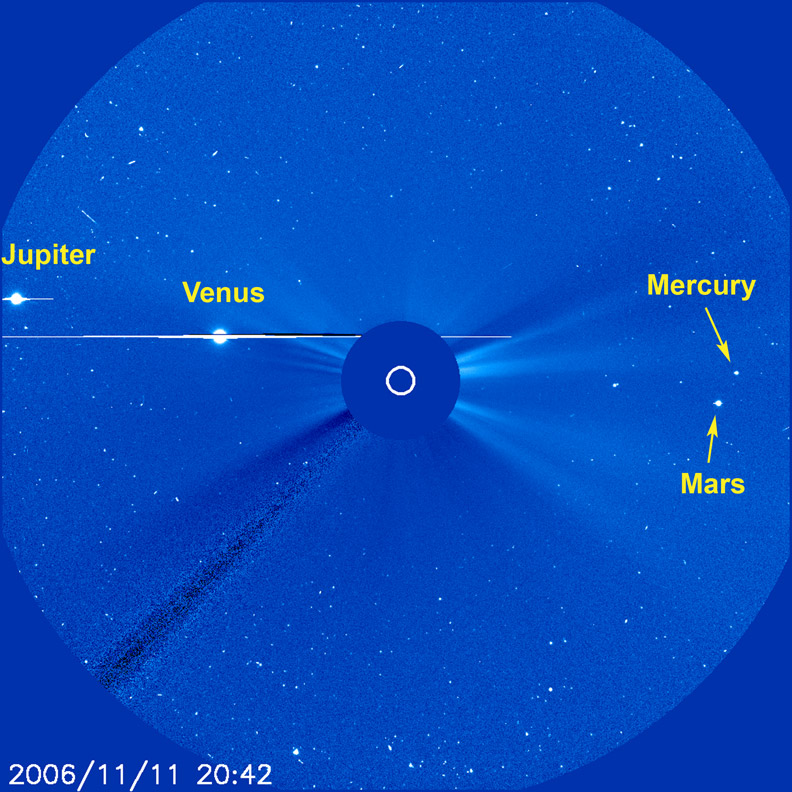
Durante un momento, los planetas Júpiter, Venus, Marte y Mercurio se alinearon cerca de su estrella madre en esta vista centrada en el Sol, registrada el 11 de noviembre. La imagen, captada por un coronógrafo a bordo de la observación espacial SOlar Heliospheric Observatory (SOHO), abarca 15 grados, con el tamaño y posición del Sol indicados por el círculo blanco. Las estrellas de fondo también son visibles, ya que la luz solar normalmente abrumadora es bloqueada por el disco ocultador del coronógrafo. Sin embargo, los planetas en sí mismos, especialmente Júpiter y Venus, son suficientemente brillantes como para causar manchas horizontales significativas en la imagen. Mercurio, de hecho, se mueve más rápidamente (de izquierda a derecha) a través del campo, y días antes fue observado cruzando frente al disco solar. Entonces, ¿qué es esa estrella doble brillante a la izquierda de Marte? Zubenelgenubi, por supuesto.