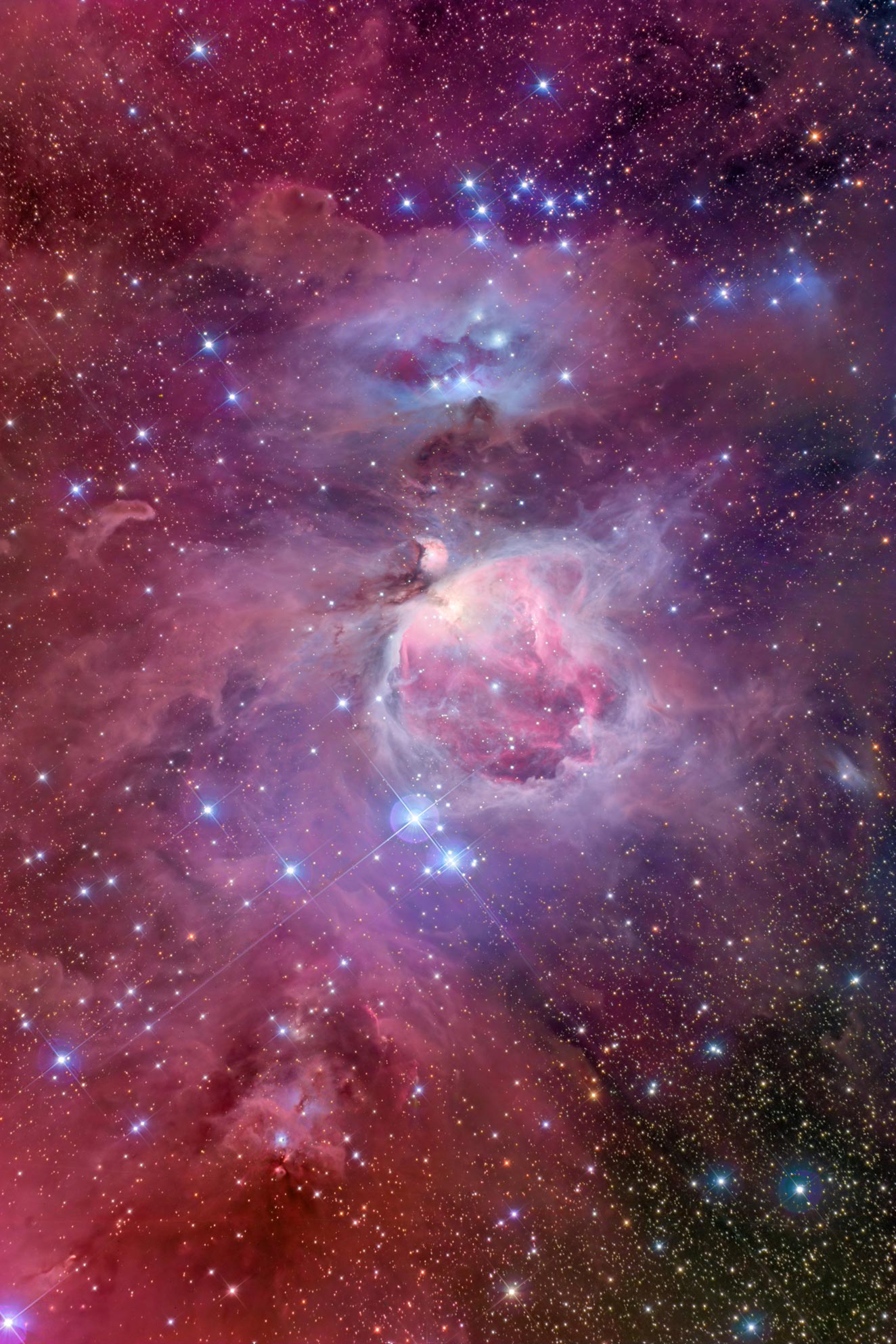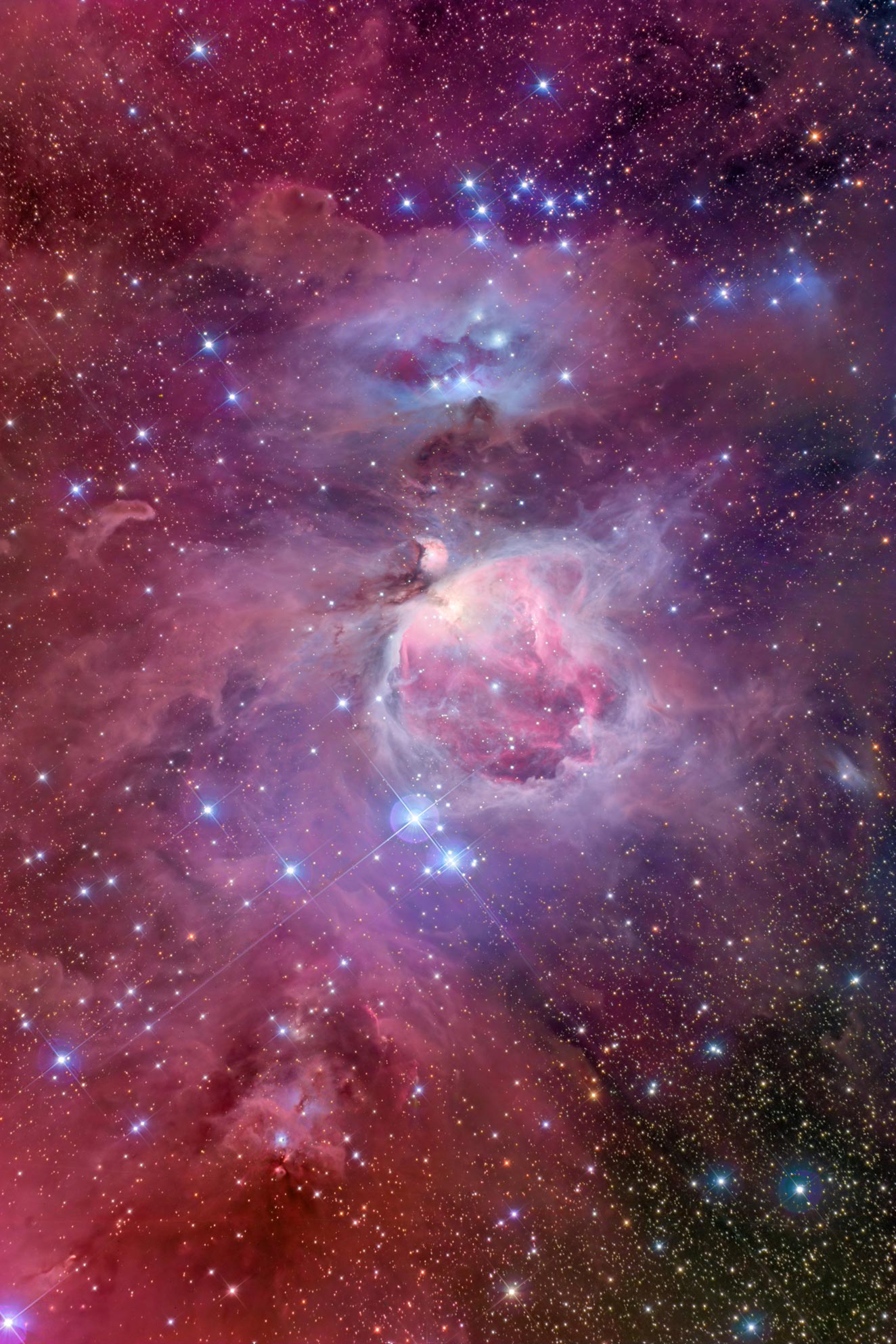
The Great Nebula in Orion, an immense, nearby starbirth region, is probably the most famous of all astronomical nebulas. Here, glowing gas surrounds hot young stars at the edge of an immense interstellar molecular cloud only 1500 light-years away. In the above deep image, faint wisps and sheets of dust and gas are particularly evident. The Great Nebula in Orion can be found with the unaided eye just below and to the left of the easily identifiable belt of three stars in the popular constellation Orion. In addition to housing a bright open cluster of stars known as the Trapezium, the Orion Nebula contains many stellar nurseries. These nurseries contain hydrogen gas, hot young stars, proplyds, and stellar jets spewing material at high speeds. Also known as M42, the Orion Nebula spans about 40 light years and is located in the same spiral arm of our Galaxy as the Sun.
La Gran Nebulosa de Orión, una región de formación estelar cercana e inmensa, probablemente es la nebulosa más famosa de todas. Aquí, gas luminoso rodea estrellas jóvenes y calientes en el borde de una nube molecular interestelar inmensa situada a solo 1500 años luz de distancia. En la imagen profunda mostrada arriba, hilos y capas tenues de polvo y gas son particularmente evidentes. La Gran Nebulosa de Orión puede localizarse a simple vista, justo debajo y a la izquierda del fácilmente identificable cinturón de tres estrellas en la popular constelación de Orión. Además de albergar un brillante cúmulo abierto de estrellas conocido como el Trapecio, la Nebulosa de Orión contiene muchos berceles estelares. Estos berceles contienen gas de hidrógeno, estrellas jóvenes y calientes, proplyds y chorros estelares que expulsan material a altas velocidades. También conocida como M42, la Nebulosa de Orión abarca aproximadamente 40 años luz y se encuentra en el mismo brazo espiral de nuestra Galaxia que el Sol.