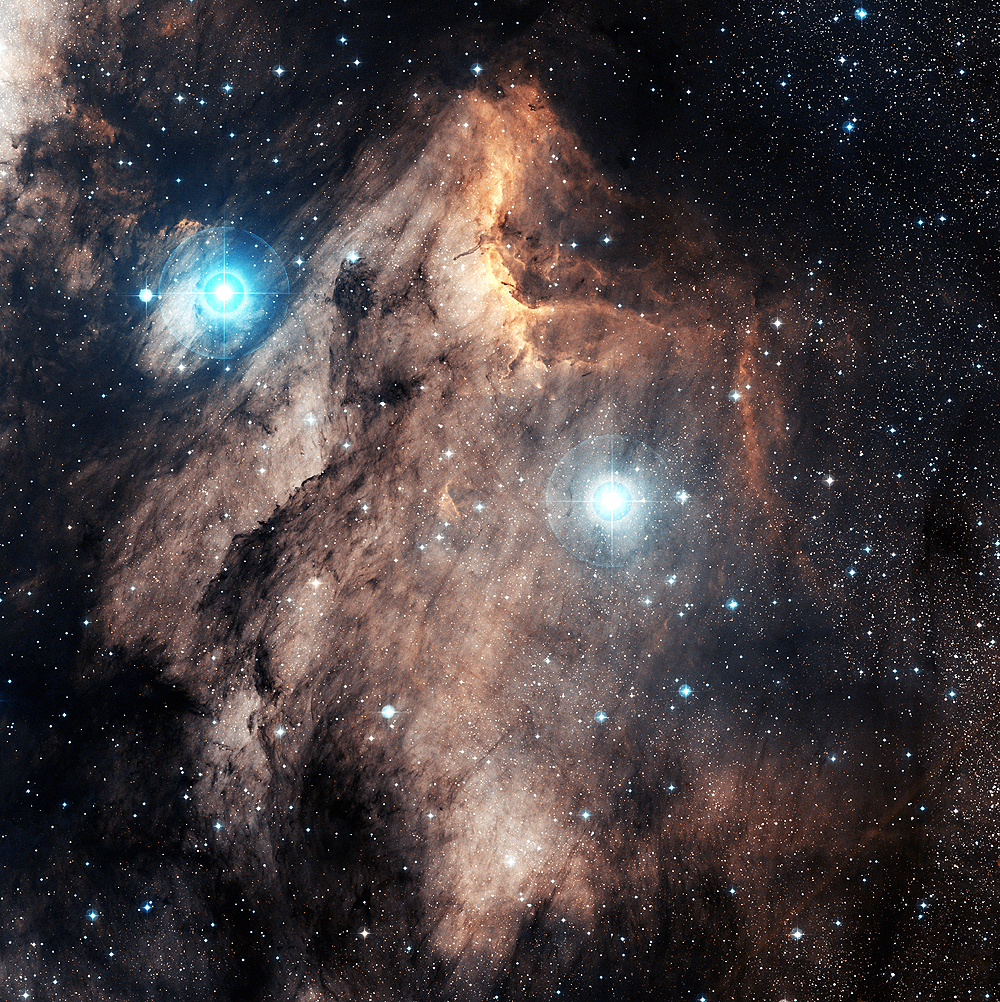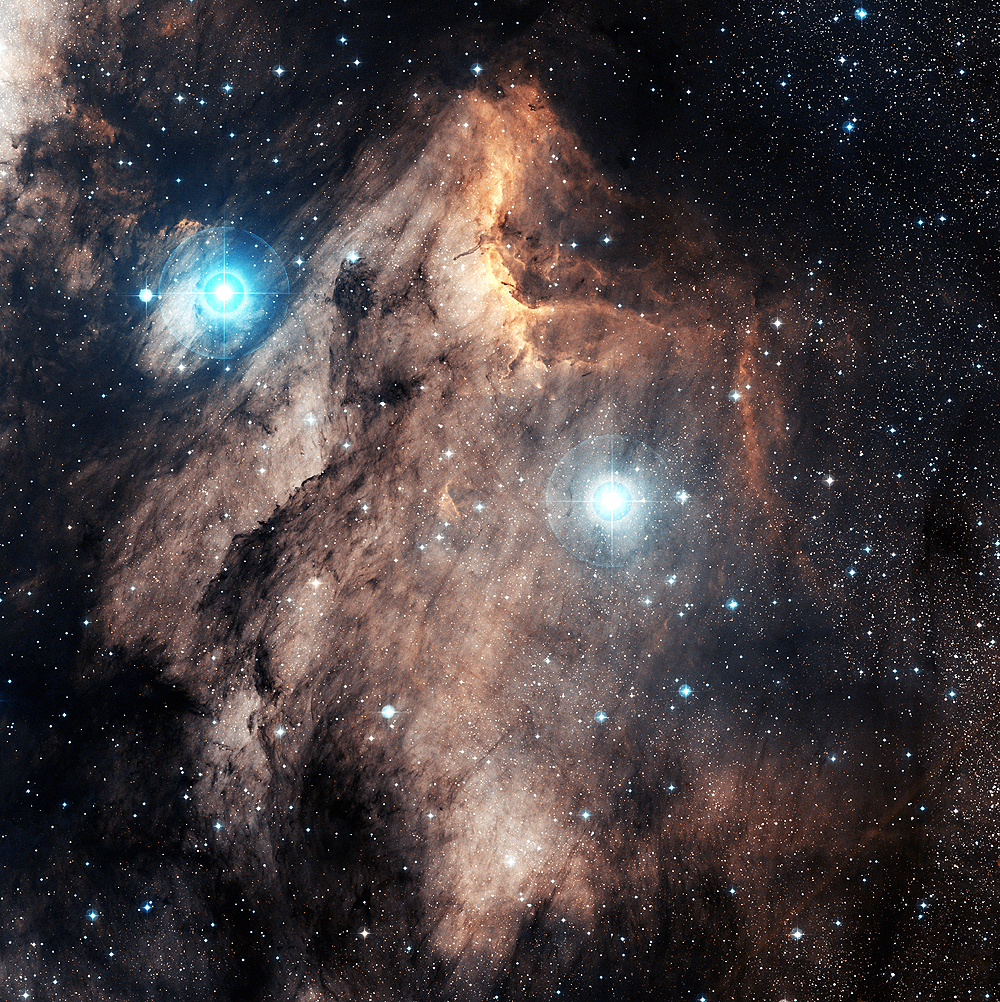
The Pelican Nebula lies about 2,000 light-years away in the high flying constellation Cygnus, the Swan. Also known as IC 5070, this cosmic pelican is appropriately found just off the "east coast" of the North America Nebula (NGC 7000), another surprisingly familiar looking emission nebula in Cygnus. The Pelican and North America nebulae are part of the same large and complex star forming region, almost as nearby as the better-known Orion Nebula. From our vantage point, dark dust clouds (upper left) help define the Pelican's eye and long bill, while a bright front of ionized gas suggests the curved shape of the head and neck. Based on digitized black and white images from the Samuel Oschin Telescope at Palomar Observatory, this striking synthesized color view includes two bright foreground stars and spans about 30 light-years at the estimated distance of the Pelican Nebula.
El nebulosa Pelícano se encuentra a unos 2000 años luz de distancia en la constelación de Cygnus, la Cisne. También conocida como IC 5070, esta nebulosa cósmica se encuentra convenientemente cerca de la "costa este" de la Nebulosa del Norteamérica (NGC 7000), otra nebulosa de emisión sorprendentemente familiar en Cygnus. Las nebulosas Pelícano y Norteamérica forman parte de la misma región grande y compleja de formación estelar, casi tan cercana como la más conocida Nebulosa de Orión. Desde nuestro punto de vista, nubes oscuras de polvo (arriba a la izquierda) definen el ojo del Pelícano y su largo pico, mientras que una frente brillante de gas ionizado sugiere la forma curvada de la cabeza y el cuello. Basada en imágenes en blanco y negro digitalizadas del telescopio Samuel Oschin en el Observatorio Palomar, esta impresionante vista en color sintetizado incluye dos estrellas brillantes en primer plano y abarca aproximadamente 30 años luz a la distancia estimada de la Nebulosa Pelícano.