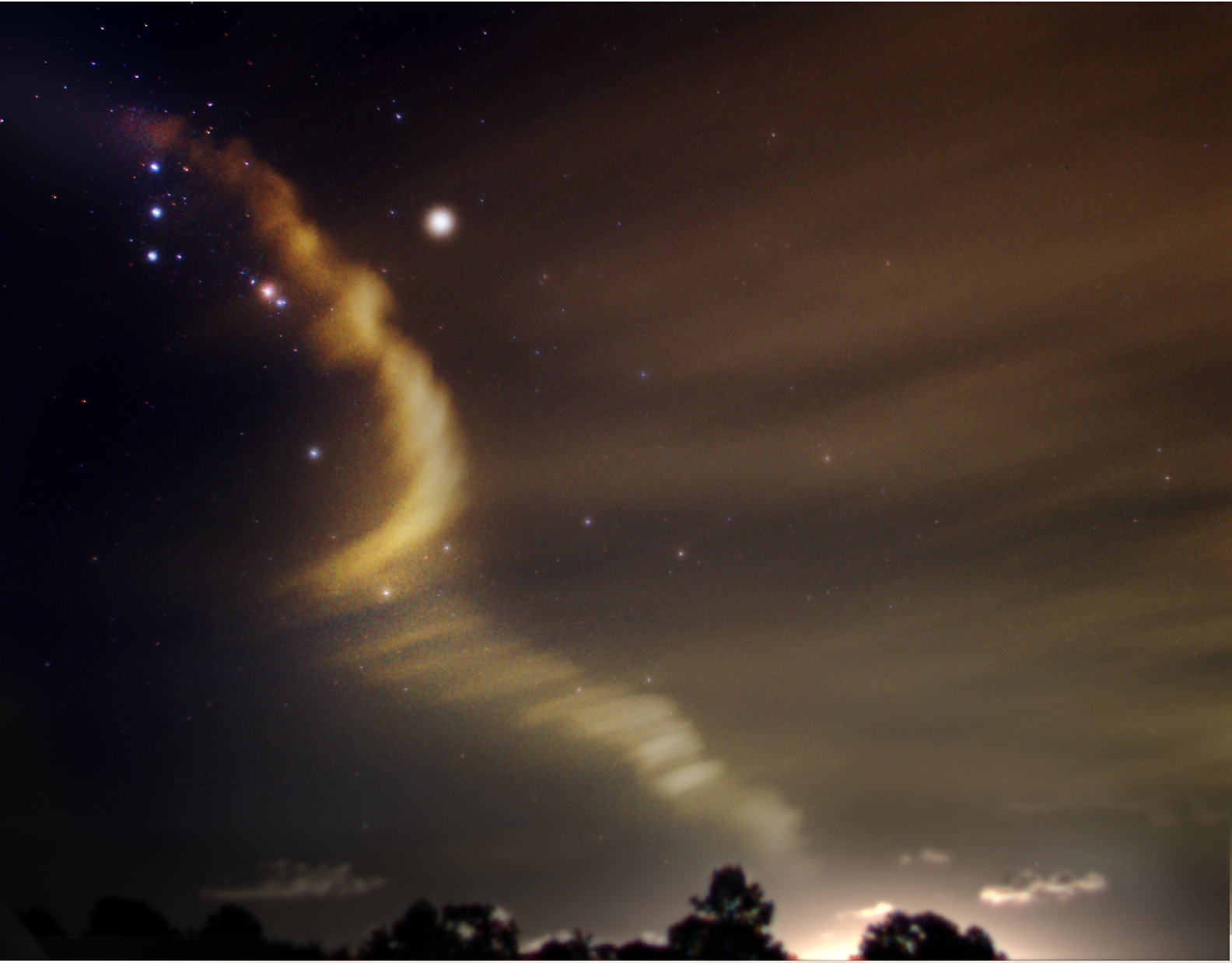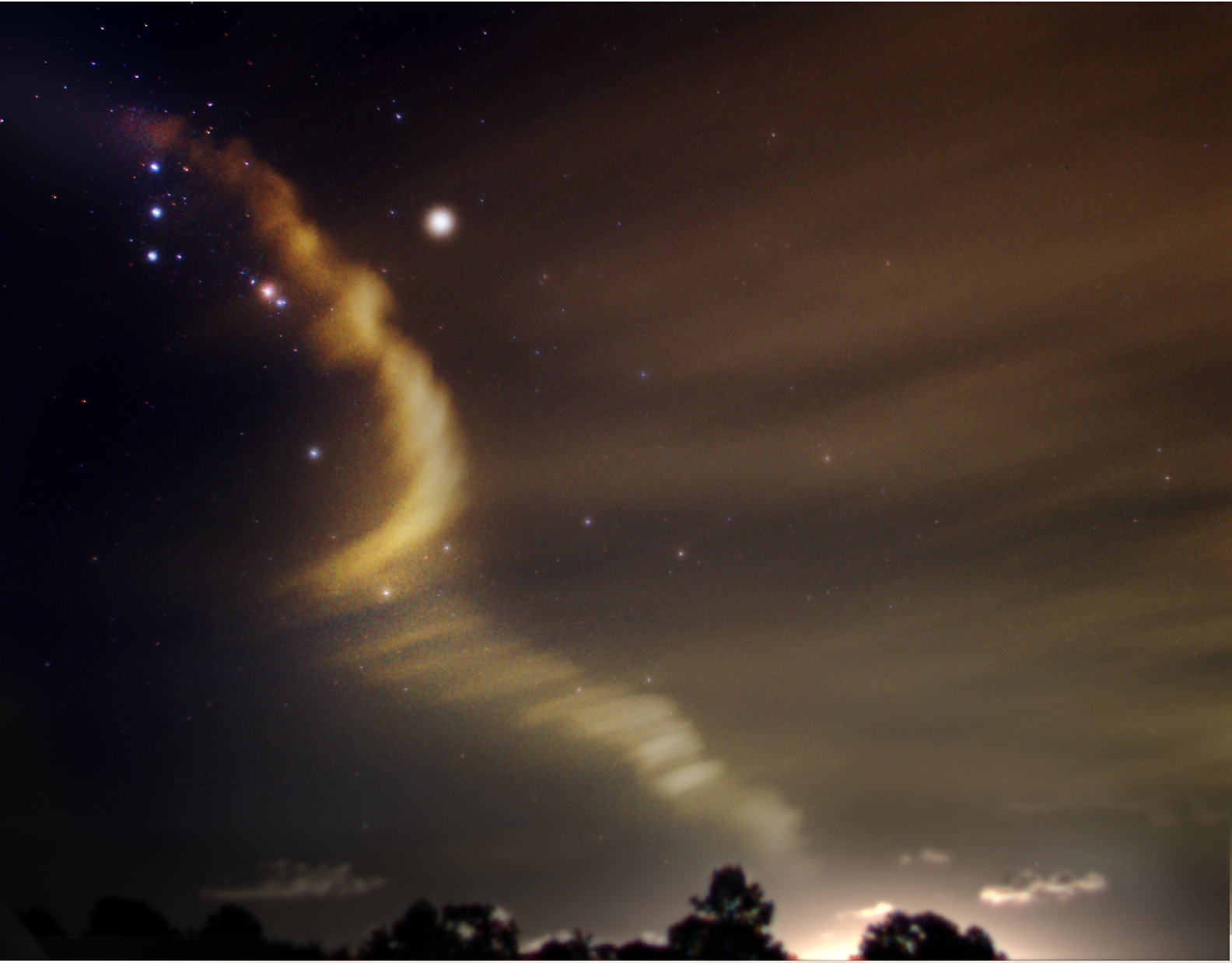
Last Saturday, the Space Shuttle Discovery lit up the night as it climbed into orbit above planet Earth. From Oak Hill, Florida, USA - about 30 miles north of the Kennedy Space Center - design engineer Andrew Arigema tracked the shuttle and recorded a four minute time exposure of the exhaust plume along Discovery's path against the background of the starry sky. At the upper left, the end of the drifting plume is punctuated by Alnitak, Alnilam, and Mintaka in a vertical line, the belt stars of Orion. To the right of the belt stars, the pinkish jewel in Orion's sword is not a star at all, but the great Orion Nebula. Still farther to the right, at the foot of the hunter, lies Rigel, the brightest star in view. Rigel is a hot supergiant star some 700 light-years in the distance.
El pasado sábado, el transbordador espacial Discovery iluminó la noche mientras ascendía a la órbita sobre la Tierra. Desde Oak Hill, Florida, EE. UU., a unos 30 millas al norte del Centro Espacial Kennedy, el ingeniero de diseño Andrew Arigema rastreó el transbordador y registró una exposición de cuatro minutos del chorro de escape a lo largo del camino de Discovery contra el fondo del cielo estrellado. En la esquina superior izquierda, el extremo del chorro que se desplaza está marcado por Alnitak, Alnilam y Mintaka alineados verticalmente, las estrellas de la cintura de Orión. A la derecha de las estrellas de la cintura, la joya rosada en la espada de Orión no es en realidad una estrella, sino la gran Nebulosa de Orión. Aún más a la derecha, en el pie del cazador, se encuentra Rigel, la estrella más brillante visible. Rigel es una supergigante caliente situada a unos 700 años luz de distancia.