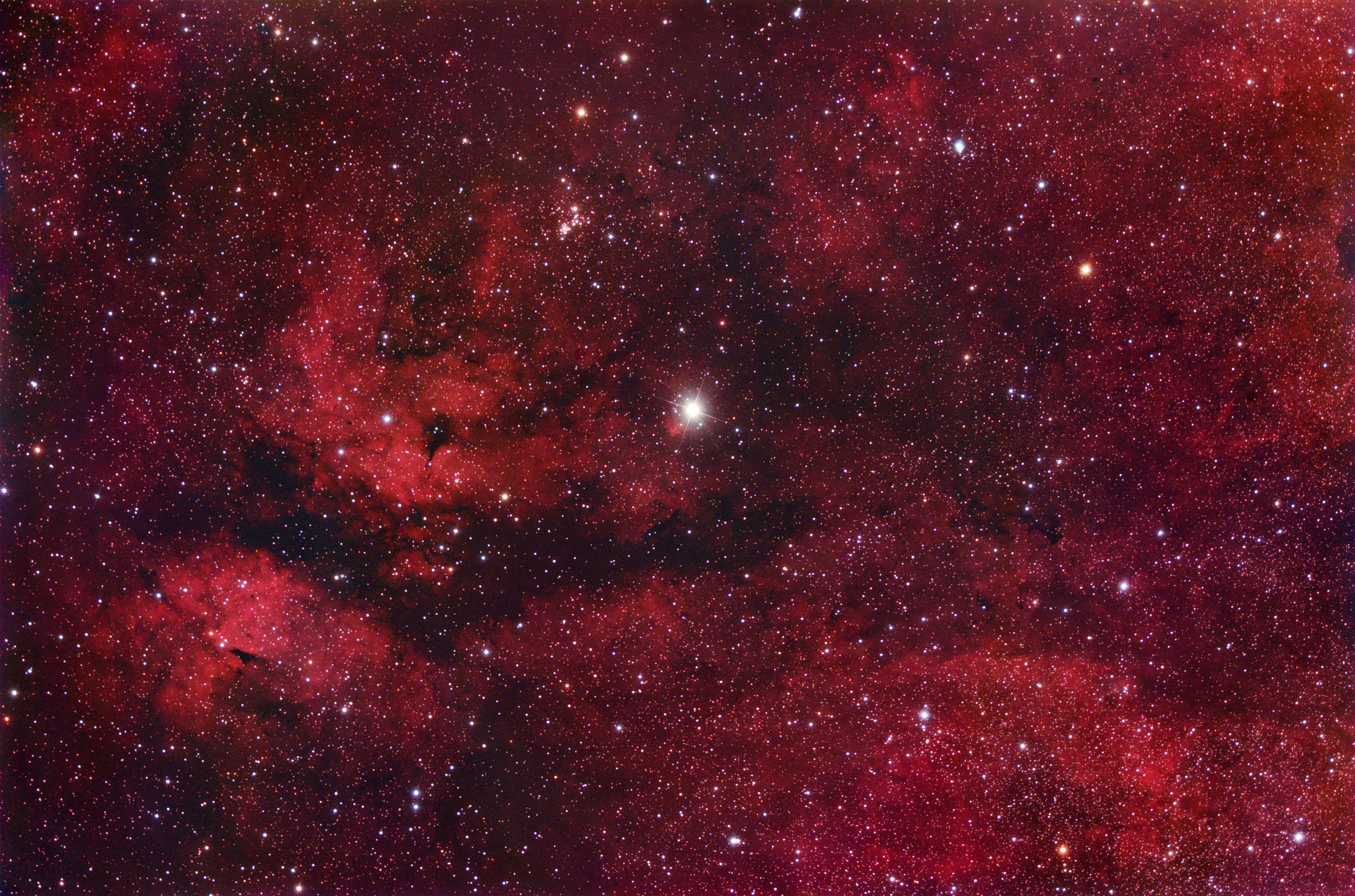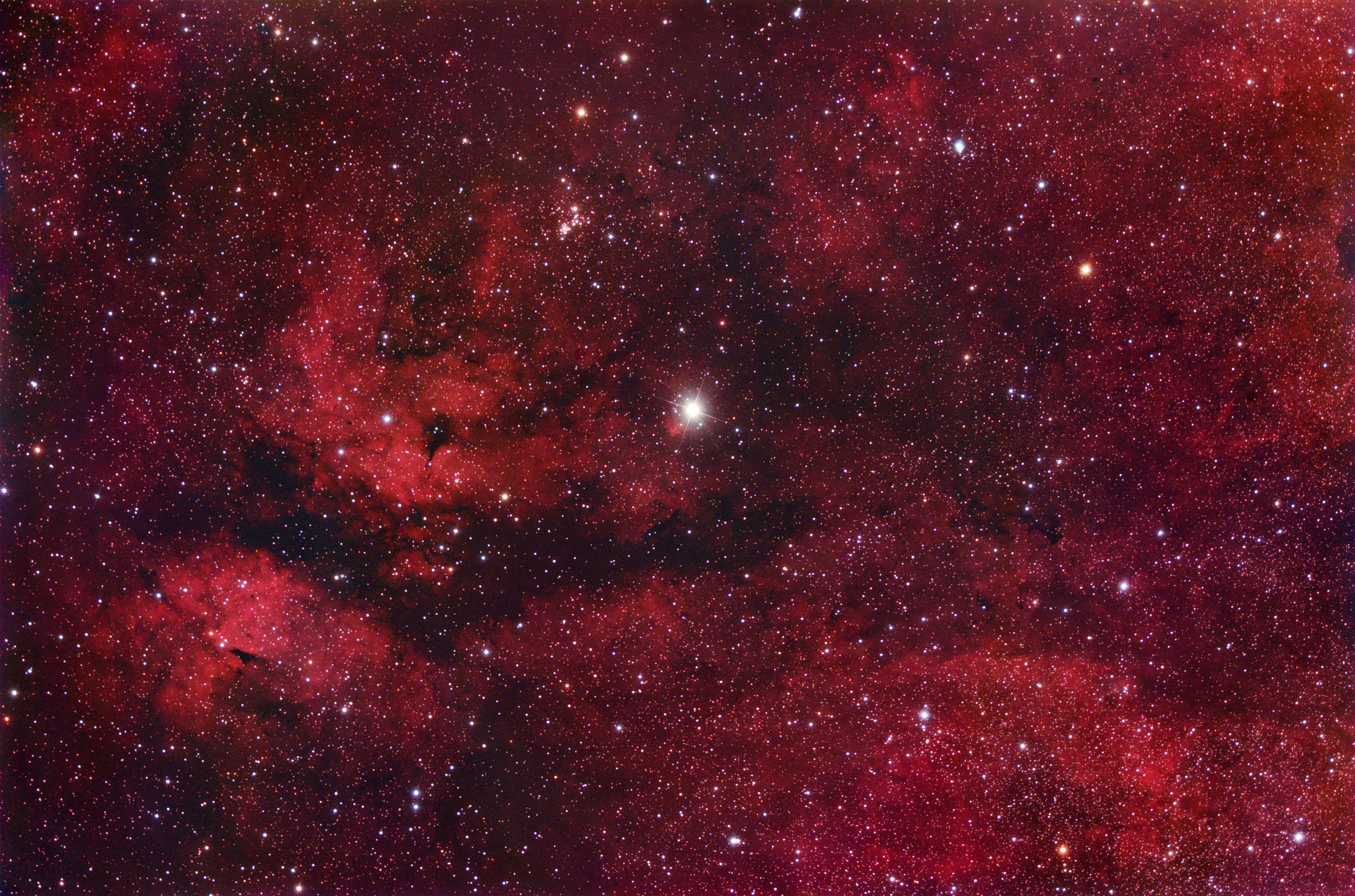
Supergiant star Gamma Cygni lies at the center of the Northern Cross, famous asterism in the constellation Cygnus the Swan. Known by the proper name Sadr, the bright star also lies at the center of this gorgeous skyscape, featuring a complex of stars, dust clouds, and glowing nebulae along the plane of our Milky Way galaxy. The field of view spans over 3 degrees (six Full Moons) on the sky and includes emission nebula IC 1318 and open star cluster NGC 6910. Left of Gamma Cyg and shaped like two glowing cosmic wings divided by a long dark dust lane, IC 1318's popular name is understandably the Butterfly Nebula. Above and left of Gamma Cyg, are the young, still tightly grouped stars of NGC 6910. Some distance estimates for Gamma Cyg place it at around 1,800 light-years while estimates for IC 1318 and NGC 6910 range from 2,000 to 5,000 light-years.
La estrella supergigante Gamma Cygni se encuentra en el centro de la Cruz Boreal, un famoso asterismo en la constelación Cygnus el Cisne. Conocida por el nombre propio Sadr, esta estrella brillante también se ubica en el centro de este magnífico paisaje celeste, que presenta un complejo de estrellas, nubes de polvo y nebulosas brillantes a lo largo del plano de nuestra galaxia Vía Láctea. El campo de visión abarca más de 3 grados (seis Lunas Llenas) en el cielo e incluye la nebulosa de emisión IC 1318 y el cúmulo estelar abierto NGC 6910. A la izquierda de Gamma Cyg y con forma de dos alas cósmicas brillantes divididas por una larga franja oscura de polvo, el nombre popular de IC 1318 es, comprensiblemente, la Nebulosa de la Mariposa. Arriba y a la izquierda de Gamma Cyg se encuentran las estrellas jóvenes aún agrupadas de NGC 6910. Algunas estimaciones de distancia para Gamma Cyg la sitúan alrededor de 1.800 años luz, mientras que las estimaciones para IC 1318 y NGC 6910 oscilan entre 2.000 y 5.000 años luz.