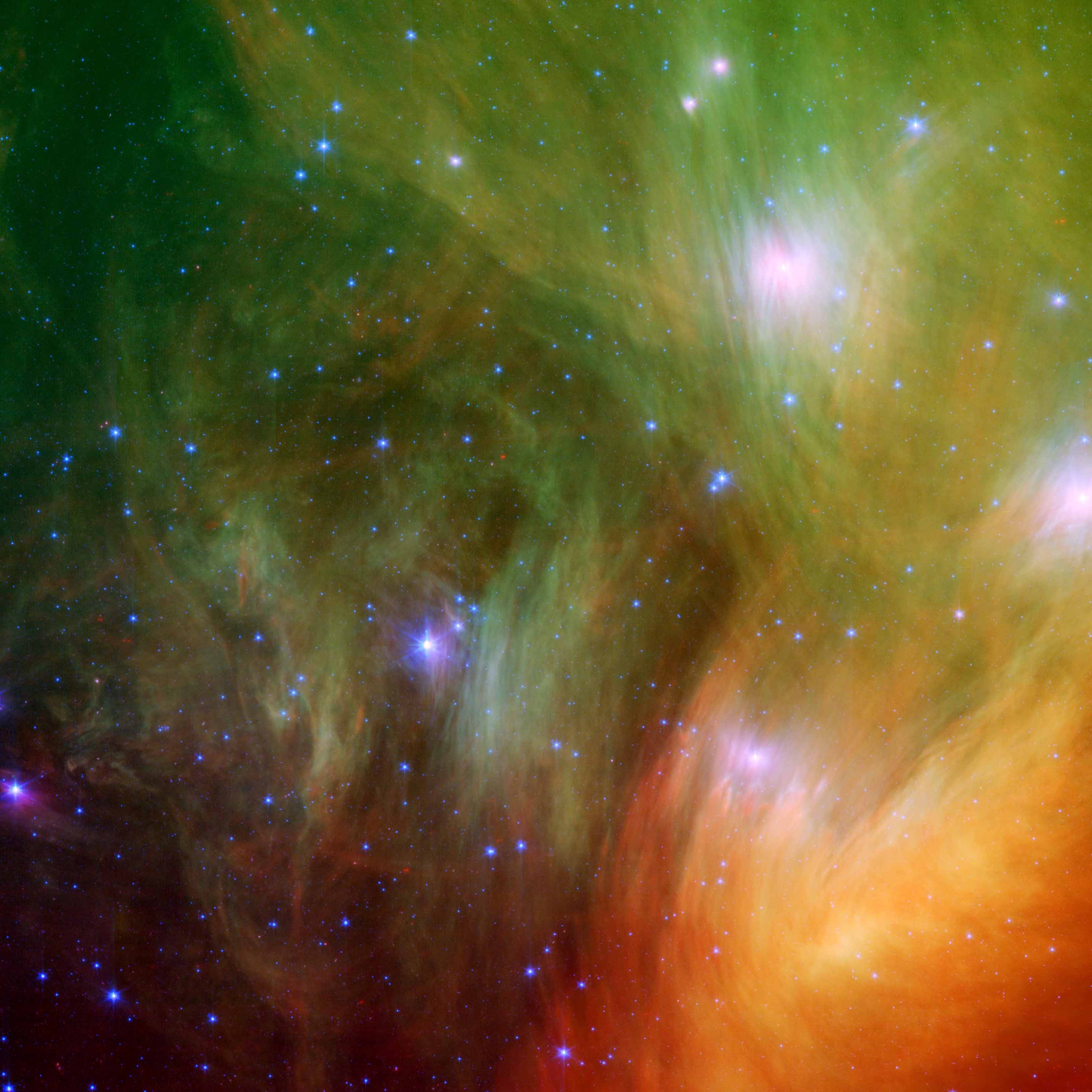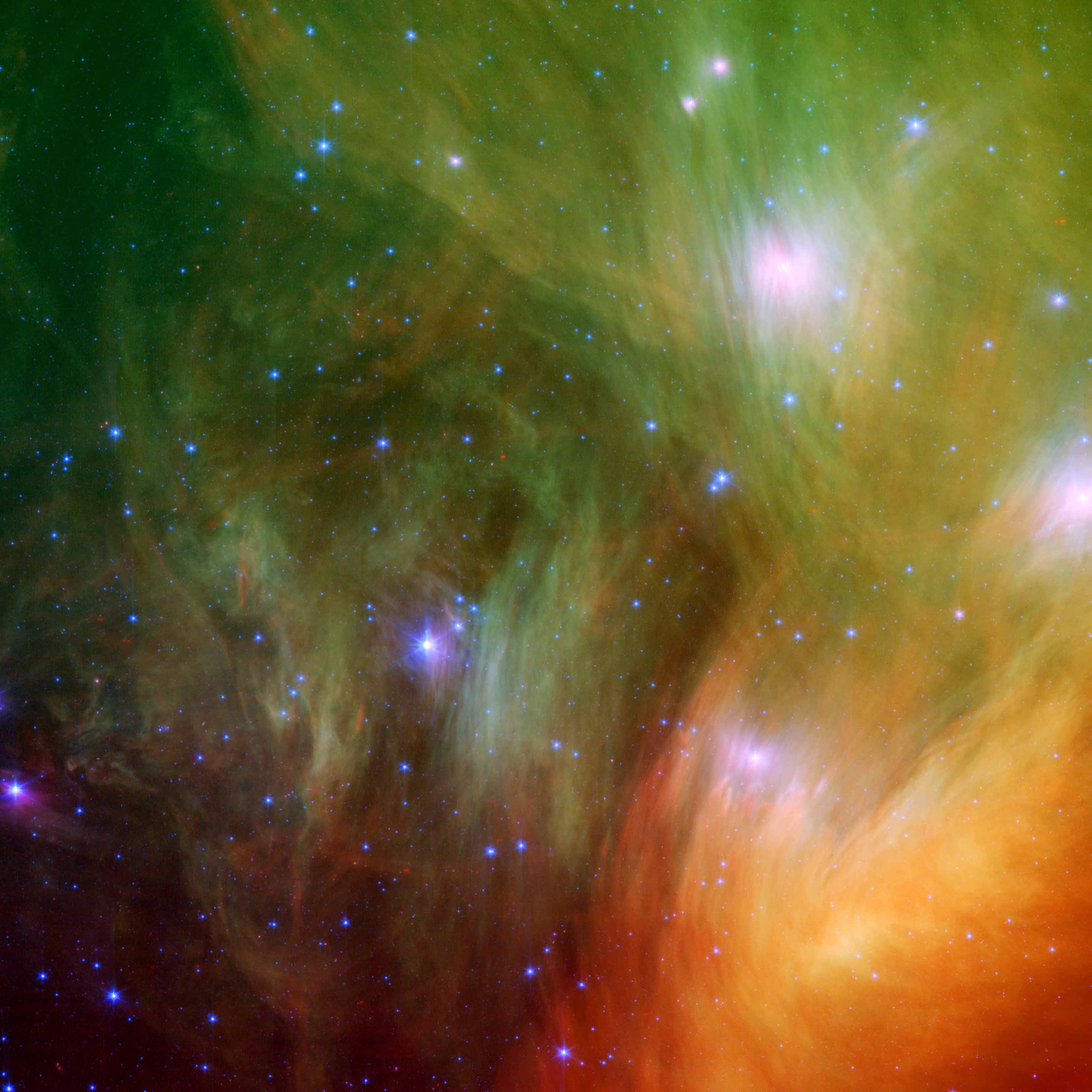
Hurtling through a cosmic dust cloud a mere 400 light-years away, the lovely Pleiades or Seven Sisters star cluster is well-known in astronomical images for its striking blue reflection nebulae. At visible wavelengths, the starlight is scattered and reflected by the dust, but in this portrait in infrared light by the Spitzer Space Telescope, the dust itself glows. The false color image spans about 1 degree or seven light-years at the distance of the Pleiades, with the densest regions of the dust cloud shown in yellow and red hues. Exploring this young, nearby cluster, the Spitzer data have revealed many cool, low mass stars, brown dwarfs or failed stars, and possible planetary debris disks. Want to see the Pleiades tonight? Look near Venus, the brilliant evening star in the west just after sunset.
Atravesando una nube de polvo cósmico a apenas 400 años luz de distancia, el hermoso cúmulo estelar de las Pléyades o Siete Hermanas es bien conocido en las imágenes astronómicas por sus llamativas nebulosas de reflexión azul. A longitudes de onda visibles, la luz estelar se dispersa y refleja en el polvo, pero en este retrato en luz infrarroja del Telescopio Espacial Spitzer, el polvo mismo emite radiación. La imagen de falso color abarca aproximadamente 1 grado o siete años luz a la distancia de las Pléyades, siendo las regiones más densas de la nube de polvo las que muestran tonalidades amarillas y rojas. Al explorar este joven cúmulo cercano, los datos del Spitzer han revelado muchas estrellas frías de baja masa, enanas marrones o estrellas fallidas, y posibles discos de escombros planetarios. ¿Desea ver las Pléyades esta noche? Busque cerca de Venus, la brillante estrella vespertina en el oeste justo después de la puesta de sol.