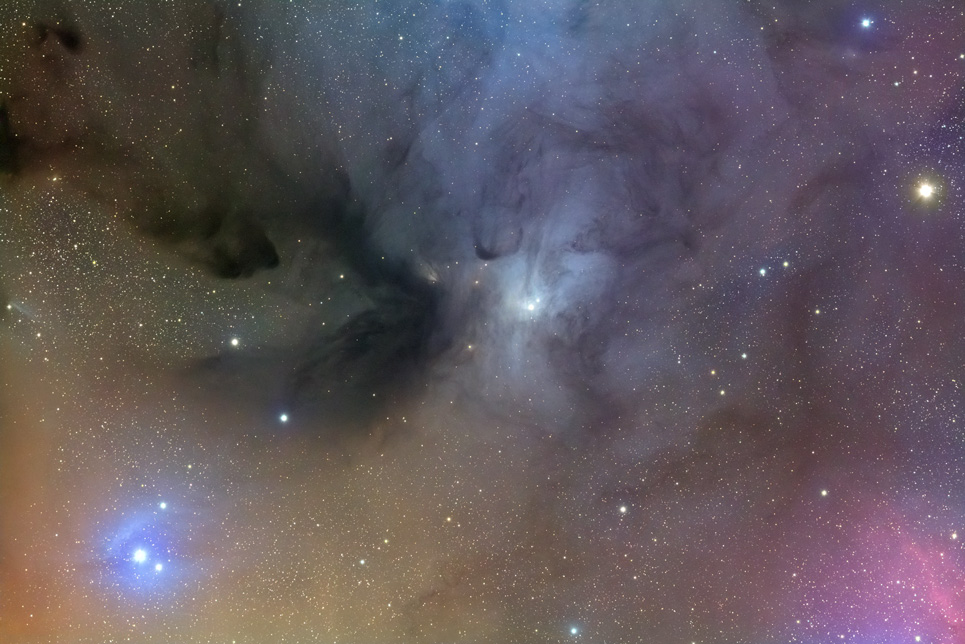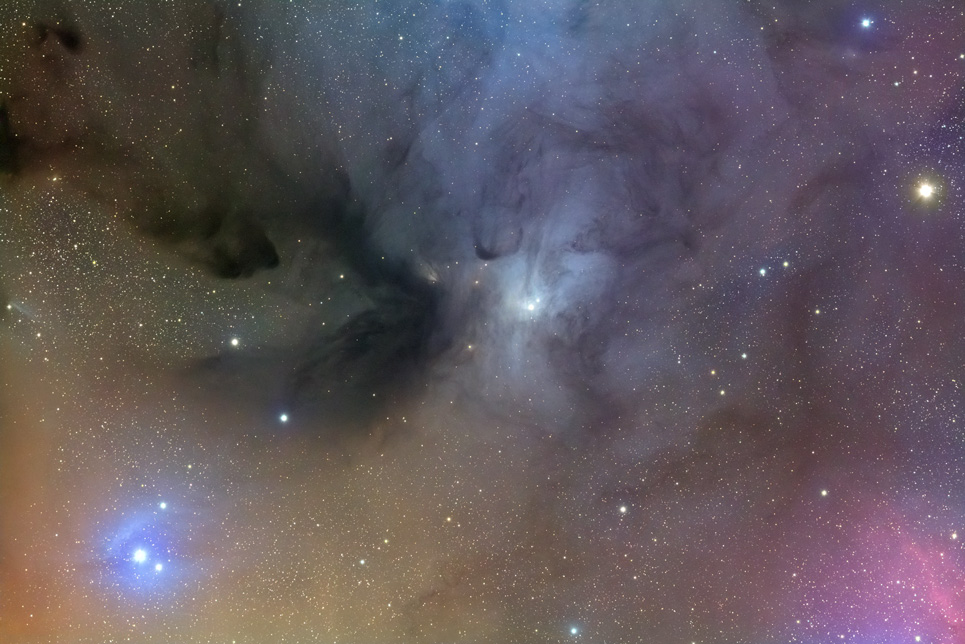
Why does this starfield photograph resemble an impressionistic painting? The effect is created not by digital trickery but by large amounts of interstellar dust. Dust, minute globs rich in carbon and similar in size to cigarette smoke, frequently starts in the outer atmospheres of large, cool, young stars. The dust is dispersed as the star dies and grows as things stick to it in the interstellar medium. Dense dust clouds are opaque to visible light and can completely hide background stars. For less dense clouds, the capacity of dust to preferentially reflect blue starlight becomes important, effectively blooming the stars blue light out and marking the surrounding dust. Nebular gas emissions, typically brightest in red light, can combine to form areas seemingly created on an artist's canvas. Photographed above is roughly four square degrees of the nebula IC 4603 near the bright star Antares toward the constellation of Ophiuchus.
¿Por qué esta fotografía de campo estelar se asemeja a una pintura impresionista? El efecto no es creado por manipulación digital, sino por grandes cantidades de polvo interestelar. El polvo, pequeños glóbulos ricos en carbono y de tamaño similar al del humo de cigarrillo, frecuentemente se origina en las atmósferas exteriores de estrellas grandes, frías y jóvenes. El polvo se dispersa cuando la estrella muere y crece a medida que las partículas se adhieren a él en el medio interestelar. Las nubes de polvo denso son opacas a la luz visible y pueden ocultar completamente las estrellas de fondo. Para las nubes menos densas, la capacidad del polvo para reflejar preferencialmente la luz azul de las estrellas se vuelve importante, expandiendo efectivamente la luz azul de las estrellas e iluminando el polvo circundante. Las emisiones gaseosas nebulares, típicamente más brillantes en luz roja, pueden combinarse para formar áreas que parecen creadas en el lienzo de un artista. Lo fotografiado arriba es aproximadamente cuatro grados cuadrados de la nebulosa IC 4603 cerca de la brillante estrella Antares hacia la constelación de Ofiuco.