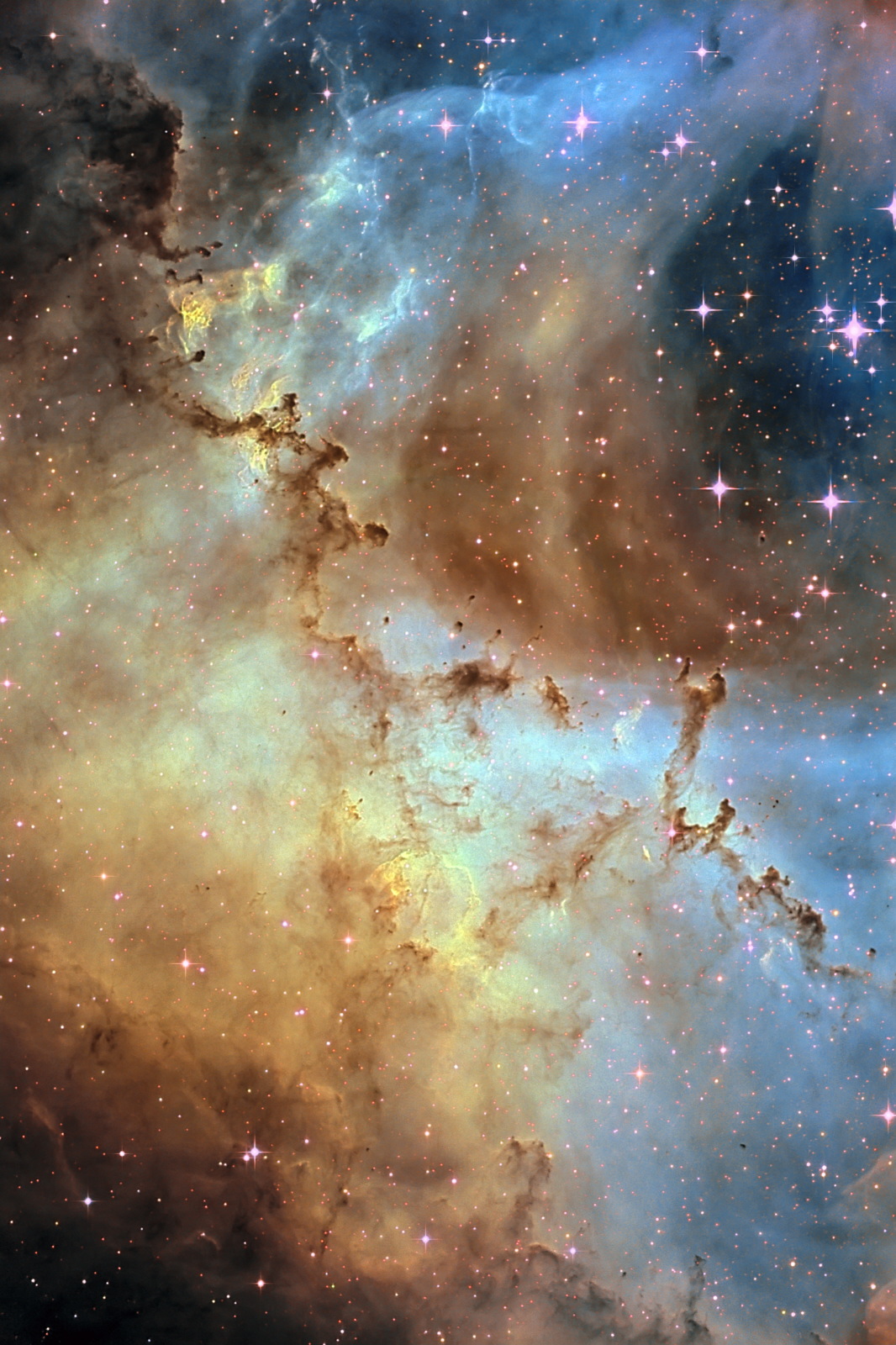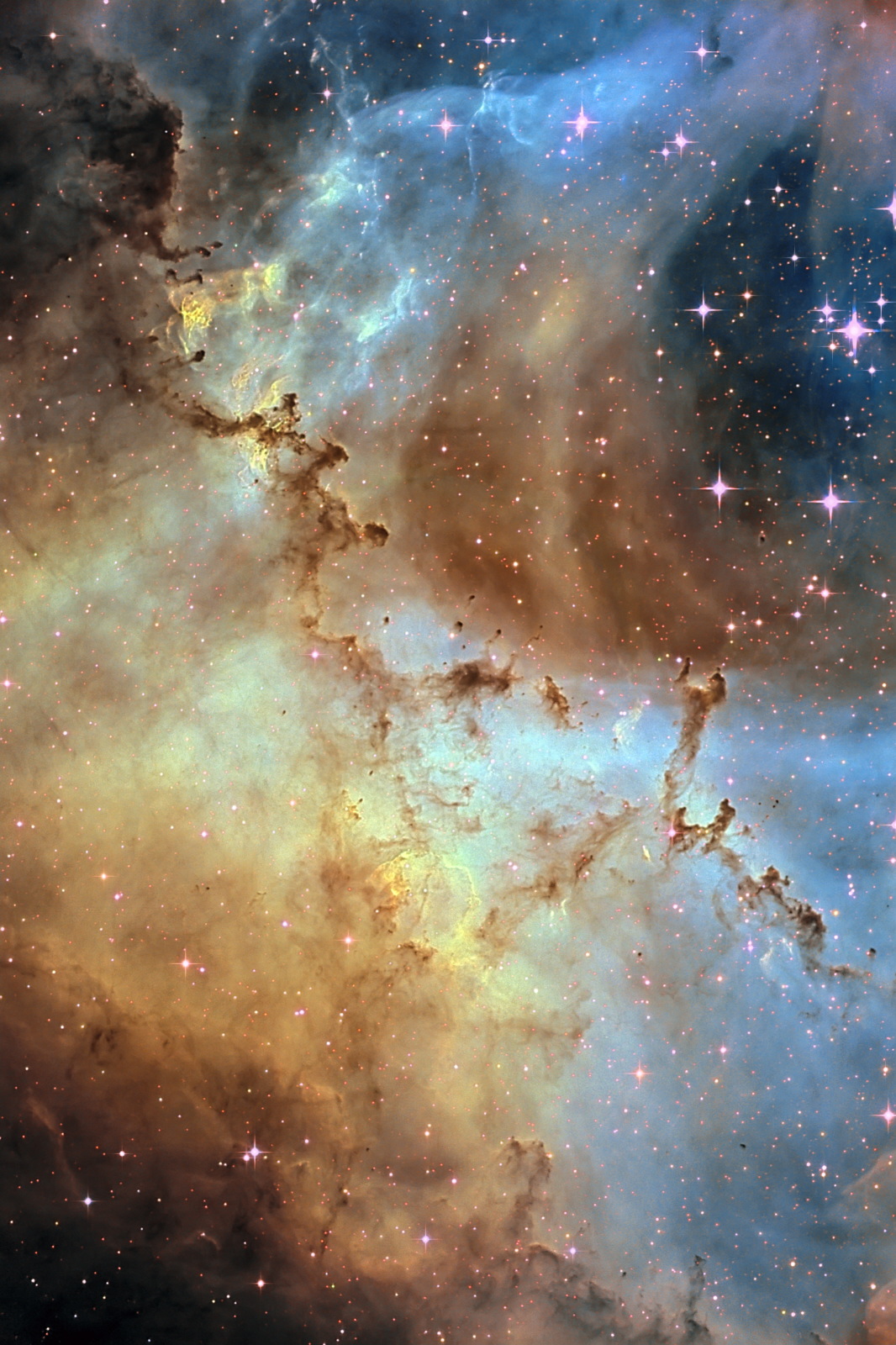
What creates the cosmic dust sculptures in the Rosette Nebula? Noted for the common beauty of its overall shape, parts of the Rosette Nebula, also known as NGC 2244, show beauty even when viewed up close. Visible above are globules of dark dust and gas that are slowly being eroded away by the energetic light and winds by nearby massive stars. Left alone long enough, the molecular-cloud globules would likely form stars and planets. The above image was taken in very specific colors of Sulfur (shaded red), Hydrogen (green), and Oxygen (blue). The Rosette Nebula spans about 50 light-years across, lies about 4,500 light-years away, and can be seen with a small telescope towards the constellation of the Unicorn (Monoceros).
¿Qué crea las esculturas de polvo cósmico en la Nebulosa de la Roseta? Conocida por la belleza común de su forma general, partes de la Nebulosa de la Roseta, también conocida como NGC 2244, muestran belleza incluso cuando se observan de cerca. Visibles arriba hay glóbulos de polvo oscuro y gas que se están erosionando lentamente por la luz energética y los vientos de estrellas masivas cercanas. Si se dejaran solos el tiempo suficiente, los glóbulos de nube molecular probablemente formarían estrellas y planetas. La imagen anterior fue tomada en colores muy específicos de Azufre (teñido de rojo), Hidrógeno (verde) y Oxígeno (azul). La Nebulosa de la Roseta abarca aproximadamente 50 años luz de ancho, se encuentra a aproximadamente 4.500 años luz de distancia y puede verse con un pequeño telescopio hacia la constelación del Unicornio (Monoceros).