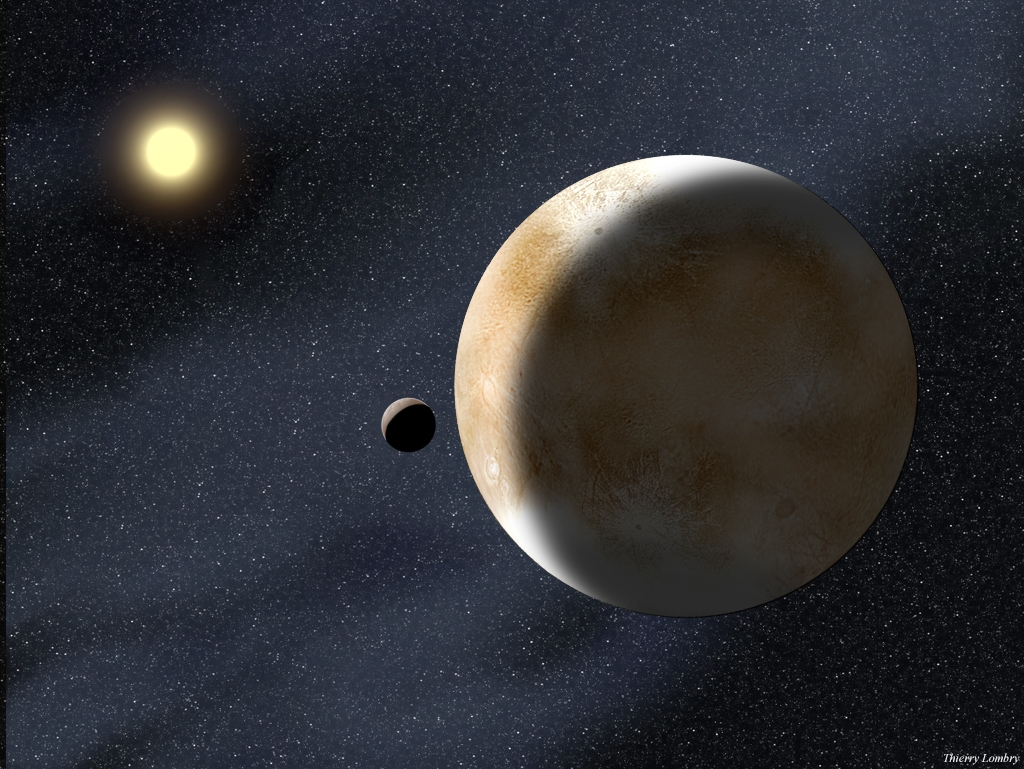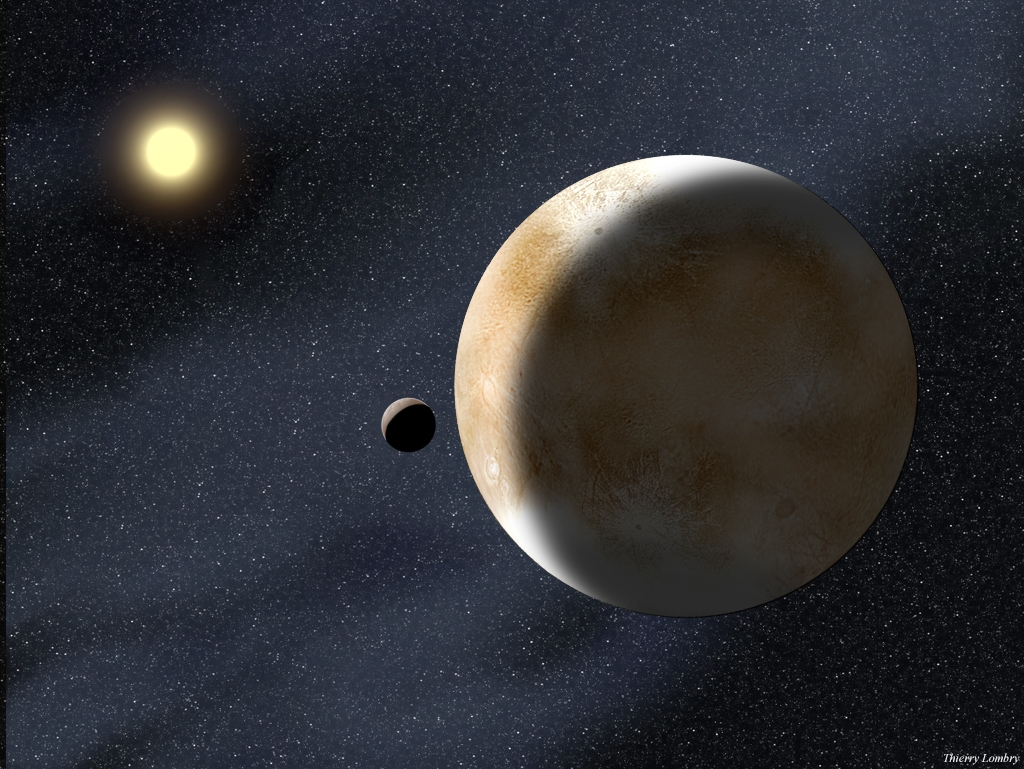
ris, a dwarf planet currently orbiting the Sun at about twice Pluto's distance, has been measured to have about 27 percent more mass than Pluto. The mass was calculated by timing the orbit of Eris' moon Dysnomia. Images taken with a ground-based Keck telescope, when combined with existing images taken by Hubble Space Telescope, show that Dysnomia has a nearly circular orbit lasting about 16 days. Cataloged as 2003 UB313 only a year ago, infrared images also showed previously that Eris is actually larger in diameter than Pluto. The plane of Eris' orbit is well out of the plane of the Solar System's planets. In the above drawing, a scientific artist has imagined Eris and Dysnomia orbiting our distant Sun. No space missions are currently planned to Eris, although the robotic New Horizons spacecraft bound for Pluto has recently passed Jupiter.
Eris, un planeta enano que actualmente orbita el Sol a una distancia aproximadamente el doble de la de Plutón, ha sido medido para tener aproximadamente un 27 por ciento más de masa que Plutón. La masa fue calculada midiendo el tiempo de órbita de Disnomia, la luna de Eris. Las imágenes tomadas con el telescopio terrestre Keck, cuando se combinan con imágenes existentes tomadas por el Telescopio Espacial Hubble, muestran que Disnomia tiene una órbita casi circular que dura aproximadamente 16 días. Catalogado como 2003 UB313 hace apenas un año, las imágenes infrarrojas también demostraron previamente que Eris es en realidad más grande en diámetro que Plutón. El plano de la órbita de Eris está bien fuera del plano de los planetas del Sistema Solar. En el dibujo anterior, un artista científico ha imaginado a Eris y Disnomia orbitando alrededor de nuestro distante Sol. Actualmente no hay misiones espaciales planeadas a Eris, aunque la nave robótica New Horizons dirigida a Plutón ha pasado recientemente por Júpiter.