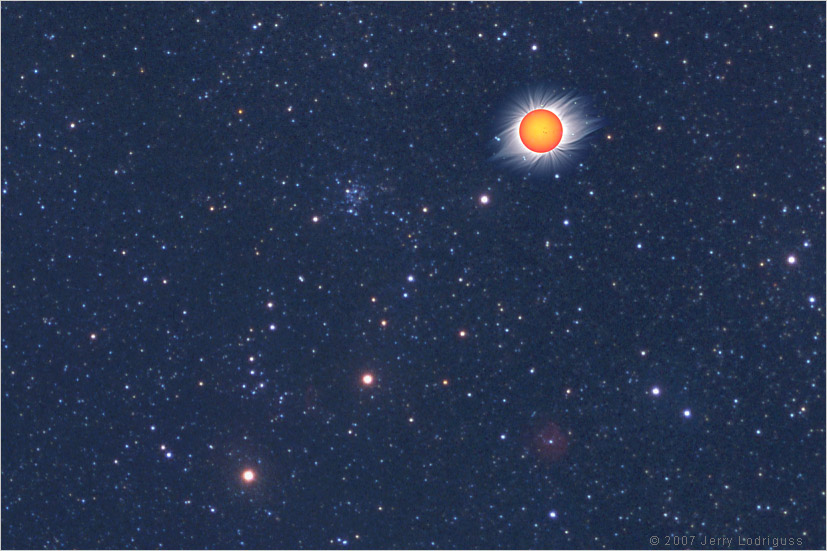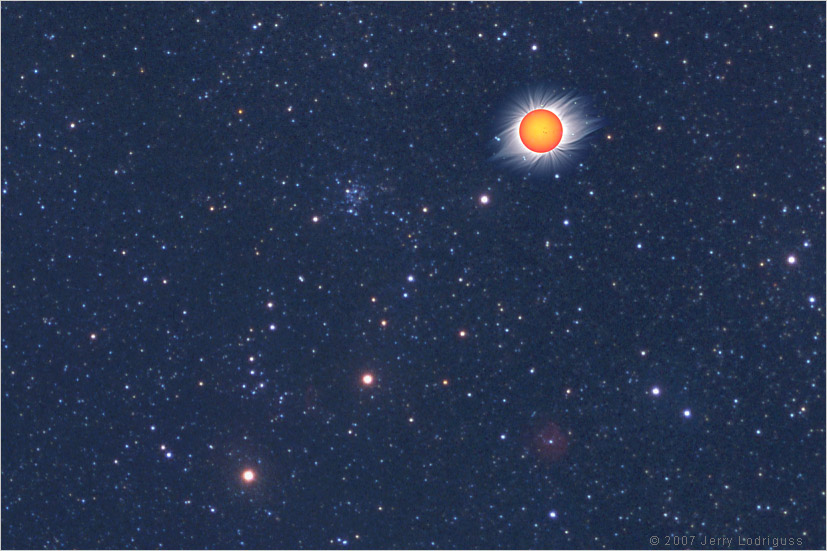
If you could turn off the atmosphere's ability to scatter overwhelming sunlight, today's daytime sky might look something like this ... with the Sun surrounded by the stars of the constellations Taurus and Gemini. Of course, today is the Solstice. Traveling along the ecliptic plane, the Sun is at its northernmost position in planet Earth's sky, marking the astronomical beginning of summer in the north. Accurate for the exact time of today's Solstice, this composite image also shows the Sun at the proper scale (about the angular size of the Full Moon). Open star cluster M35 is to the Sun's left, and the other two bright stars in view are Mu and Eta Geminorum. Digitally superimposed on a nighttime image of the stars, the Sun itself is a composite of a picture taken through a solar filter and a series of images of the solar corona recorded during the solar eclipse of February 26, 1998 by Andreas Gada.
Si pudieras desactivar la capacidad de la atmósfera para dispersar la abrumadora luz solar, el cielo diurno de hoy podría lucir así... con el Sol rodeado por las estrellas de las constelaciones de Tauro y Géminis. Por supuesto, hoy es el Solsticio. Viajando a lo largo del plano eclíptico, el Sol se encuentra en su posición más septentrional en el cielo del planeta Tierra, marcando el comienzo astronómico del verano en el norte. Preciso para el momento exacto del Solsticio de hoy, esta imagen compuesta también muestra el Sol a la escala adecuada (aproximadamente del tamaño angular de la Luna Llena). El cúmulo abierto M35 se encuentra a la izquierda del Sol, y las otras dos estrellas brillantes visibles son Mu y Eta Geminorum. Superpuesto digitalmente sobre una imagen nocturna de las estrellas, el Sol en sí es una composición de una fotografía tomada a través de un filtro solar y una serie de imágenes de la corona solar registradas durante el eclipse solar del 26 de febrero de 1998 por Andreas Gada.