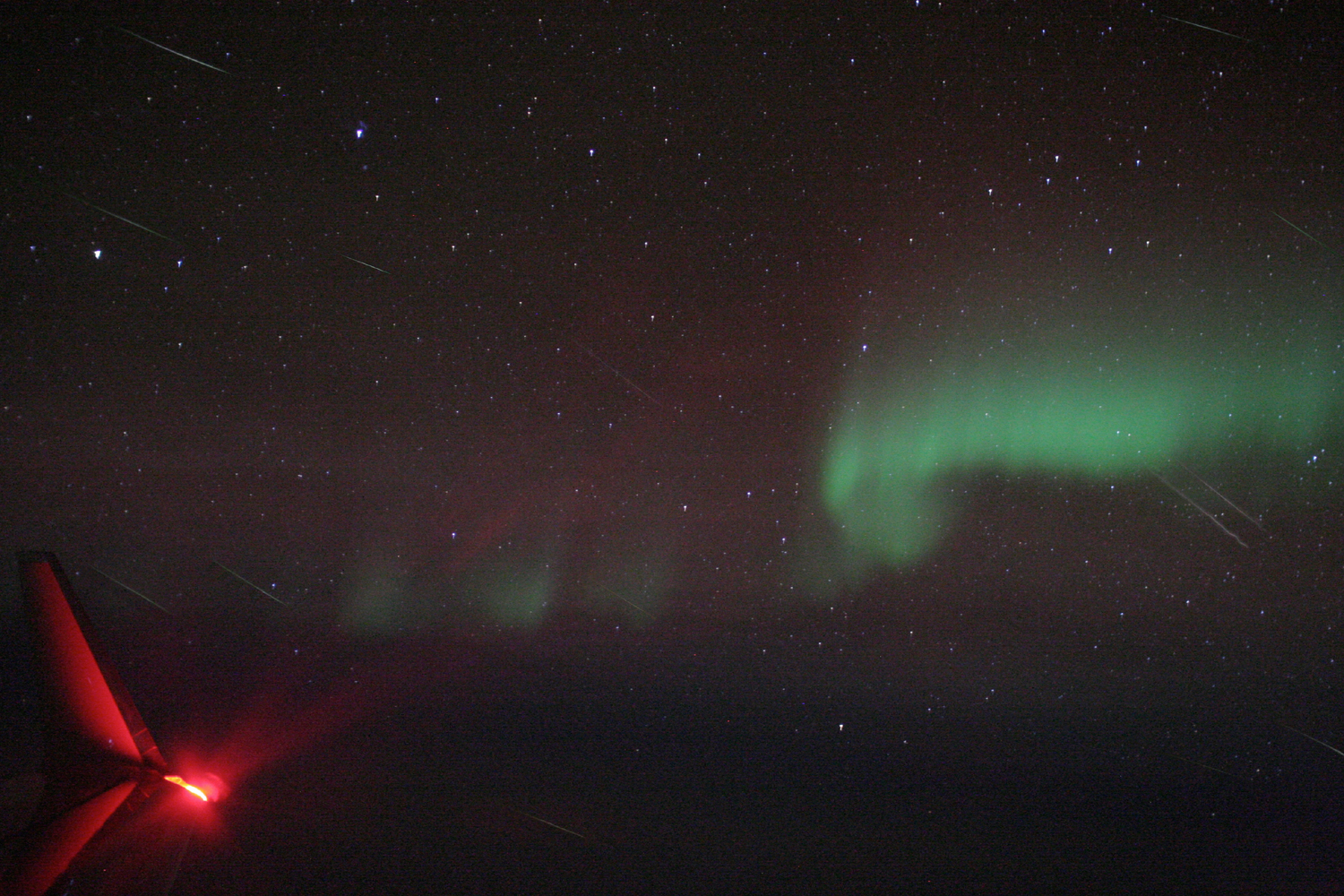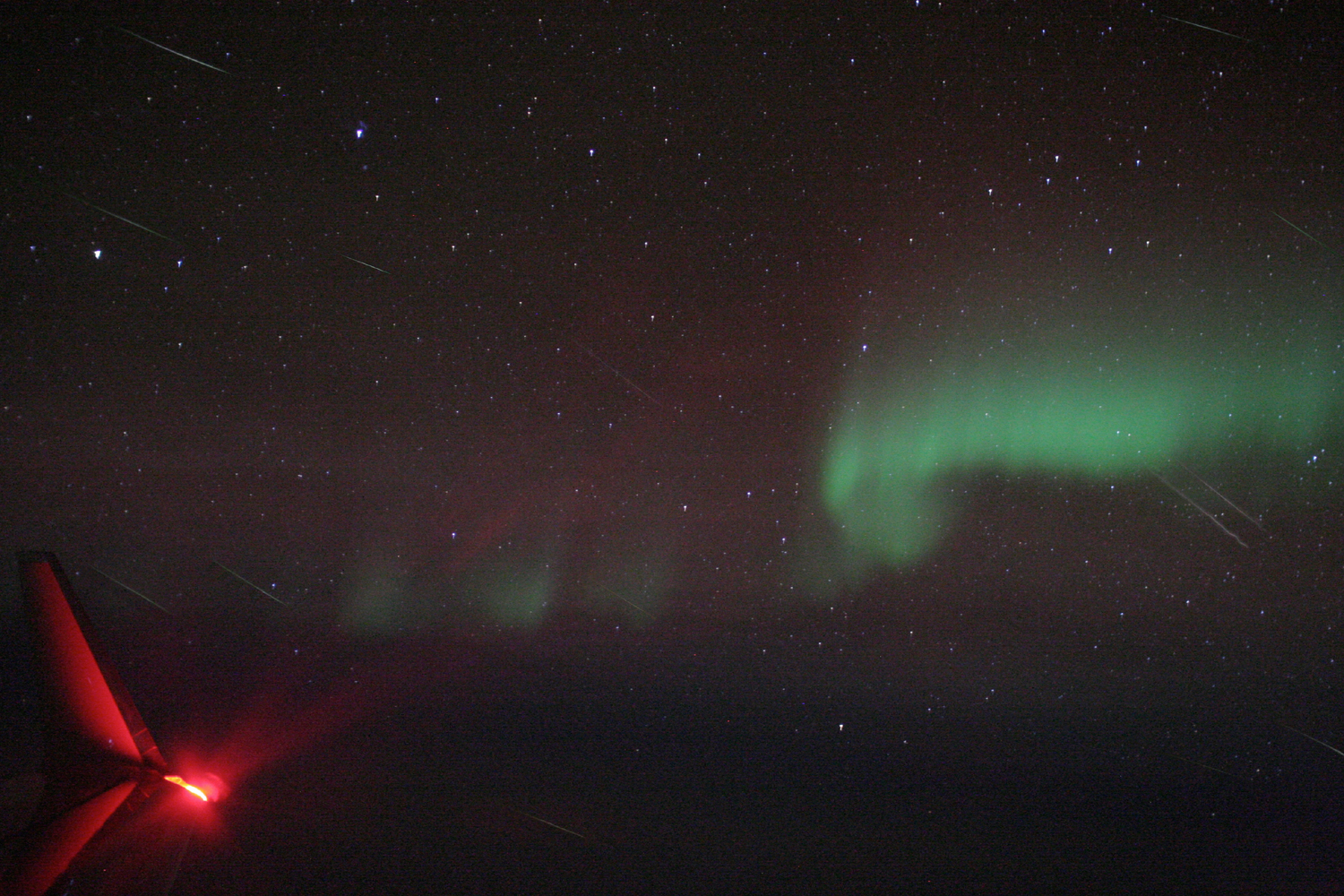
Where do meteor showers originate? To help answer this question, astronomers studied in some detail the Quadrantid meteor shower that occurred over this past weekend. In particular, astronomers with specialized cameras flew as part of the Quadrantid's Multi-Instrument Aircraft Campaign (MAC) aboard a Gulfstream V aircraft above northern Canada over the past few days and studied the Quadrantid meteor shower in unprecedented detail. Pictured above is a composite image combining many short exposures. Visible in the image are the wingtip of the airplane reflecting a red beacon on the left, green aurora most prominent on the image right, and numerous meteor streaks throughout. Preliminary indications are that the meteor stream is quite stable in time but variable in meteor abundance. Over 100 meteors per hour were visible at the peak from the MAC aircraft. Meteor data from around the world will continue to be analyzed to try to verify Peter Jenniskens's recent hypothesis that minor planet 2003 EH1 is an intermittently active comet and the parent body of the annual Quadrantid meteor shower. Note: Meet sky enthusiasts, astro bloggers, and APOD editor RN in Austin tomorrow (Tuesday) night.
¿De dónde se originan las lluvias de meteoros? Para ayudar a responder esta pregunta, los astrónomos estudiaron en detalle la lluvia de meteoros Cuadrántidas que ocurrió durante este fin de semana pasado. En particular, astrónomos con cámaras especializadas volaron como parte de la Campaña de Instrumentos Múltiples de las Cuadrántidas (MAC) a bordo de un avión Gulfstream V sobre el norte de Canadá durante los últimos días y estudiaron la lluvia de meteoros Cuadrántidas con un detalle sin precedentes. La imagen mostrada arriba es una imagen compuesta que combina muchas exposiciones cortas. Visibles en la imagen se encuentran la punta del ala del avión reflejando un faro rojo a la izquierda, aurora verde más prominente en el lado derecho de la imagen, y numerosas estelas de meteoros a lo largo de toda ella. Las indicaciones preliminares sugieren que la corriente de meteoros es bastante estable en el tiempo pero variable en la abundancia de meteoros. Se observaron más de 100 meteoros por hora en el pico desde el avión MAC. Los datos de meteoros de alrededor del mundo continuarán siendo analizados para tratar de verificar la hipótesis reciente de Peter Jenniskens de que el asteroide menor 2003 EH1 es un cometa activo intermitentemente y el cuerpo progenitor de la lluvia de meteoros Cuadrántidas anual.