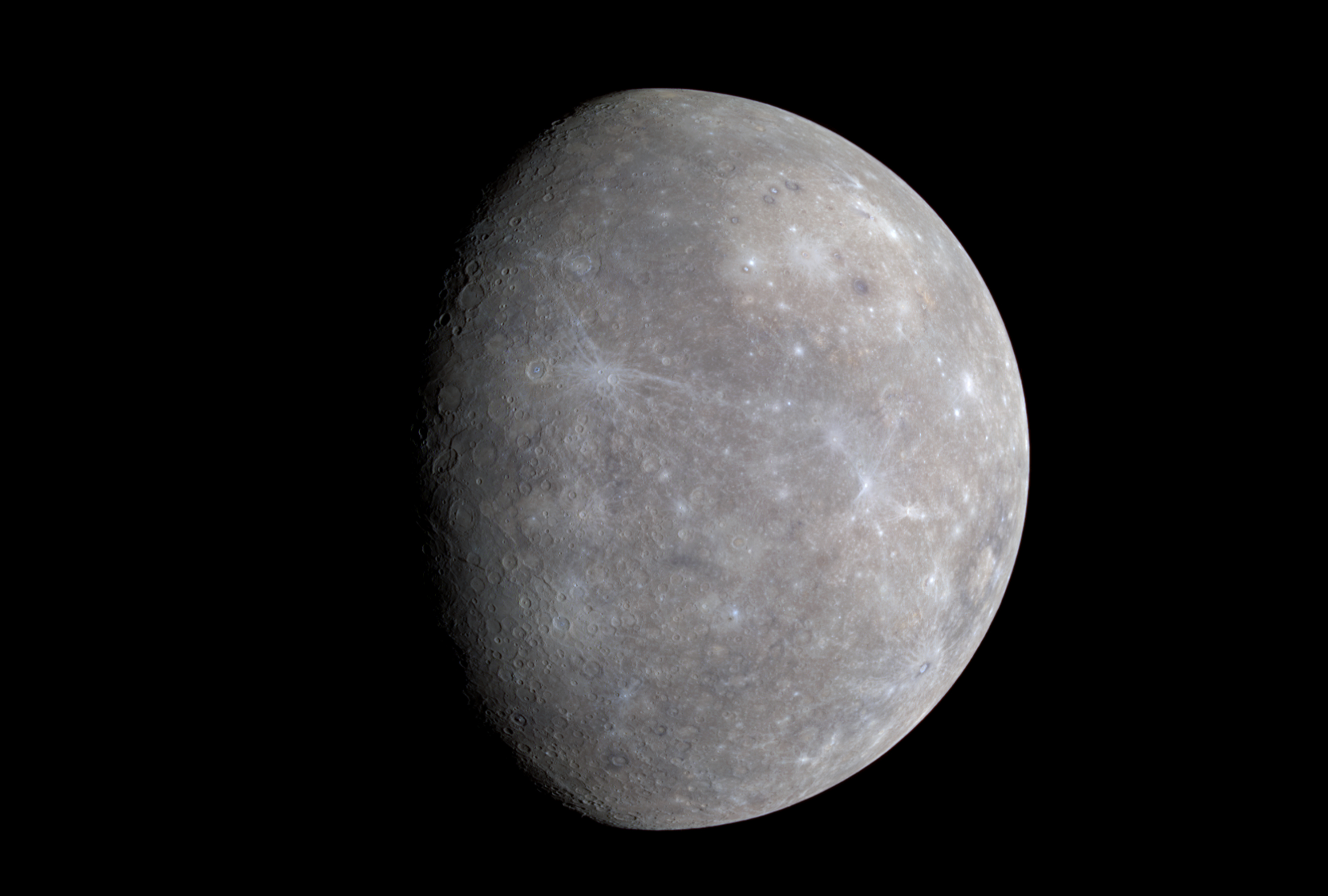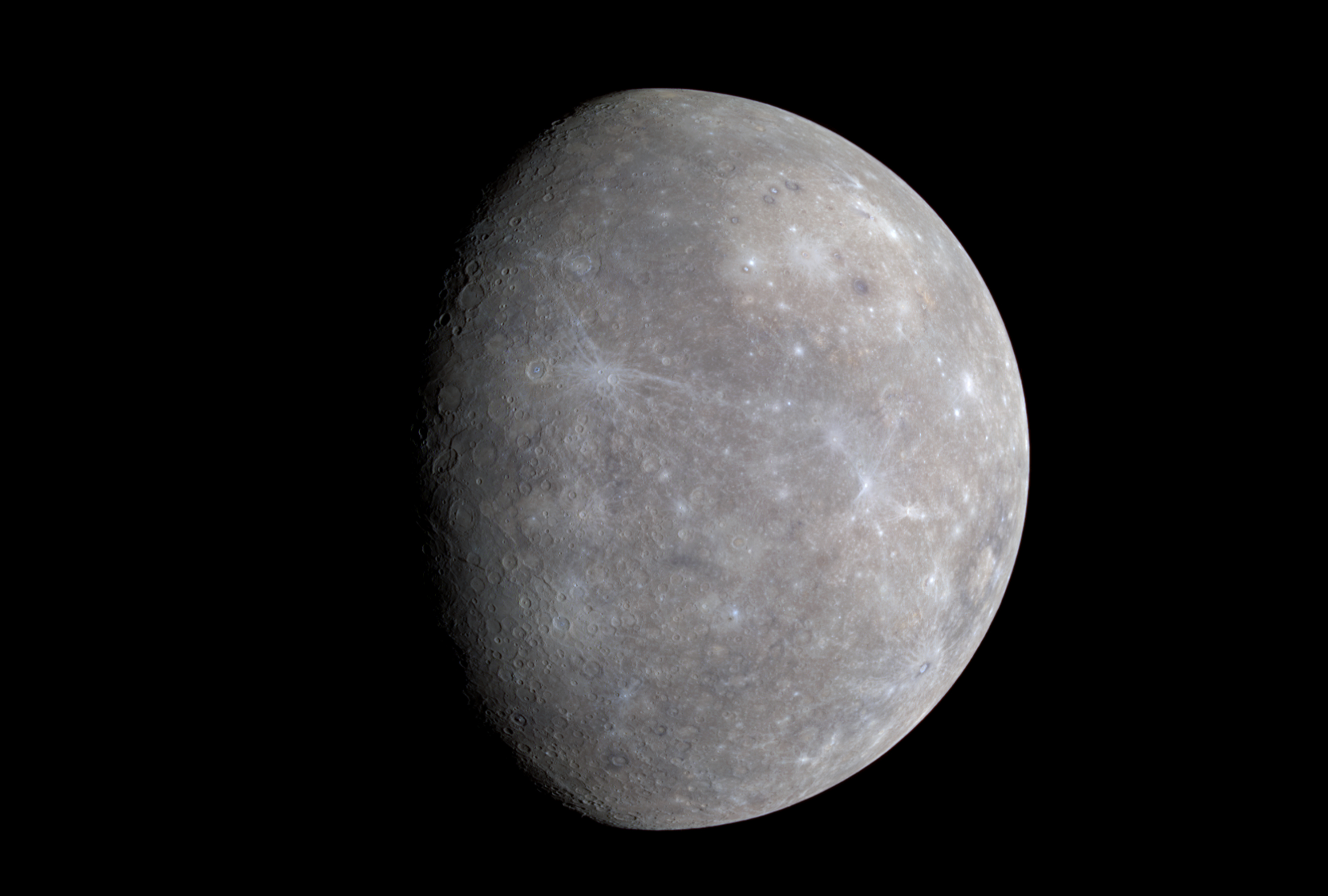
The colors of Mercury are subtle but beautiful. At first glance, our Solar System's innermost planet appears simply black and white, but images that include infrared colors normally beyond human vision accentuate a world of detail. One such image, shown above, was acquired by the robotic MESSENGER spacecraft that swung by Mercury in mid-January. Here, most generally, the hot world itself acquires a slightly more brown hue. Many craters that appear on top of other craters -- and so surely have formed more recently -- appear here as bright with bright rays that include a slightly blue tint, indicating that soil upended during the impact was light in color. A few craters, such as some in the huge Caloris Basin impact feature visible on the upper right, appear unexpectedly to be ringed with a dark material, the nature of which is being researched. MESSENGER continues to glide through the inner Solar System and will pass Mercury again this October and next September, before entering orbit around the desolate world in 2011. Arthur C. Clarke 1917-2008
Los colores de Mercurio son sutiles pero hermosos. A primera vista, el planeta más interno de nuestro Sistema Solar parece simplemente blanco y negro, pero las imágenes que incluyen colores infrarrojos normalmente fuera de la visión humana acentúan un mundo lleno de detalles. Una de esas imágenes, mostrada arriba, fue adquirida por la nave robótica MESSENGER que pasó junto a Mercurio a mediados de enero. Aquí, en general, el mundo caluroso adquiere un matiz ligeramente más marrón. Muchos cráteres que aparecen sobre otros cráteres —y que, por lo tanto, seguramente se han formado más recientemente— aparecen aquí como brillantes con rayos brillantes que incluyen un tinte ligeramente azul, lo que indica que el suelo removido durante el impacto era de color claro. Algunos cráteres, como algunos en la enorme característica de impacto de la Cuenca Caloris visible en la parte superior derecha, aparecen inesperadamente rodeados de un material oscuro, cuya naturaleza se está investigando. MESSENGER continúa deslizándose a través del Sistema Solar interno y pasará nuevamente por Mercurio este octubre y el próximo septiembre, antes de entrar en órbita alrededor del árido mundo en 2011.