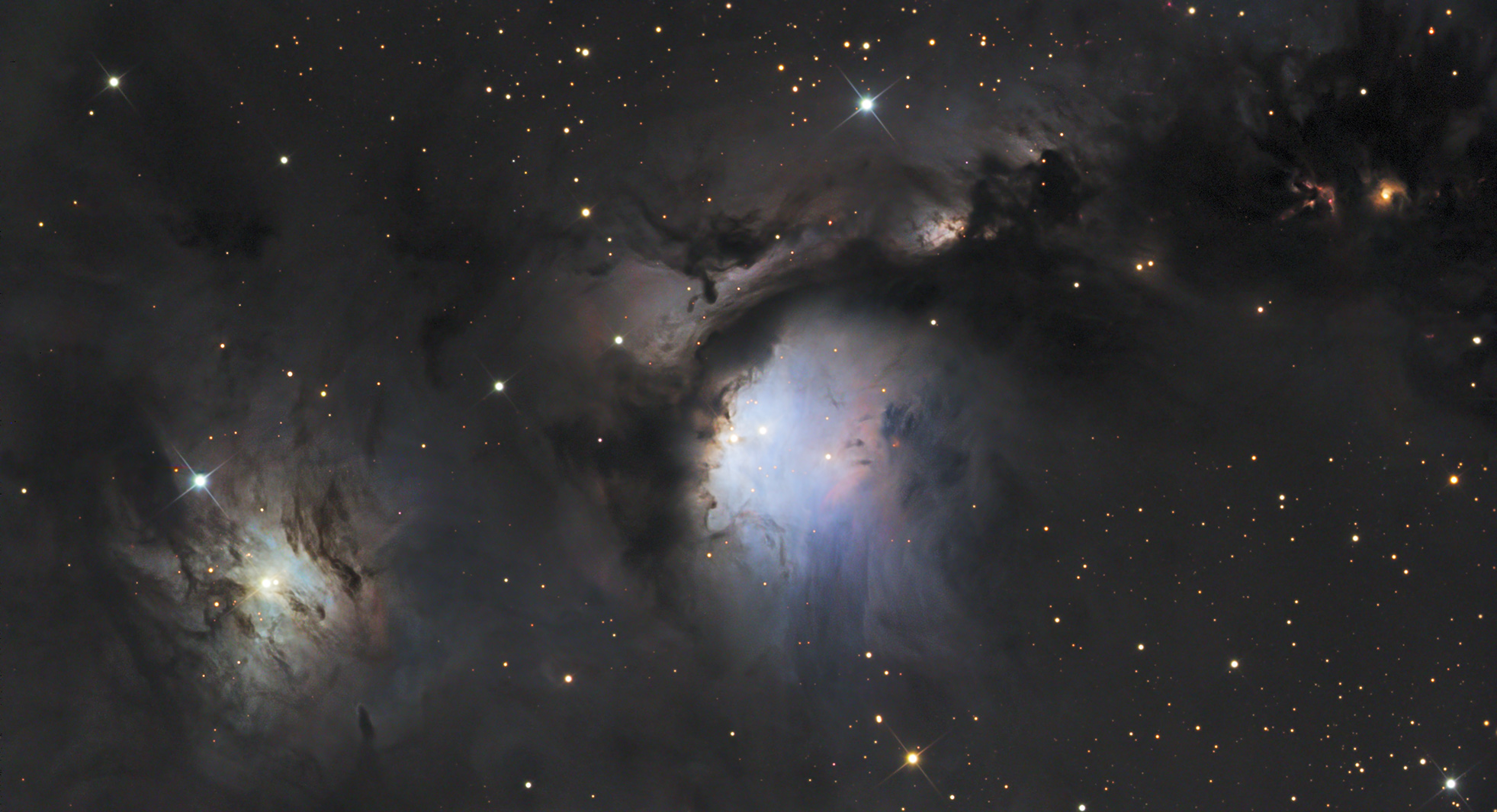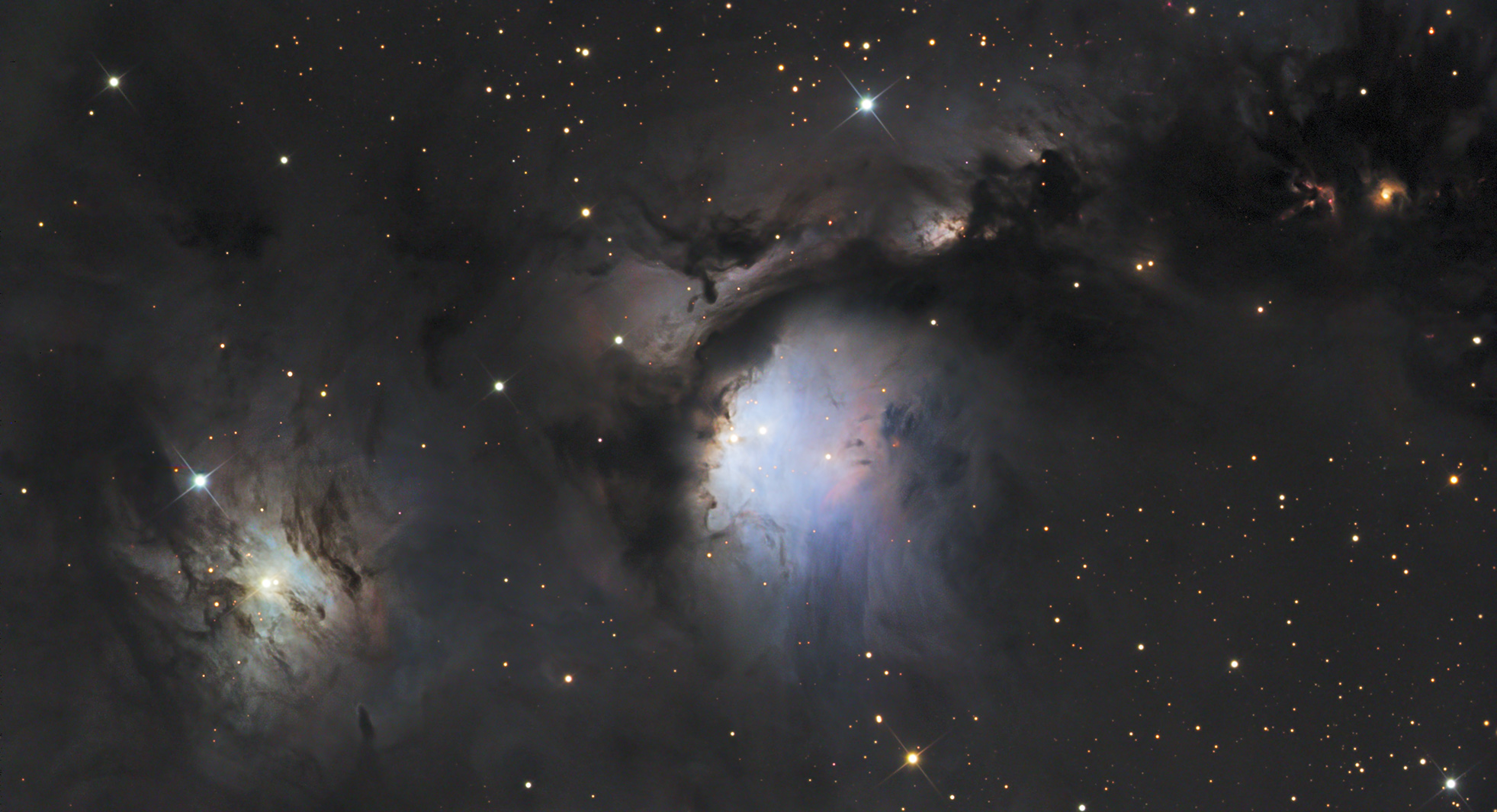
An eerie blue glow and ominous columns of dark dust highlight M78 and other bright reflection nebula in the constellation of Orion. The dark filamentary dust not only absorbs light, but also reflects the light of several bright blue stars that formed recently in the nebula. Of the two reflection nebulas pictured above, the more famous nebula is M78, on the upper right, while NGC 2071 can be seen to its lower left. The same type of scattering that colors the daytime sky further enhances the blue color. M78 is about five light-years across and visible through a small telescope. M78 appears above only as it was 1600 years ago, however, because that is how long it takes light to go from there to here. M78 belongs to the larger Orion Molecular Cloud Complex that contains the Great Nebula in Orion and the Horsehead Nebula. Arthur C. Clarke 1917-2008
Un resplandor azul inquietante y columnas siniestras de polvo oscuro destacan a M78 y otras nebulosas de reflexión brillantes en la constelación de Orión. El polvo filamentario oscuro no solo absorbe la luz, sino que también refleja la luz de varias estrellas azules brillantes que se formaron recientemente en la nebulosa. De las dos nebulosas de reflexión mostradas arriba, la más famosa es M78, en la parte superior derecha, mientras que NGC 2071 se puede ver a su izquierda inferior. El mismo tipo de dispersión que colorea el cielo diurno realza aún más el color azul. M78 tiene aproximadamente cinco años luz de diámetro y es visible a través de un telescopio pequeño. M78 aparece arriba solo como era hace 1600 años, sin embargo, porque ese es el tiempo que tarda la luz en llegar desde allí hasta aquí. M78 pertenece al complejo molecular de Orión más grande que contiene la Gran Nebulosa en Orión y la Nebulosa de la Cabeza de Caballo.