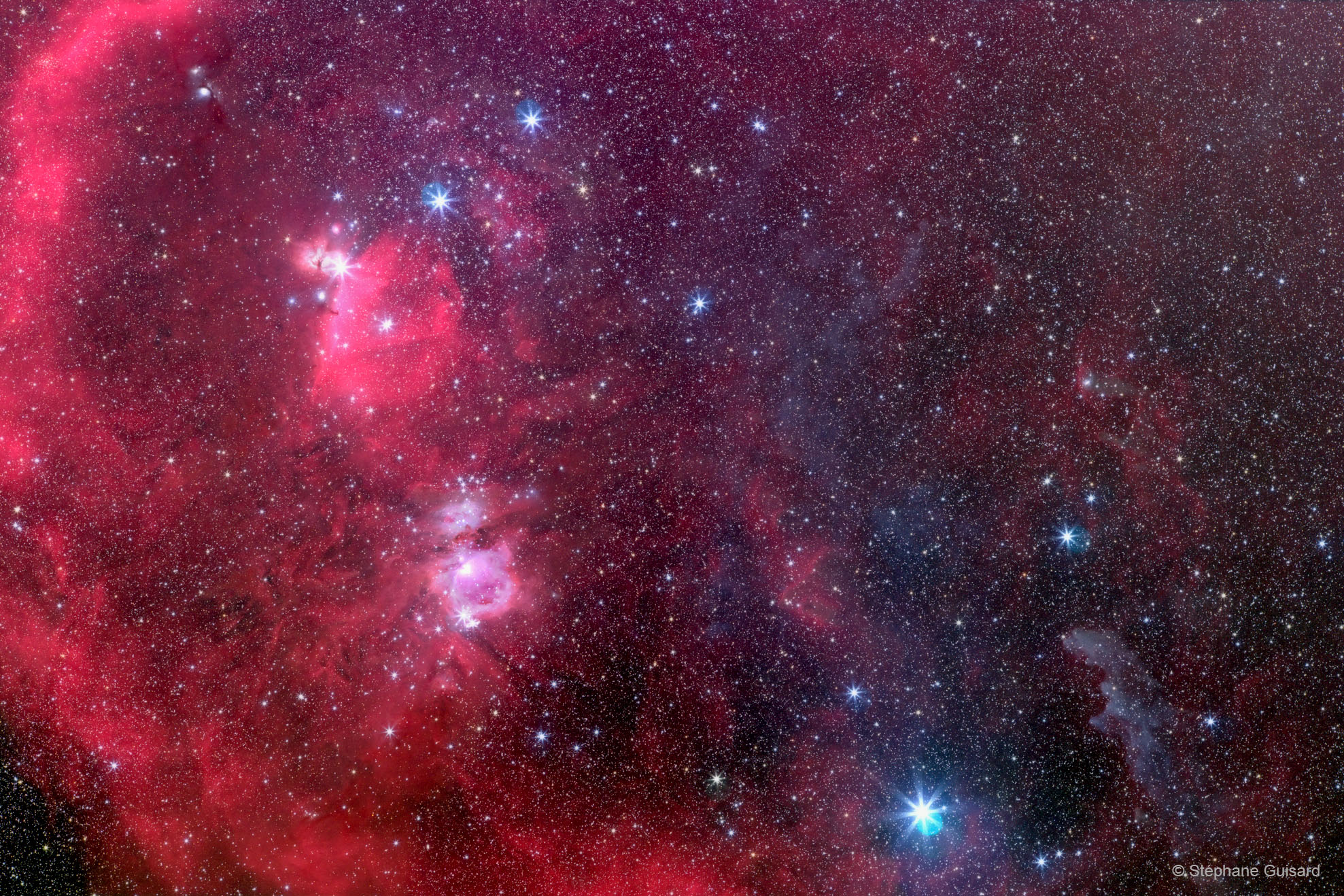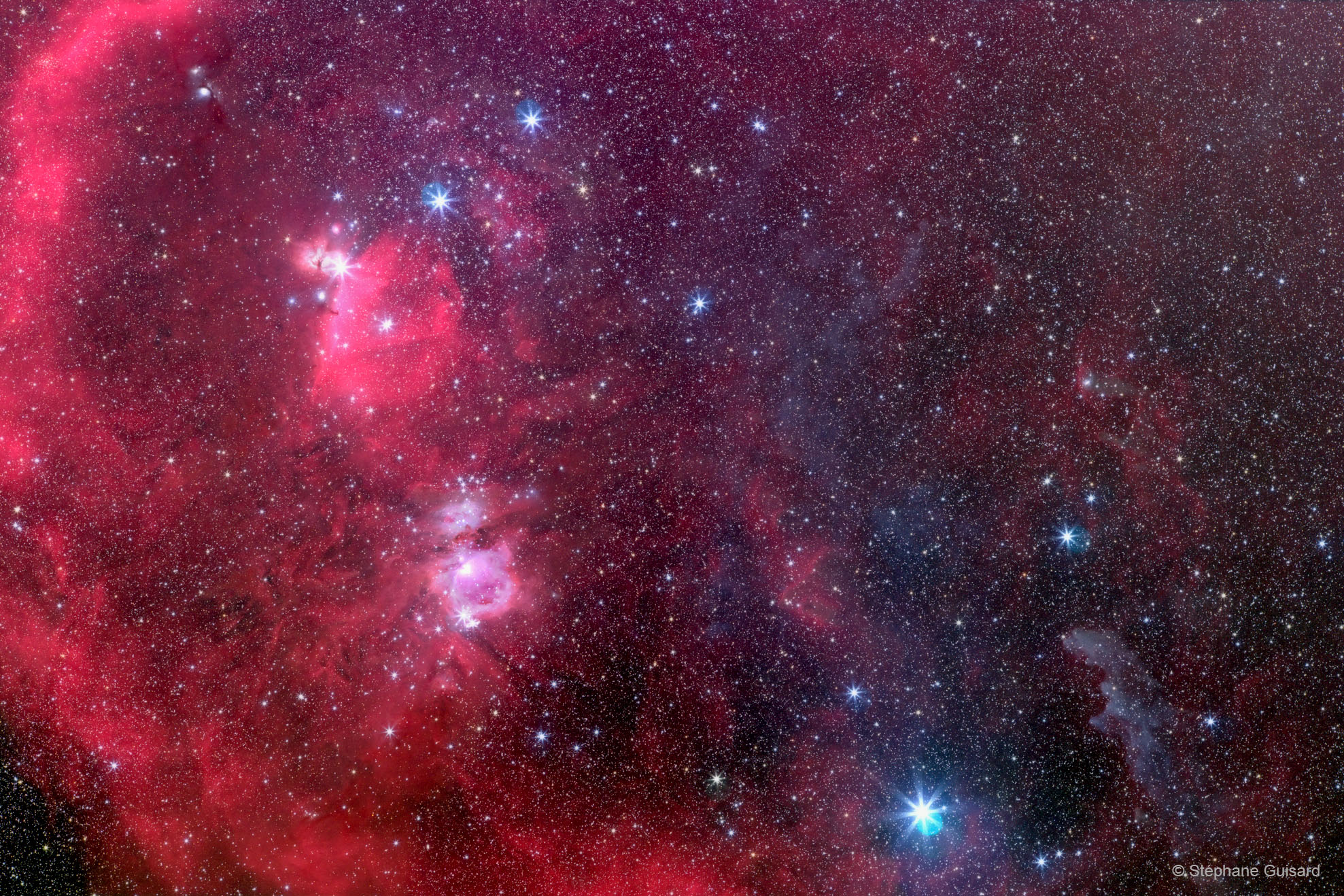
Do you recognize the belt of Orion in this image? The familiar trio of stars, visible to the unaided eye, can be found across the upper left. Otherwise, the southern part of the constellation Orion has taken on a new look in this unusually deep and wide view First note that the lower left belt star, Alnitak, is the easternmost star in Orion's belt. Left of Alnitak is the Flame Nebula, with clouds of bright emission and dramatic dark dust lanes. Directly below Alnitak, a close inspection will reveal the Horsehead Nebula. Farther right and below is the Orion Nebula, M42, itself visible to the unaided eye. The brightest star in the frame, near the bottom right, is Rigel. A bright blue star, Rigel illuminates the ominously shaped dust patch known as the Witch Head Nebula, visible as the blue reflection nebula near the lower right corner. Finally, appearing as a vast red ring and encompassing the entire region, is Barnard's Loop. Humans could see this entire menagerie, unaided, were their eyes about 10,000 times more sensitive.
¿Reconoces el cinturón de Orión en esta imagen? El familiar trío de estrellas, visible a simple vista, se encuentra en la parte superior izquierda. Por lo demás, la parte meridional de la constelación de Orión presenta un nuevo aspecto en esta vista inusualmente profunda y amplia. En primer lugar, ten en cuenta que la estrella inferior izquierda del cinturón, Alnitak, es la estrella más oriental del cinturón de Orión. A la izquierda de Alnitak se encuentra la Nebulosa de la Llama, con nubes de emisión brillante y dramáticos carriles de polvo oscuro. Directamente debajo de Alnitak, una inspección cuidadosa revelará la Nebulosa de la Cabeza de Caballo. Más a la derecha y debajo se encuentra la Nebulosa de Orión, M42, visible también a simple vista. La estrella más brillante del marco, cerca de la esquina inferior derecha, es Rigel. Rigel, una estrella azul brillante, ilumina el parche de polvo de forma ominosa conocido como la Nebulosa de la Bruja, visible como la nebulosa de reflexión azul cerca de la esquina inferior derecha. Finalmente, apareciendo como un vasto anillo rojo que abarca toda la región, está el Bucle de Barnard. Los seres humanos podrían ver todo este conjunto de objetos a simple vista, si sus ojos fueran aproximadamente 10,000 veces más sensibles.