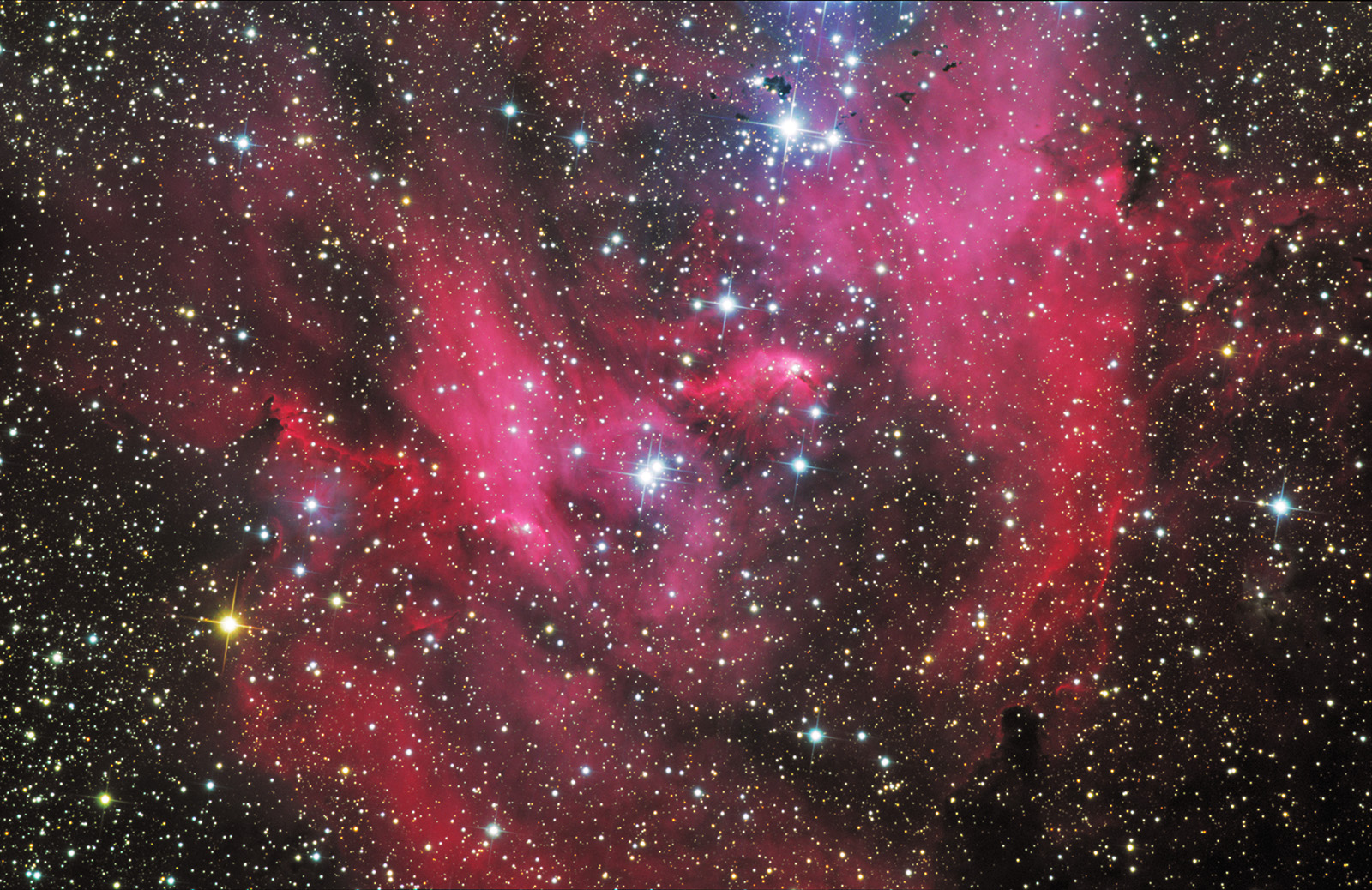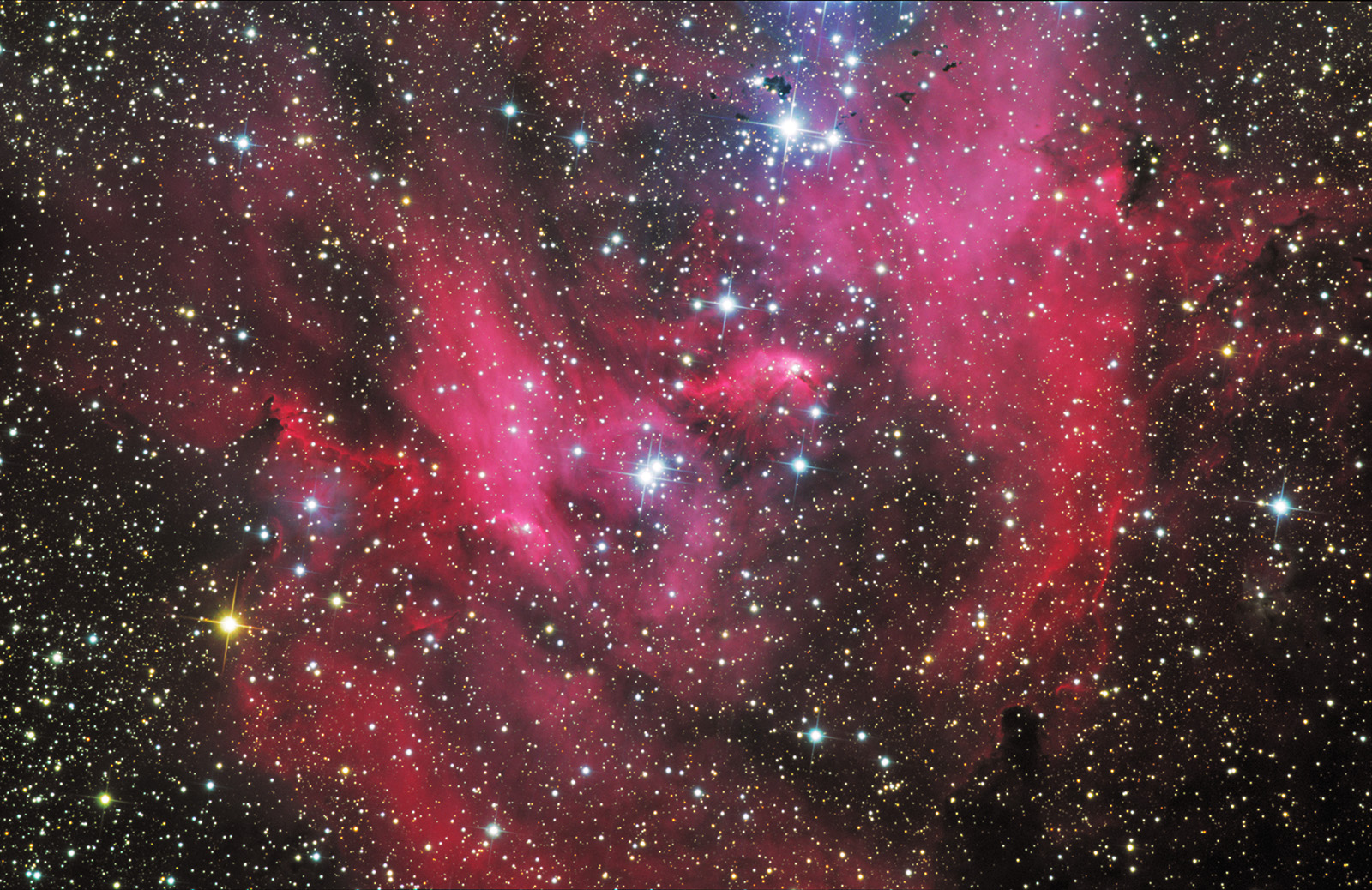
Bright nebulae abound in and around the expansive southern constellation of Centaurus. This one, cataloged as IC 2948/2944 is near the star Lambda Centauri (just off the top of the frame) and not far on the sky from the better known Eta Carinae Nebula. Embedded in the reddish glowing cloud of hydrogen gas, typical of emission nebulae found in massive star-forming regions, is the energetic young star cluster Collinder 249. Seen in silhouette near the top of the view are small, dark clouds of obscuring cosmic dust. Called Thackeray's Globules for their discoverer, they are potential sites for the formation of new stars, but are likely being eroded by the intense radiation from the nearby young stars. Of course, gazing at the center of the region suggests to some IC 2948's popular name - The Running Chicken Nebula. The gorgeous skyscape spans about 70 light-years at the nebula's estimated 6,000 light-year distance.
Las nebulosas brillantes abundan dentro y alrededor de la extensa constelación austral de Centauro. Esta, catalogada como IC 2948/2944, se encuentra cerca de la estrella Lambda Centauri (justo fuera del borde superior del marco) y no muy lejos en el cielo de la más conocida Nebulosa de Eta Carinae. Incrustado en la nube de gas hidrógeno de brillo rojizo, típica de las nebulosas de emisión que se encuentran en regiones masivas de formación estelar, está el energético cúmulo estelar joven Collinder 249. Visibles en silueta cerca de la parte superior de la vista hay pequeñas nubes oscuras de polvo cósmico que oscurece. Llamadas Glóbulos de Thackeray por su descubridor, son sitios potenciales para la formación de nuevas estrellas, pero es probable que estén siendo erosionados por la intensa radiación de las jóvenes estrellas cercanas. Por supuesto, al observar el centro de la región, algunos sugieren el nombre popular de IC 2948: La Nebulosa del Pollo en Fuga. Este magnífico paisaje celeste abarca aproximadamente 70 años luz a la distancia estimada de 6.000 años luz de la nebulosa.