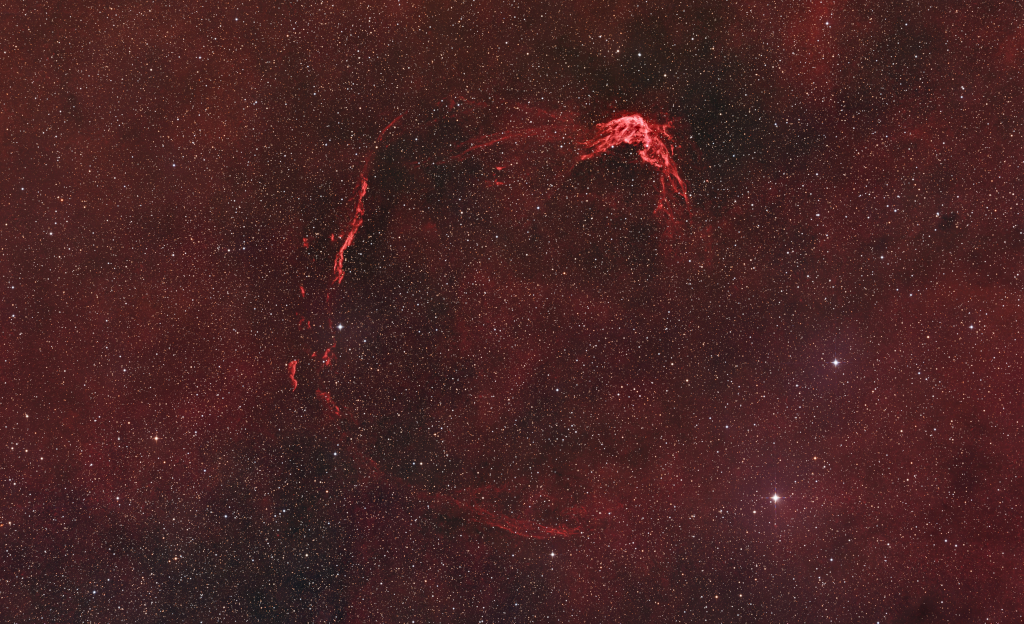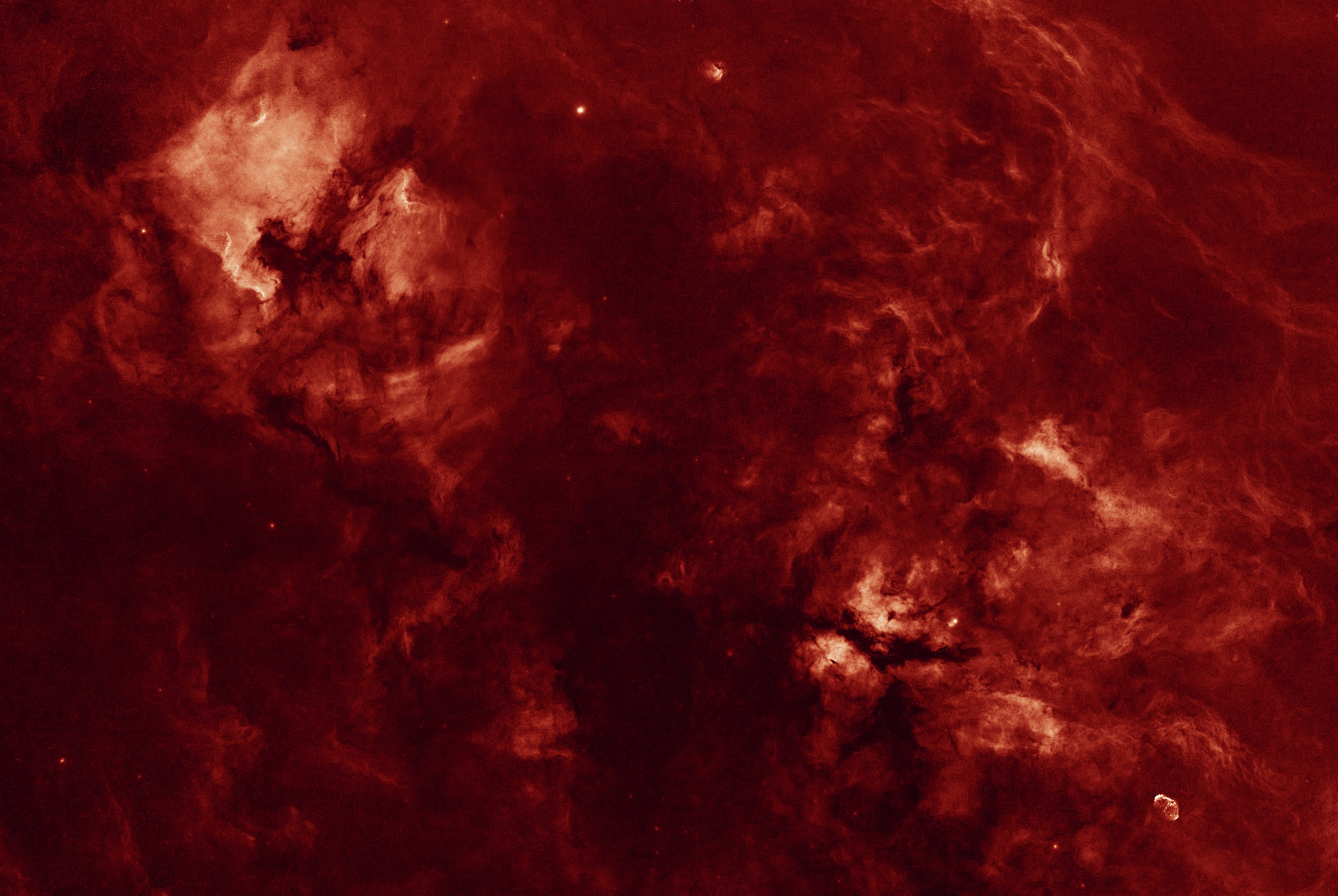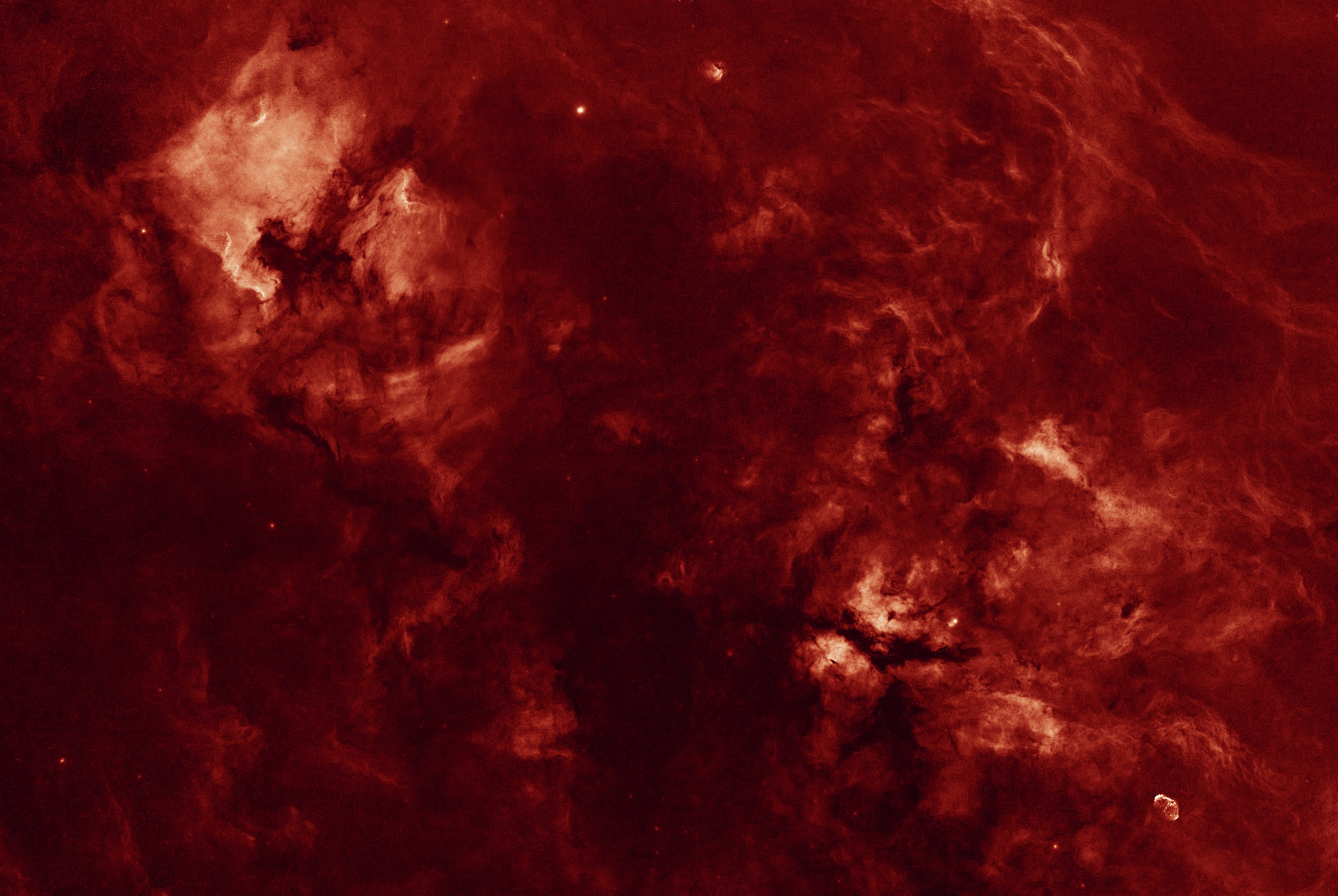
The sky is full of hydrogen, though it can take a sensitive camera and telescope to see it. For example, this twelve-degree-wide view of the northern part of the constellation Cygnus reveals cosmic clouds of hydrogen gas along the plane of our Milky Way galaxy. The mosaic of telescopic images was recorded through an h-alpha filter that transmits only visible red light from glowing hydrogen atoms. Further digital processing has removed most of what is left of the myriad, point-like Milky Way stars from the scene, though bright Deneb, alpha star of Cygnus and head of the Northern Cross, remains near top center. Recognizable bright nebulae include NGC 7000 (North America Nebula), and IC 5070 (Pelican Nebula) at the upper left with IC 1318 (Butterfly Nebula) and NGC 6888 (Crescent Nebula) at lower right -- but others can be found throughout the wide field. Want the stars back? Just slide your cursor over the picture.
El cielo está lleno de hidrógeno, aunque se requiere una cámara sensible y un telescopio para verlo. Por ejemplo, esta vista de doce grados de ancho de la parte septentrional de la constelación Cygnus revela nubes cósmicas de gas hidrógeno a lo largo del plano de nuestra galaxia Vía Láctea. El mosaico de imágenes telescópicas fue capturado a través de un filtro H-alfa que transmite únicamente la luz roja visible emitida por átomos de hidrógeno fluorescentes. El procesamiento digital posterior ha eliminado la mayoría de las innumerables estrellas puntuales de la Vía Láctea de la escena, aunque la brillante Deneb, la estrella alfa de Cygnus y cabeza de la Cruz del Norte, permanece cerca del centro superior. Las nebulosas brillantes reconocibles incluyen NGC 7000 (Nebulosa América del Norte) e IC 5070 (Nebulosa del Pelícano) en la parte superior izquierda con IC 1318 (Nebulosa Mariposa) y NGC 6888 (Nebulosa Creciente) en la parte inferior derecha, aunque se pueden encontrar otras a lo largo de este extenso campo.