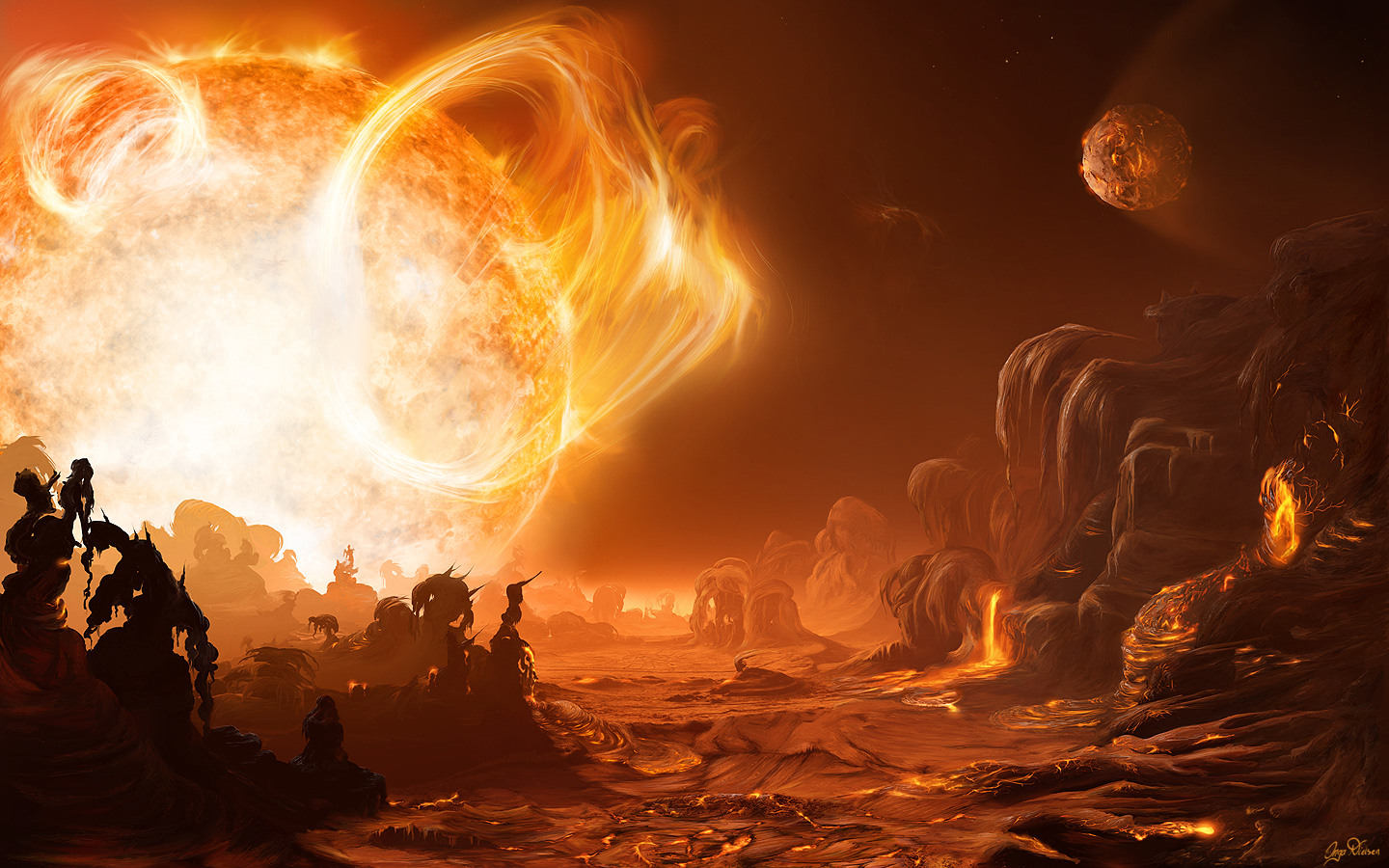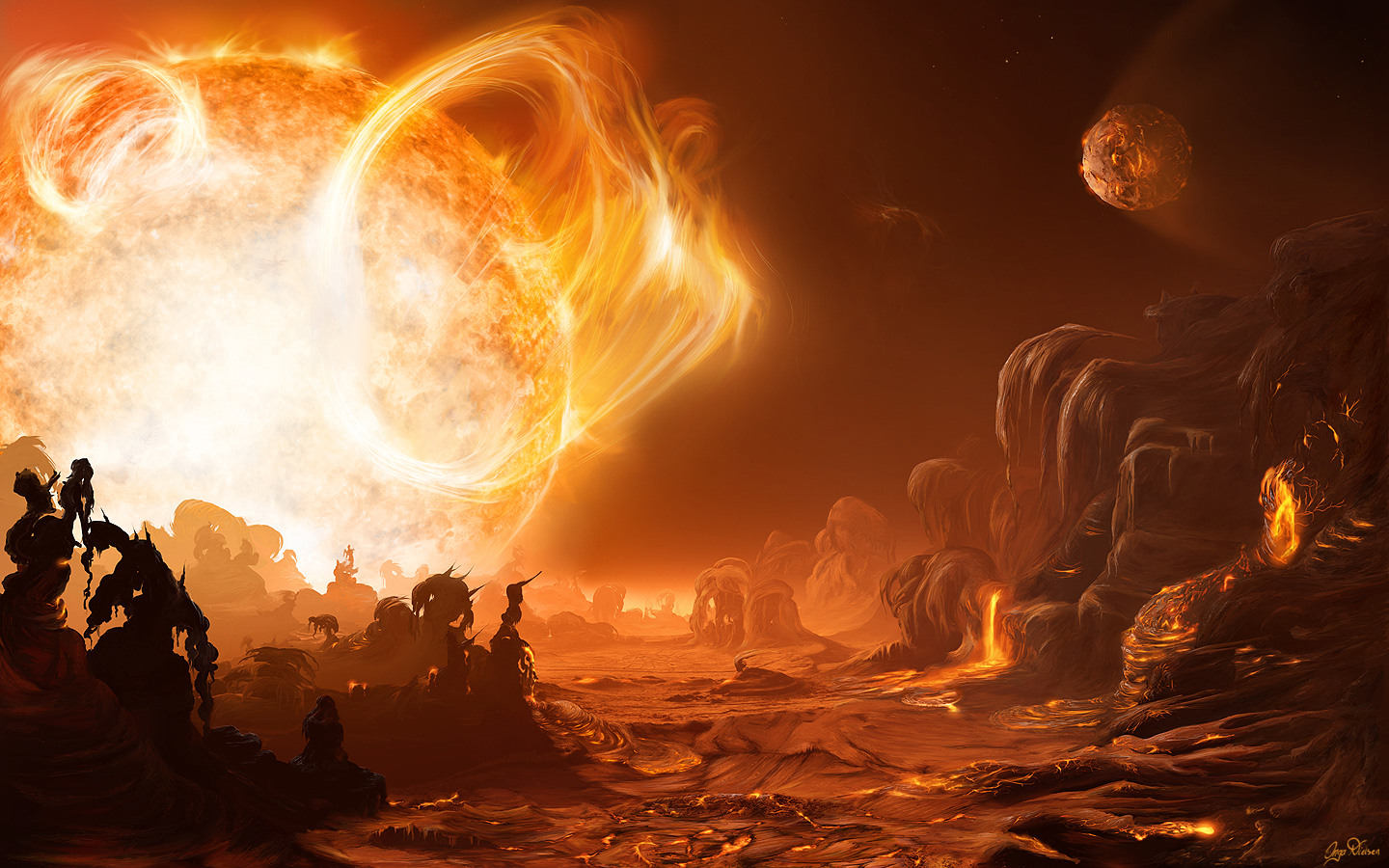
On planet Gliese 876d, sunrises might be dangerous. Although nobody really knows what conditions are like on this close-in planet orbiting variable red dwarf star Gliese 876, the above artistic illustration gives one impression. With an orbit well inside Mercury and a mass several times that of Earth, Gliese 876d might rotate so slowly that dramatic differences exist between night and day. Gliese 876d is imagined above showing significant volcanism, possibly caused by gravitational tides flexing and internally heating the planet, and possibly more volatile during the day. The rising red dwarf star shows expected stellar magnetic activity which includes dramatic and violent prominences. In the sky above, a hypothetical moon has its thin atmosphere blown away by the red dwarf's stellar wind. Gliese 876d excites the imagination partly because it is one of the few extrasolar planets known to be close to the habitable zone of its parent star.
En el planeta Gliese 876d, los amaneceres podrían ser peligrosos. Aunque nadie sabe realmente cuáles son las condiciones en este planeta cercano que orbita la enana roja variable Gliese 876, la ilustración artística anterior ofrece una perspectiva. Con una órbita bien dentro de la de Mercurio y una masa varias veces superior a la de la Tierra, Gliese 876d podría rotar tan lentamente que existieran diferencias dramáticas entre la noche y el día. Gliese 876d se imagina arriba mostrando un vulcanismo significativo, posiblemente causado por mareas gravitacionales que flexionan y calientan internamente el planeta, y posiblemente más volátil durante el día. La enana roja en ascenso muestra la actividad magnética estelar esperada, que incluye protuberancias dramáticas y violentas. En el cielo superior, una luna hipotética tiene su fina atmósfera barrida por el viento estelar de la enana roja. Gliese 876d excita la imaginación en parte porque es uno de los pocos exoplanetas conocidos que se encuentra cerca de la zona habitable de su estrella madre.