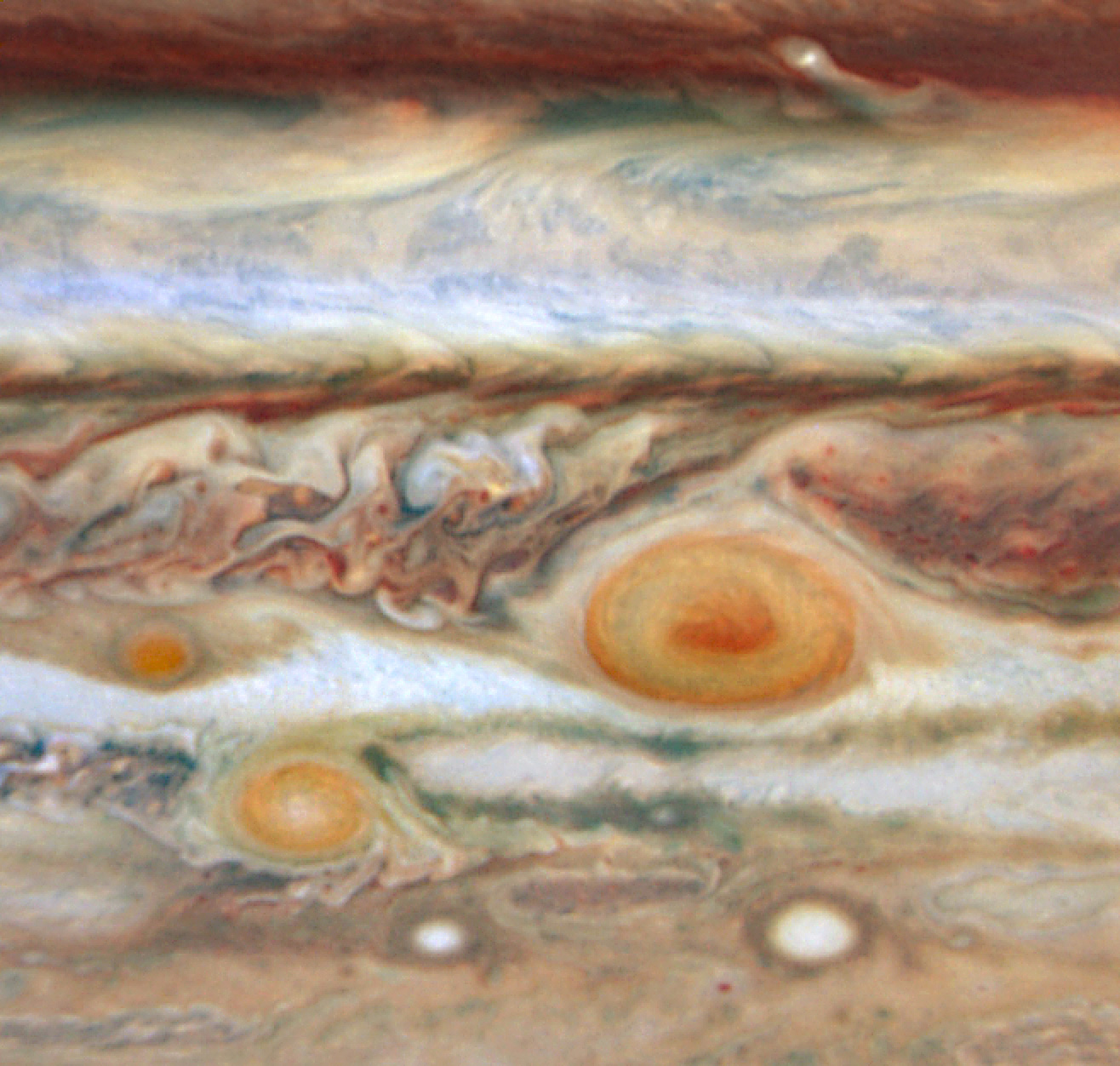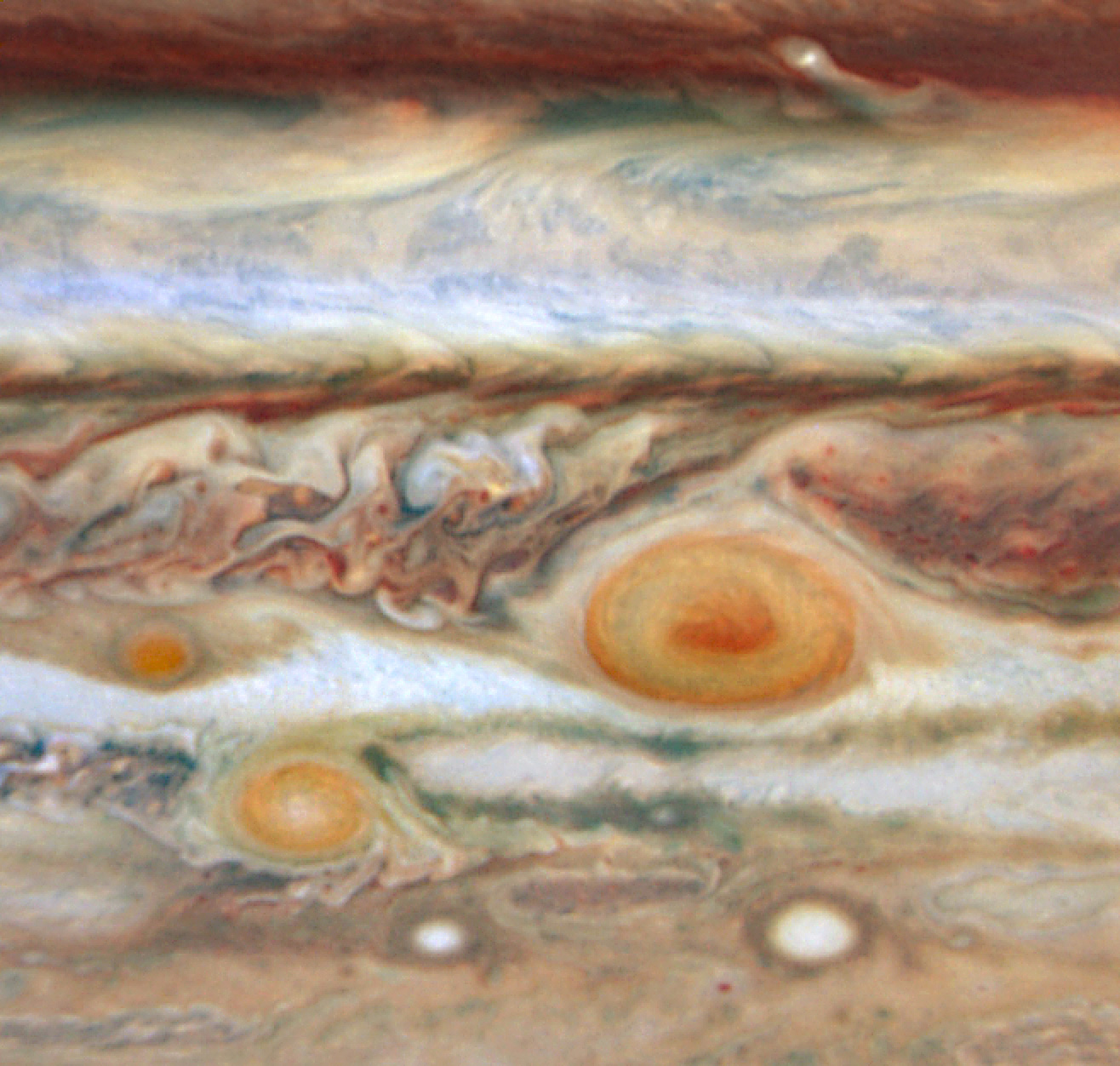
For about 300 years Jupiter's banded atmosphere has shown a remarkable feature to telescopic viewers, a large swirling storm system known as The Great Red Spot. In 2006, another red storm system appeared, actually seen to form as smaller whitish oval-shaped storms merged and then developed the curious reddish hue. Now, Jupiter has a third red spot, again produced from a smaller whitish storm. All three are seen in this image made from data recorded on May 9 and 10 with the Hubble Space Telescope's Wide Field and Planetary Camera 2. The spots extend above the surrounding clouds and their red color may be due to deeper material dredged up by the storms and exposed to ultraviolet light, but the exact chemical process is still unknown. For scale, the Great Red Spot has almost twice the diameter of planet Earth, making both new spots less than one Earth-diameter across. The newest red spot is on the far left (west), along the same band of clouds as the Great Red Spot and is drifting toward it. If the motion continues, the new spot will encounter the much larger storm system in August. Jupiter's recent outbreak of red spots is likely related to large scale climate change as the gas giant planet is getting warmer near the equator.
Durante aproximadamente 300 años, la atmósfera con bandas de Júpiter ha mostrado una característica notable para los observadores con telescopio: un gran sistema de tormentas giratorias conocido como la Gran Mancha Roja. En 2006, apareció otro sistema de tormenta roja, observándose realmente su formación a partir de tormentas ovales de menor tamaño de color blanco que se fusionaron y luego desarrollaron el curioso matiz rojizo. Ahora, Júpiter tiene un tercer punto rojo, producido nuevamente a partir de una tormenta blanca más pequeña. Los tres se observan en esta imagen elaborada a partir de datos registrados el 9 y 10 de mayo con la Cámara 2 de Campo Amplio y Planetaria del Telescopio Espacial Hubble. Los puntos se extienden por encima de las nubes circundantes y su color rojo podría deberse a material más profundo arrastrado por las tormentas y expuesto a la luz ultravioleta, pero el proceso químico exacto sigue siendo desconocido. A modo de escala, la Gran Mancha Roja tiene casi el doble del diámetro del planeta Tierra, lo que hace que ambos nuevos puntos sean menores a un diámetro terrestre. El punto rojo más reciente se encuentra en el extremo izquierdo (oeste), a lo largo de la misma banda de nubes que la Gran Mancha Roja, y se desplaza hacia ella. Si el movimiento continúa, el nuevo punto encontrará el sistema de tormenta mucho más grande en agosto. El reciente brote de puntos rojos en Júpiter probablemente esté relacionado con un cambio climático a gran escala, ya que el gigante gaseoso se está calentando cerca del ecuador.