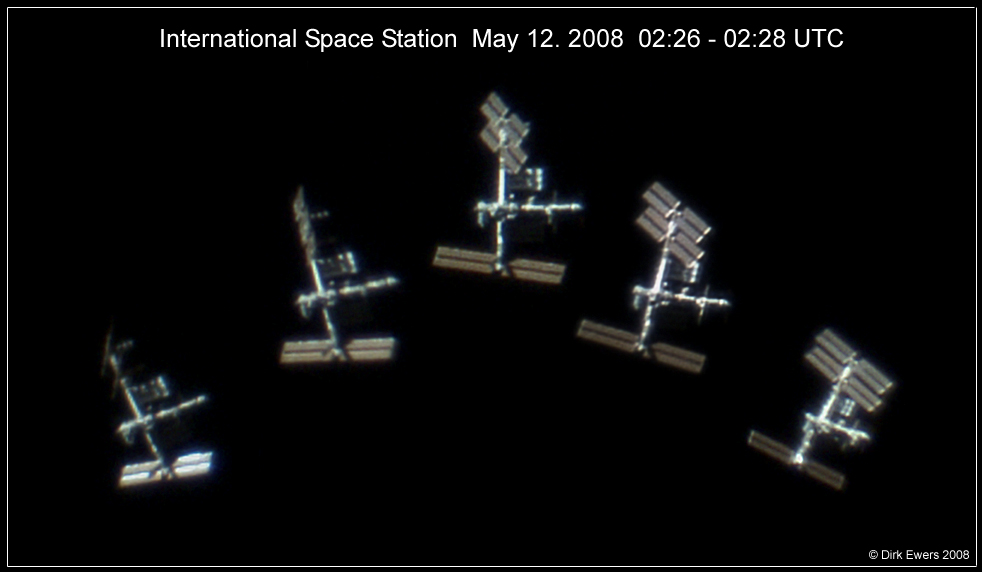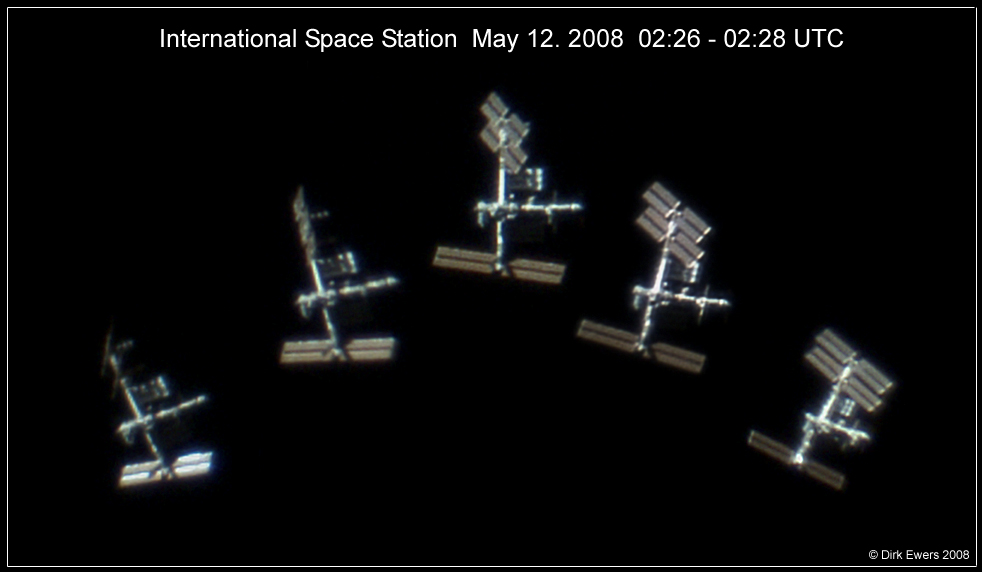
Still bathed in sunlight, the International Space Station tracked through night skies above Hombressen, Germany on May 12. From a range of at least 360 kilometers, astronomer Dirk Ewers was able to record an impressively sharp video sequence of the passage with a small telescope, using some of the individual frames to construct this composite image. Sporting solar arrays, the station's integrated truss structure is nearly 90 meters long. The ATV Jules Verne is docked with the station, while the space station itself is orbiting at aproximately 27,800 kilometers per hour (17,200 mph). A complete video sequence is available as a 1 megabyte mpeg file or avi file.
Aún bañada por la luz solar, la Estación Espacial Internacional fue rastreada a través de los cielos nocturnos sobre Hombressen, Alemania el 12 de mayo. Desde una distancia de al menos 360 kilómetros, el astrónomo Dirk Ewers logró registrar una secuencia de vídeo notablemente nítida del paso con un pequeño telescopio, utilizando algunos de los fotogramas individuales para construir esta imagen compuesta. Equipada con paneles solares, la estructura de armadura integrada de la estación tiene casi 90 metros de largo. El ATV Jules Verne está acoplado a la estación, mientras que la estación espacial orbita a aproximadamente 27.800 kilómetros por hora (17.200 mph). Una secuencia de vídeo completa está disponible como archivo mpeg o avi de 1 megabyte.