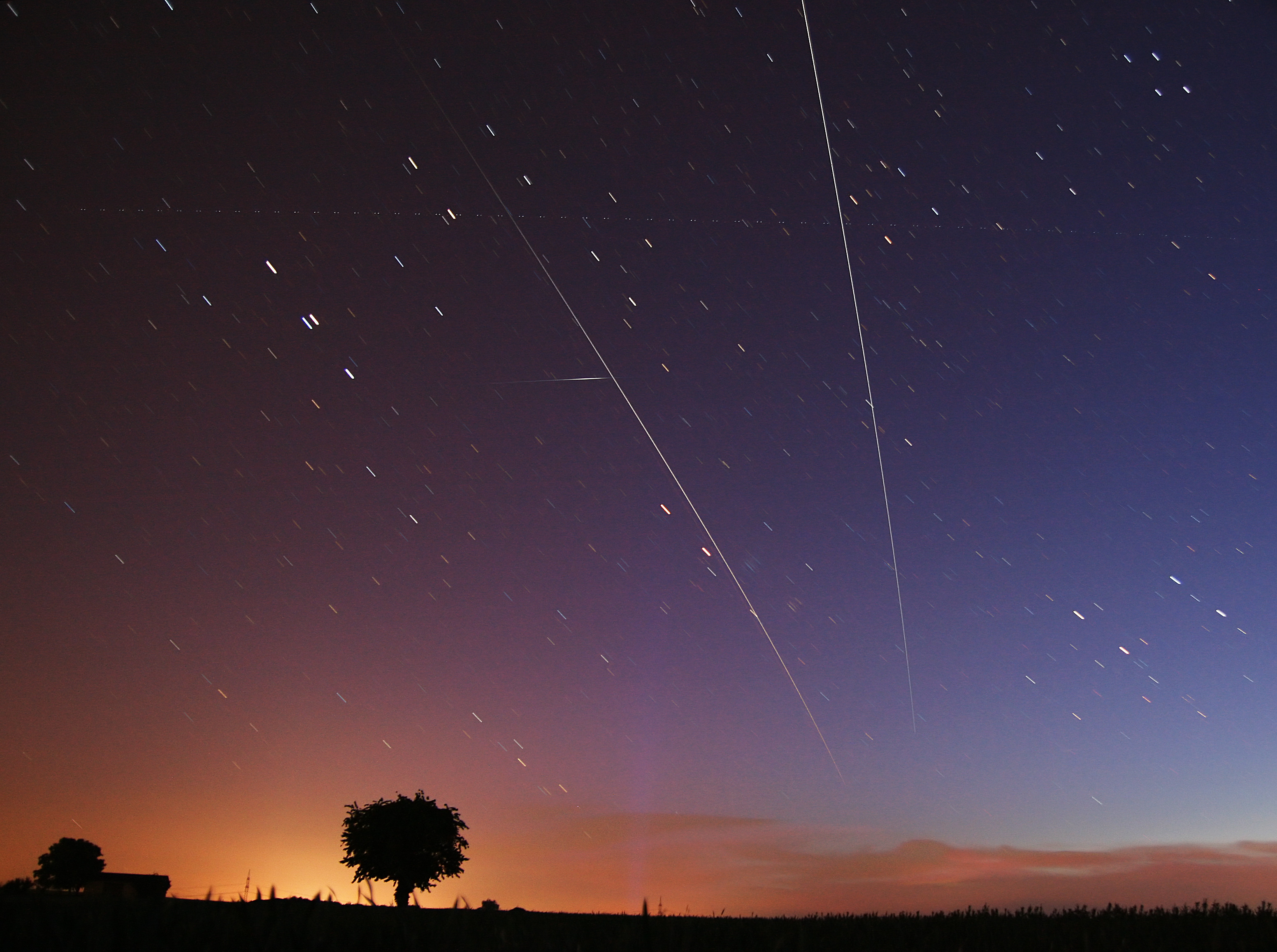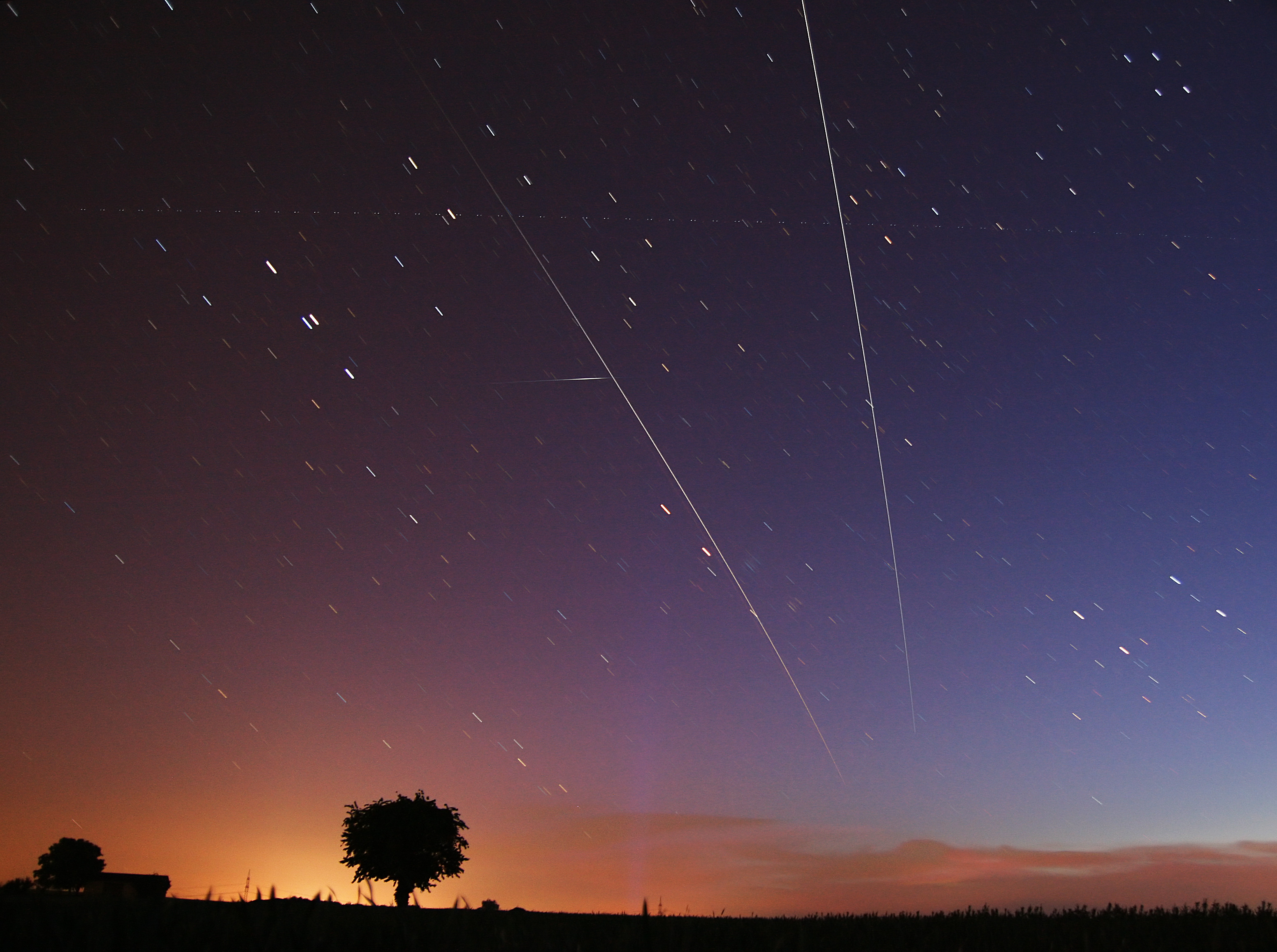
Bathed in sunlight, the International Space Station (ISS) arced through the evening sky above the town of Lauffen in southern Germany on May 31st. The timing of the bright passage was about 10 minutes after the launch of the Space Shuttle Discovery on the STS-124 mission from Kennedy Space Center, Florida, in the southeastern US. Of course, Discovery was headed toward an orbital rendezvous with the ISS. In chasing after the space station, the shuttle also made a pass over Lauffen just 21 minutes after launch. With a camera fixed to a tripod, astronomer Jürgen Michelberger recorded both magnificent machines streaking overhead in two different time exposures, each about 2 minutes long, and merged them in this composite view. Parallax causes the paths of the ISS (right) and Discovery (near center) to seem to diverge as they were at very different altitudes. Stars (and bright planets) leave two, separated, short trails. The brief, flaring track of an Iridium satellite and faint dotted trail of a passing airplane are also visible. A close inspection will reveal a dim reddish track, the jettisoned external fuel tank, just left of Discovery. Placing your cursor over the picture should help identify some of the features.
Bañada por la luz solar, la Estación Espacial Internacional (EEI) trazó un arco a través del cielo vespertino sobre la localidad de Lauffen en el sur de Alemania el 31 de mayo. El paso brillante ocurrió aproximadamente 10 minutos después del lanzamiento del transbordador espacial Discovery en la misión STS-124 desde el Centro Espacial Kennedy en Florida, en el sureste de Estados Unidos. Por supuesto, Discovery se dirigía hacia un encuentro orbital con la EEI. Al perseguir la estación espacial, el transbordador también pasó sobre Lauffen apenas 21 minutos después del lanzamiento. Con una cámara fija en un trípode, el astrónomo Jürgen Michelberger registró ambas máquinas magnificentes surcando el cielo en dos exposiciones de tiempo diferentes, cada una de aproximadamente 2 minutos de duración, y las fusionó en esta vista compuesta. El paralaje causa que las trayectorias de la EEI (derecha) y Discovery (cerca del centro) parezcan divergir ya que se encontraban a altitudes muy diferentes. Las estrellas (y planetas brillantes) dejan dos sendas cortas separadas. También es visible el breve rastro destellante de un satélite Iridium y el tenue rastro punteado de un avión en paso. Una inspección cuidadosa revelará un tenue rastro rojizo, el tanque de combustible externo eyectado, justo a la izquierda de Discovery. Colocar el cursor sobre la imagen debería ayudar a identificar algunas de las características.