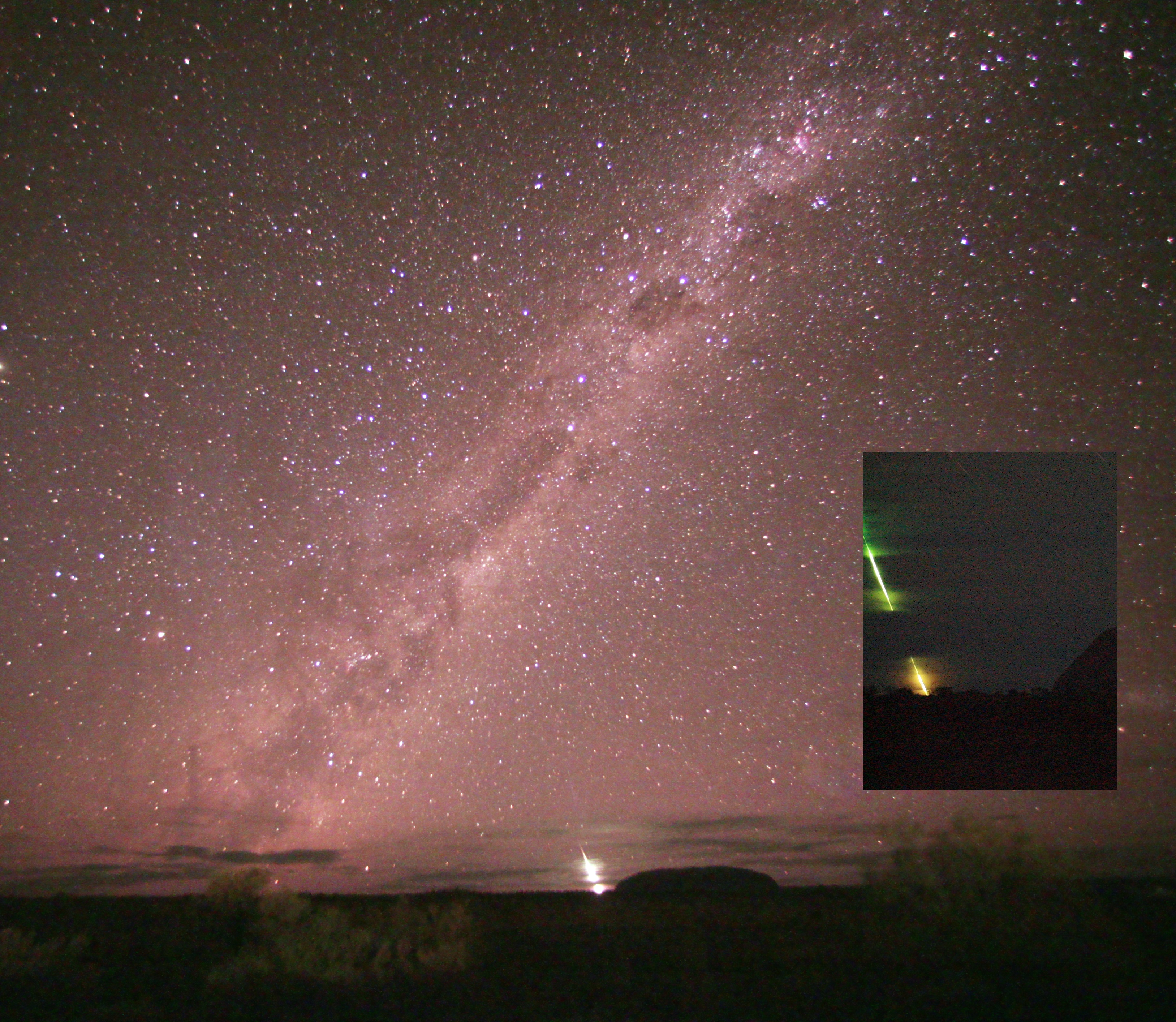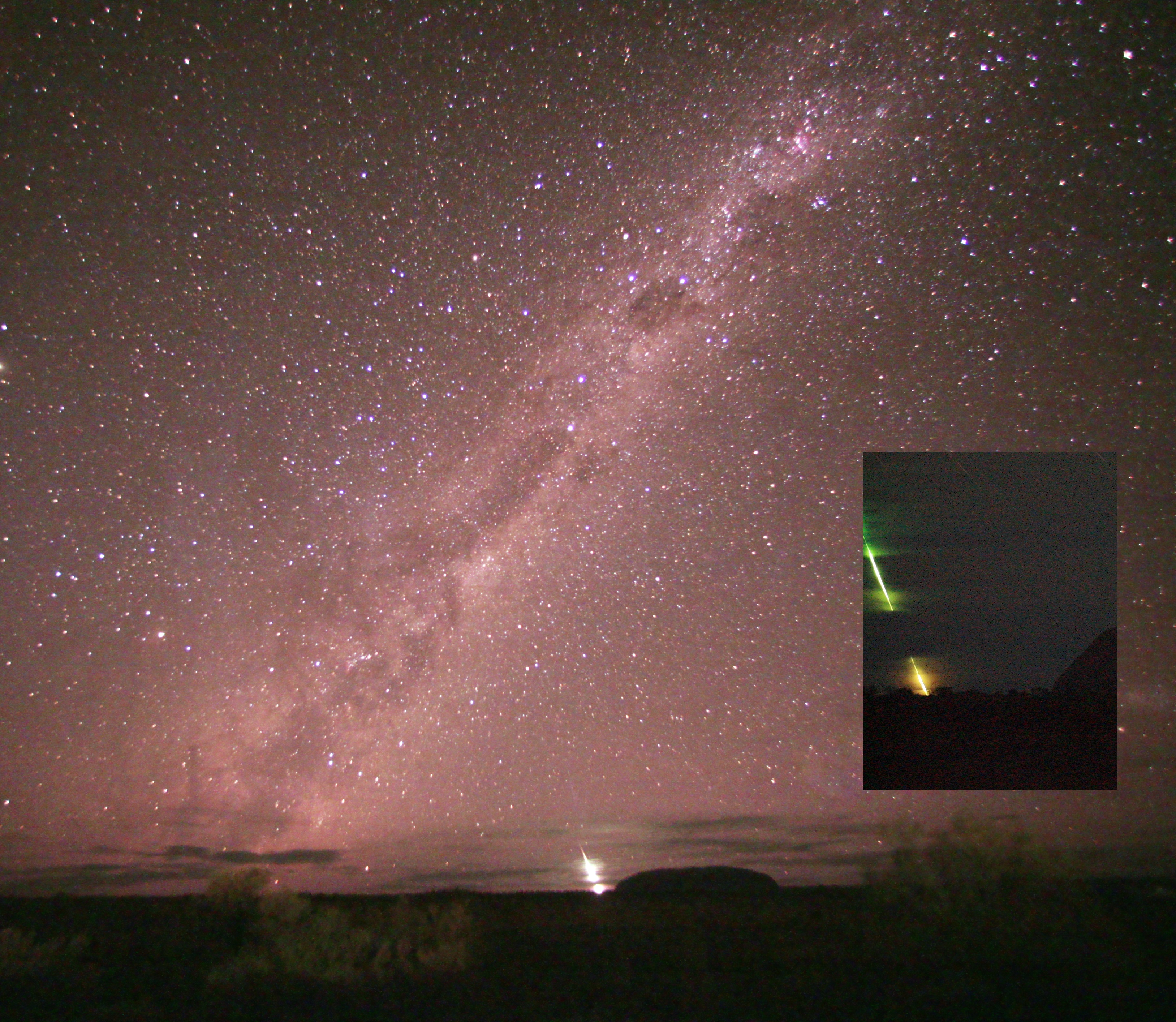
A weekend trip for astrophotography in central Australia can result in gorgeous skyscapes. In this example recorded in March of 2006, the center of our Milky Way Galaxy rises over planet Earth's horizon and the large sandstone formation called Uluru, also known as Ayers Rock. After setting up two cameras to automatically image this celestial scene in a series of exposures, one through a wide-angle and the other through a telephoto lens, photographer Joseph Brimacombe briefly turned his back to set up other equipment. To his surprise, the ground around him suddenly lit up with the brilliant flash of a fireball meteor. To his delight, both cameras captured the bright meteor streak. Highlighted in the telephoto view (inset), the fireball trail shines through cloud banks, just left of Ayers Rock.
Un viaje de fin de semana dedicado a la astrofotografía en el centro de Australia puede resultar en espectaculares vistas celestes. En este ejemplo registrado en marzo de 2006, el centro de nuestra galaxia de la Vía Láctea se eleva sobre el horizonte de la Tierra y la gran formación de arenisca conocida como Uluru, también llamada Ayers Rock. Después de configurar dos cámaras para capturar automáticamente esta escena celestial en una serie de exposiciones, una con un objetivo de gran angular y la otra con un teleobjetivo, el fotógrafo Joseph Brimacombe brevemente giró su espalda para preparar otro equipo. Para su sorpresa, el terreno a su alrededor se iluminó repentinamente con el brillo brillante de un meteoro bola de fuego. Para su satisfacción, ambas cámaras capturaron el brillante rastro del meteoro. Destacado en la vista de teleobjetivo (recuadro), el rastro de la bola de fuego brilla a través de capas de nubes, justo a la izquierda de Ayers Rock.