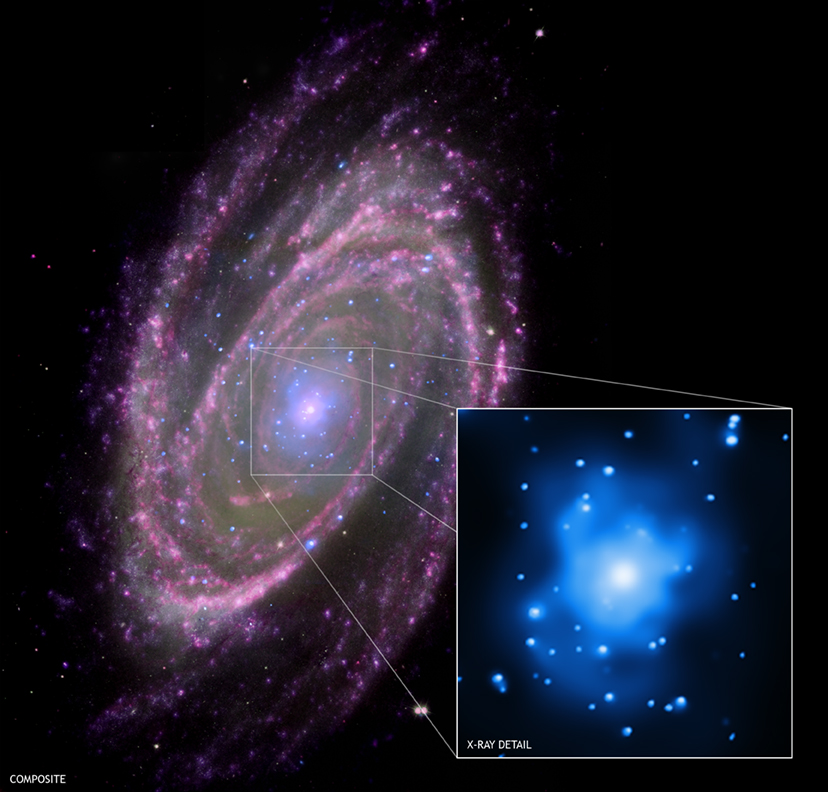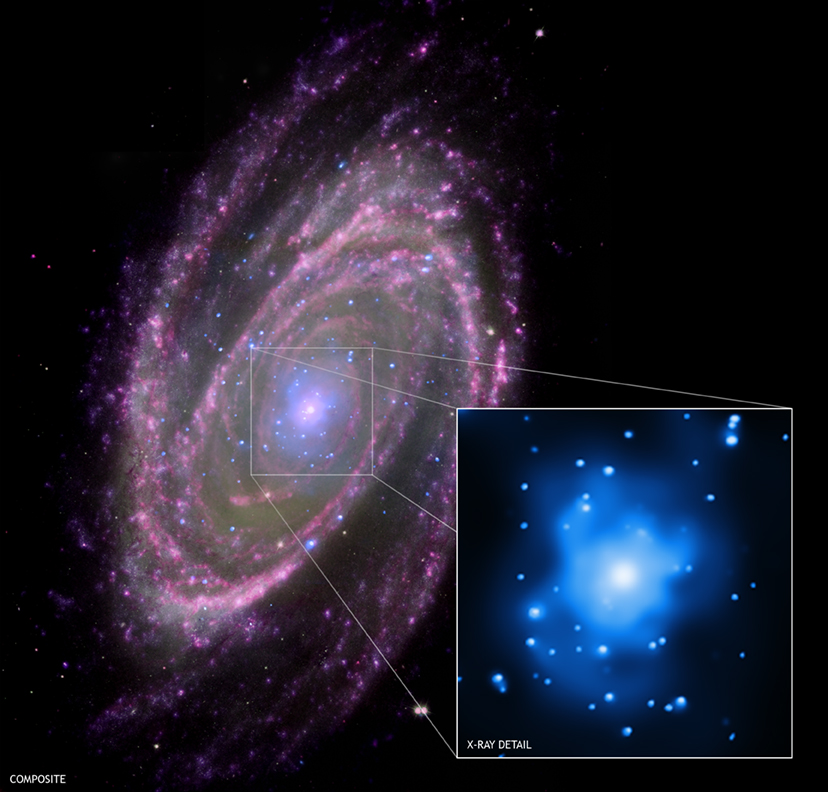
This impressive color composite shows spiral galaxy M81 across the electromagnetic spectrum. It combines X-ray data (blue) from the Chandra Observatory, infrared data (pink) from the Spitzer Space Telescope, and an ultraviolet image (purple) from the GALEX satellite, with a visible light (green) Hubble image. The inset highlights X-rays from some of M81's black holes, including black holes in binary star systems with about 10 times the mass of the sun, as well as the central, supermassive black hole of over 70 million solar masses. Comparing computer models of the giant black hole's energy output to the multiwavelength data suggests that feeding that monster is relatively simple -- energy and radiation is generated as material in the central region swirls inwards forming an accretion disk. In fact, the process otherwise appears to be just like the accretion process feeding M81's stellar mass black holes, even though the central black hole is millions of times more massive. M81 itself is about 70,000 light-years across and only 12 million light-years away in the northern constellation Ursa Major.
Esta impresionante composición en color muestra la galaxia espiral M81 en todo el espectro electromagnético. Combina datos de rayos X (azul) del Observatorio Chandra, datos infrarrojos (rosa) del Telescopio Espacial Spitzer, una imagen ultravioleta (púrpura) del satélite GALEX, con una imagen de luz visible (verde) del Hubble. El recuadro destaca rayos X de algunos de los agujeros negros de M81, incluyendo agujeros negros en sistemas binarios de estrellas con aproximadamente 10 veces la masa del Sol, así como el agujero negro supermasivo central de más de 70 millones de masas solares. Comparar modelos computacionales de la salida energética del agujero negro gigante con los datos multilongitud de onda sugiere que alimentar ese monstruo es relativamente simple: la energía y la radiación se generan cuando el material en la región central se arremolina hacia adentro, formando un disco de acreción. De hecho, el proceso parece ser idéntico al proceso de acreción que alimenta los agujeros negros de masa estelar de M81, aunque el agujero negro central es millones de veces más masivo. M81 mide aproximadamente 70.000 años luz de diámetro y se encuentra a solo 12 millones de años luz de distancia en la constelación boreal de la Osa Mayor.