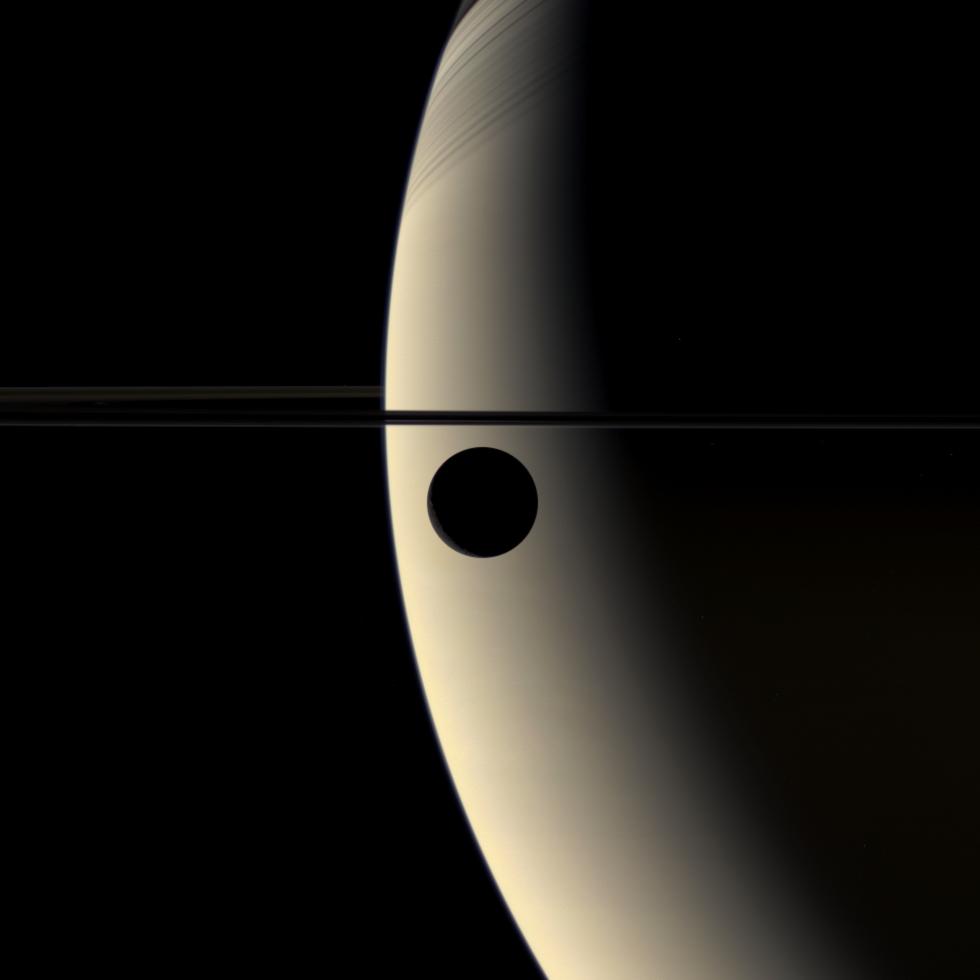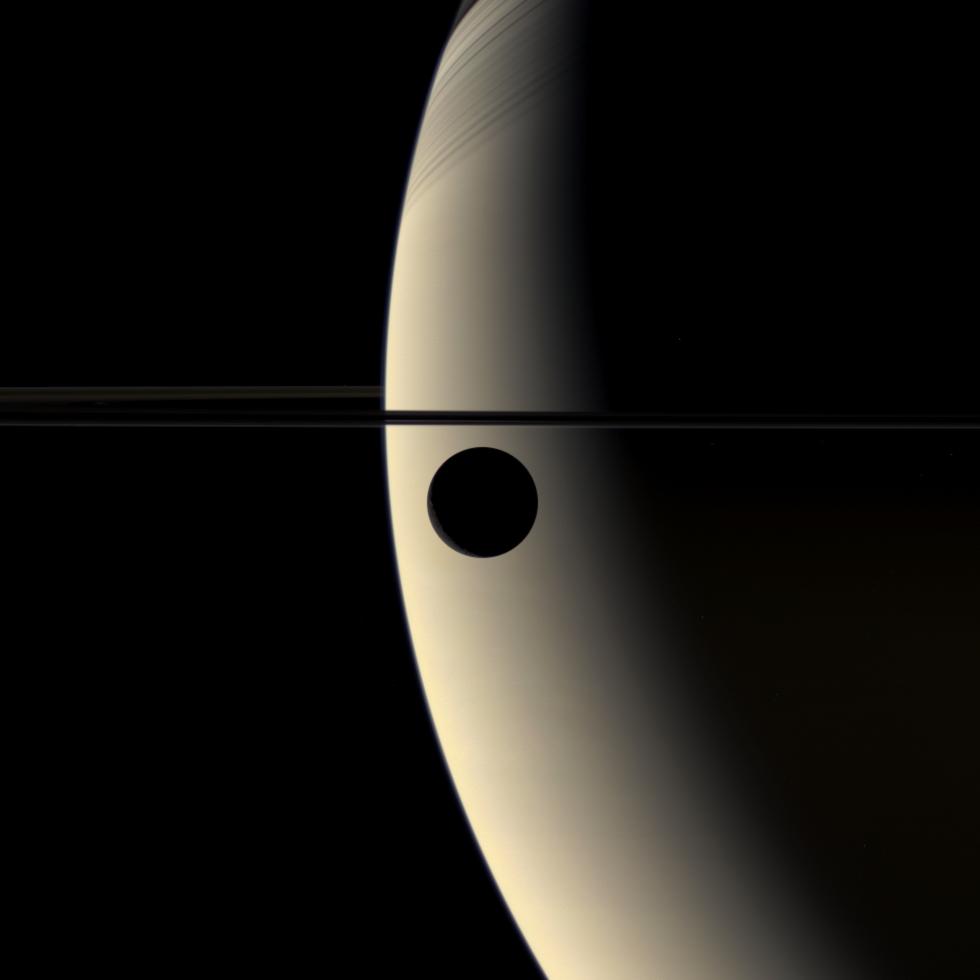
Soft hues, partially lit orbs, a thin trace of the ring, and slight shadows highlight this understated view of the majestic surroundings of the giant planet Saturn. Looking nearly back toward the Sun, the robot Cassini spacecraft now orbiting Saturn captured crescent phases of Saturn and its moon Rhea in color a few years ago. As striking as the above image is, it is but a single frame from a recently released 60-frame silent movie where Rhea can be seen gliding in front of its parent world. Since Cassini was nearly in the plane of Saturn's rings, the normally impressive rings are visible here only as a thin line across the image center. Although Cassini has now concluded its primary mission, its past successes and opportunistic location have prompted NASA to start a two-year Equinox Mission, further exploring not only Saturn's enigmatic moons Titan and Enceladus, but Saturn herself as her grand rings tilt right at the Sun in August 2009.
Tonos suaves, orbes parcialmente iluminados, un fino trazo del anillo y ligeras sombras resaltan esta sutil vista de los majestuosos alrededores del planeta gigante Saturno. Mirando casi directamente hacia el Sol, la sonda robótica Cassini, que orbita Saturno, capturó las fases de cuarto creciente de Saturno y su luna Rea en color hace algunos años. Por sorprendente que sea la imagen anterior, es solo un fotograma de una película silenciosa de 60 fotogramas recientemente publicada, en la que se puede ver a Rea deslizándose frente a su planeta madre. Dado que Cassini estaba casi en el plano de los anillos de Saturno, los anillos normalmente impresionantes son visibles aquí solo como una línea fina en el centro de la imagen. Aunque Cassini ha concluido su misión primaria, sus éxitos pasados y su ubicación estratégica llevaron a la NASA a iniciar una Misión de Equinoccio de dos años, explorando más a fondo no solo las enigmáticas lunas de Saturno, Titán y Encélado, sino también a Saturno mismo mientras sus majestuosos anillos se inclinan directamente hacia el Sol en agosto de 2009.