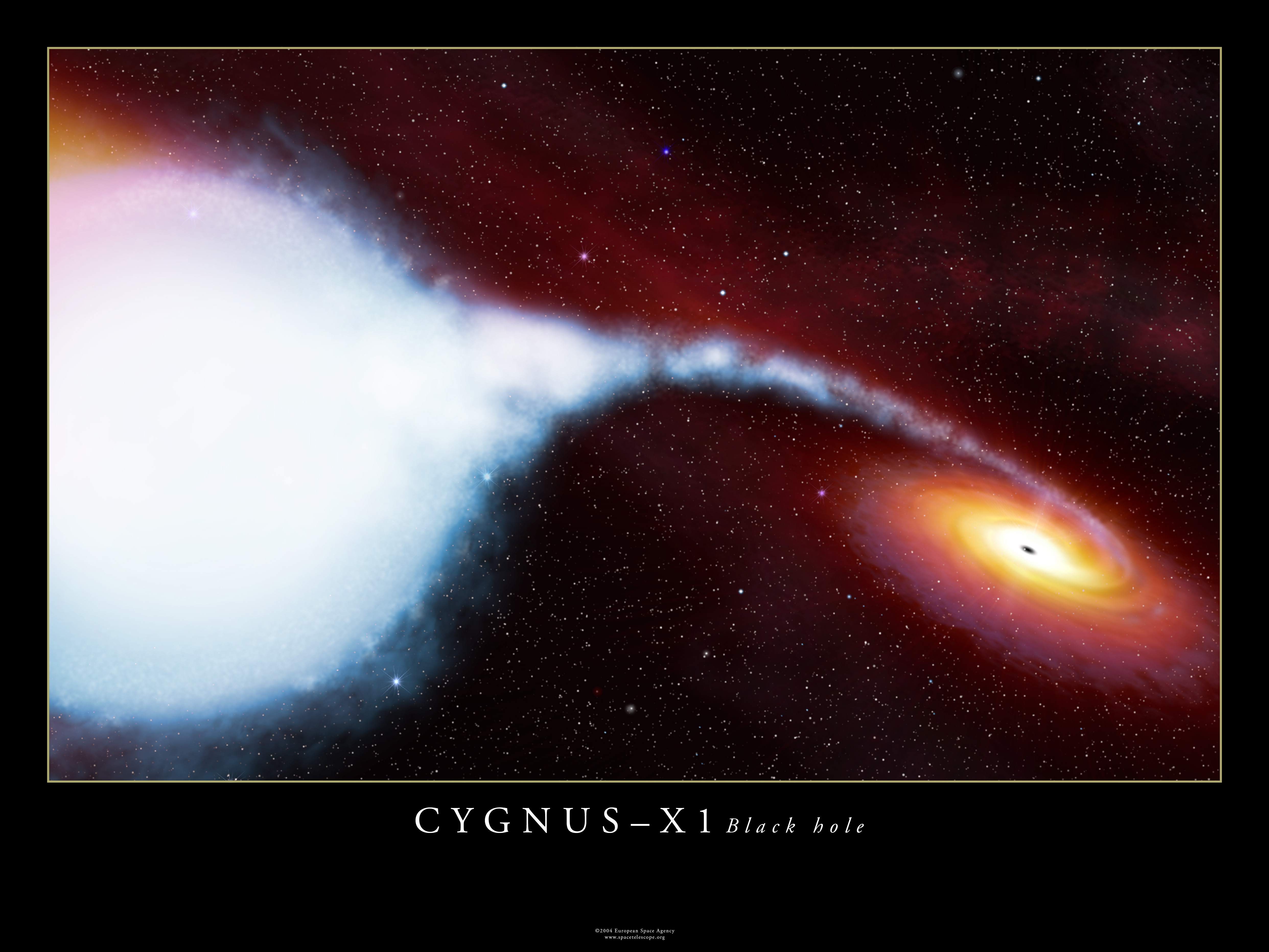
Is that a black hole? Quite possibly. The Cygnus X-1 binary star system contains one of the best candidates for a black hole. The system was discovered because it is one of the brightest X-ray sources on the sky, shining so bright it was detected by the earliest rockets carrying cameras capable of seeing the previously unknown X-ray sky. The star's very name indicates that it is the single brightest X-ray source in the constellation of the Swan Cygnus. Data indicate that a compact object there contains about nine times the mass of the Sun and changes its brightness continually on several time scales, at least down to milliseconds. Such behavior is expected for a black hole, and difficult to explain with other models. Pictured above is an artistic impression of the Cygnus X-1 system. On the left is the bright blue supergiant star designated HDE 226868, which is estimated as having about 30 times the mass of our Sun. Cygnus X-1 is depicted on the right, connected to its supergiant companion by a stream of gas, and surrounded by an impressive accretion disk. The bright star in the Cygnus X-1 system is visible with a small telescope. Strangely, the Cygnus X-1 black hole candidate appears to have formed without a bright supernova explosion.
¿Es realmente un agujero negro? Muy probablemente. El sistema binario de Cygnus X-1 contiene uno de los mejores candidatos para un agujero negro. El sistema fue descubierto porque es una de las fuentes de rayos X más brillantes del cielo, tan resplandeciente que fue detectado por los primeros cohetes equipados con cámaras capaces de observar el hasta entonces desconocido cielo de rayos X. El nombre mismo de la estrella indica que es la fuente de rayos X más brillante en la constelación del Cisne, Cygnus. Los datos indican que un objeto compacto allí contiene aproximadamente nueve veces la masa del Sol y cambia continuamente su brillo en varias escalas de tiempo, al menos hasta milisegundos. Este comportamiento es lo que se espera de un agujero negro, y es difícil de explicar con otros modelos. La imagen superior es una representación artística del sistema de Cygnus X-1. A la izquierda se encuentra la brillante estrella supergigante azul designada HDE 226868, que se estima tiene aproximadamente 30 veces la masa de nuestro Sol. Cygnus X-1 se muestra a la derecha, conectado a su compañero supergigante mediante una corriente de gas, y rodeado por un impresionante disco de acreción. La estrella brillante en el sistema de Cygnus X-1 es visible con un pequeño telescopio. Curiosamente, el candidato a agujero negro de Cygnus X-1 parece haberse formado sin una brillante explosión de supernova.