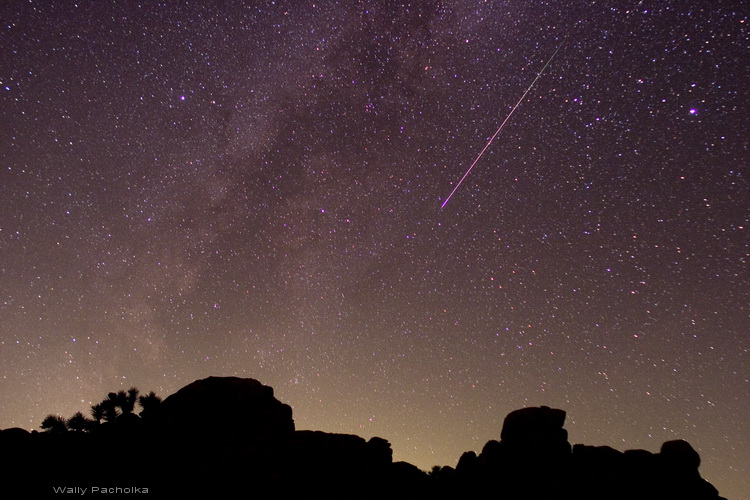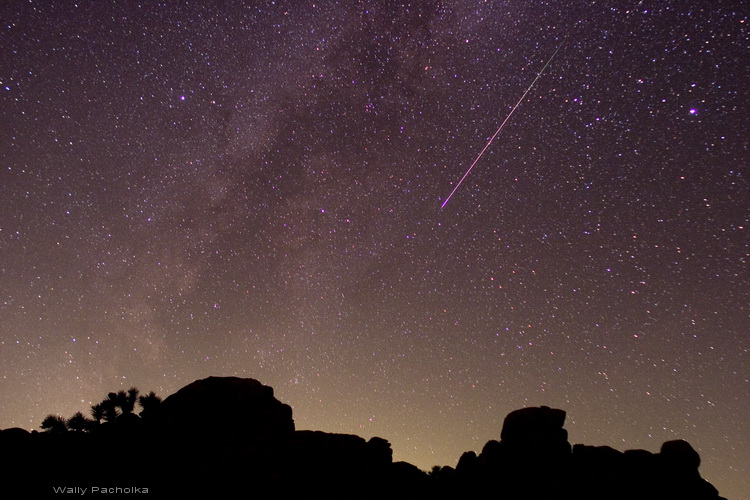
This bright and colorful meteor flashed through Tuesday's early morning skies, part of the annual Perseid Meteor Shower. The lovely image is one of over 350 frames captured on August 12 from the Joshua Tree National Park, in California, USA . Dust from comet Swift-Tuttle is responsible for the Perseids, creating the northern hemisphere's regular summer sky show. The comet dust is vaporized as it enters the atmosphere at upwards of 60 kilometers per second, producing visible trails that begin at altitudes of around 100 kilometers. Of course, the trails point back to a radiant point in the constellation Perseus, giving the meteor shower its name. Recorded after moonset, the starry background features the bright star Vega on the right. Extending below the western horizon is the faint band of the northern Milky Way.
Un meteoro brillante y colorido cruzó los cielos de la madrugada del martes, como parte de la lluvia de meteoros Perseidas que ocurre anualmente. Esta hermosa imagen es una de más de 350 fotografías capturadas el 12 de agosto desde el Parque Nacional Joshua Tree, en California, EE.UU. El polvo del cometa Swift-Tuttle es responsable de las Perseidas, produciendo el espectáculo de verano más regular del cielo del hemisferio norte. El polvo cometario se vaporiza al entrar en la atmósfera a velocidades superiores a 60 kilómetros por segundo, produciendo rastros visibles que comienzan a altitudes de alrededor de 100 kilómetros. Por supuesto, los rastros apuntan hacia un punto radiante en la constelación de Perseo, lo que da nombre a la lluvia de meteoros. Registrada después de la puesta de la Luna, el fondo estrellado presenta la brillante estrella Vega a la derecha. Extendiéndose por debajo del horizonte occidental se encuentra la tenue banda de la Vía Láctea boreal.