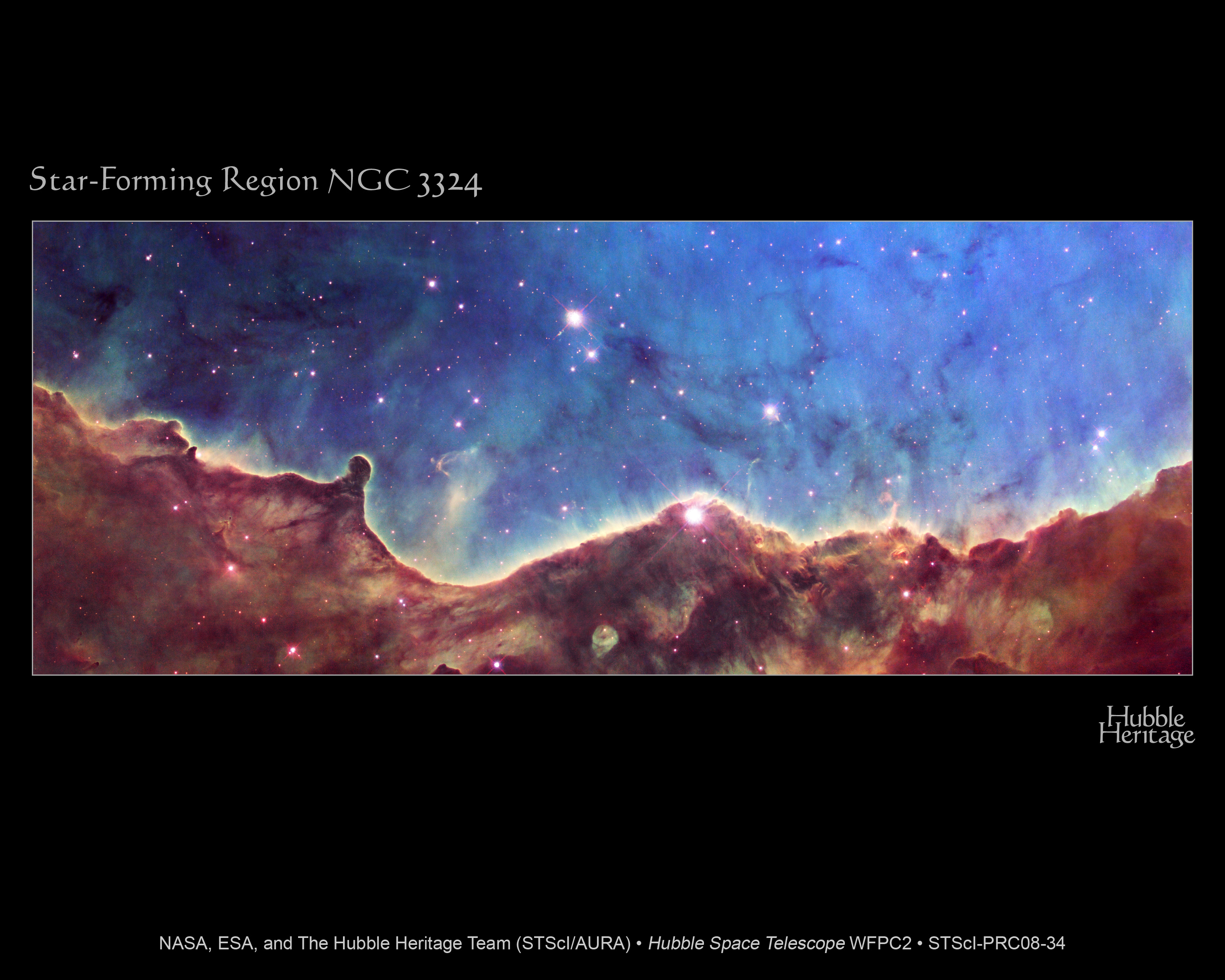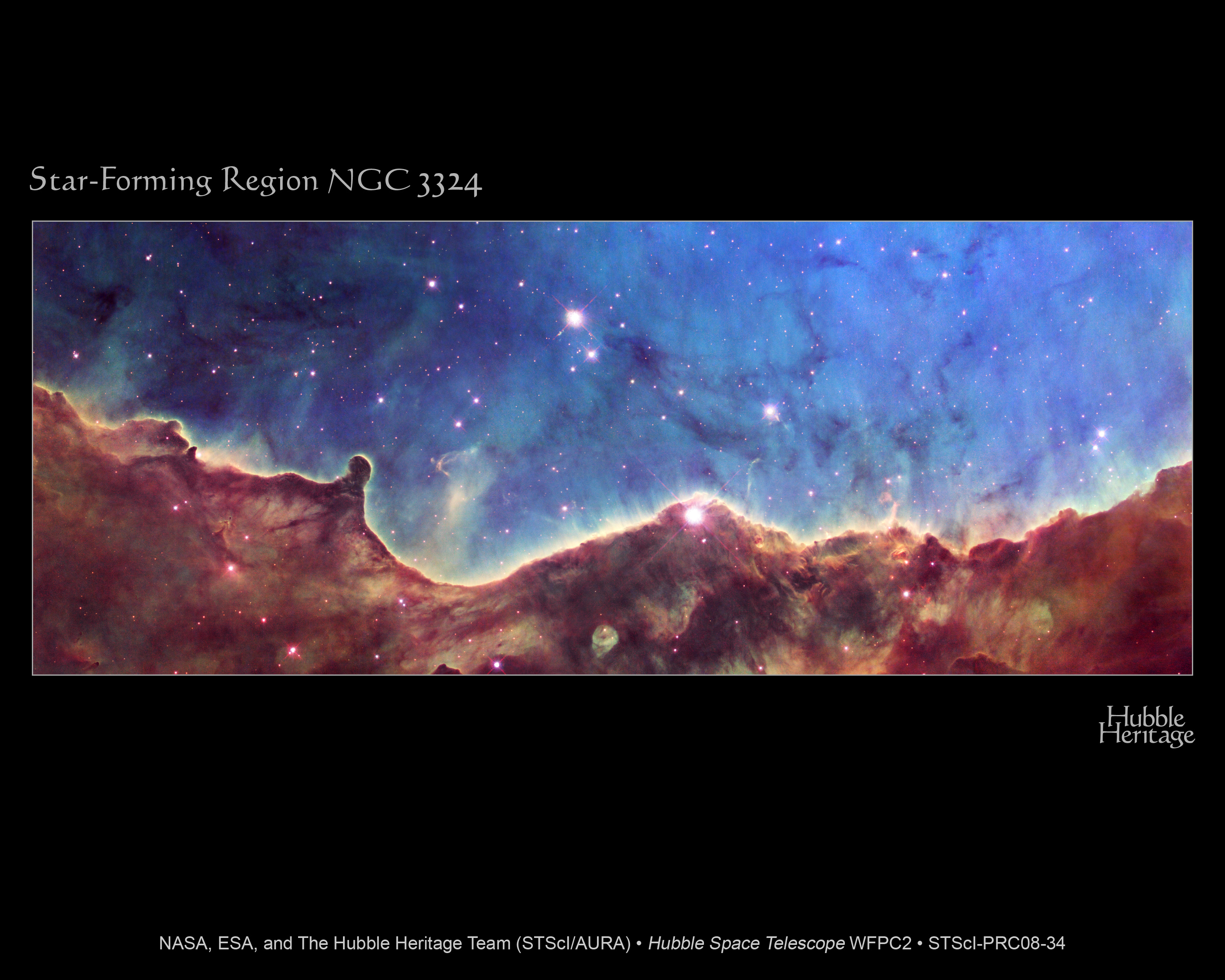
Bright young stars sometimes sculpt picturesque dust mountains soon after being born. Created quite by accident, the energetic light and winds from these massive newborn stars burn away accumulations of dark dust and cool gas in a slow but persistent manner. Such is the case in NGC 3324, a star forming region near the edge of NGC 3372, the energetic and expansive Carina Nebula. Pictured above, in scientifically assigned colors, is only a small part of NGC 3324. The Carina Nebula itself is one of the largest star forming regions known and home to Eta Carinae, one of the most unstable and variable stars known. The above image was created from archived Hubble Space Telescope data in honor of the 10th anniversary of the Hubble Heritage Project. The Hubble Heritage Project has created, so far, nearly 130 visually stunning images.
Las jóvenes estrellas brillantes a menudo esculpen pintorescas montañas de polvo poco después de nacer. Creadas accidentalmente, la luz energética y los vientos de estas masivas estrellas recién nacidas erosionan lentamente pero de manera persistente acumulaciones de polvo oscuro y gas frío. Este es el caso de NGC 3324, una región de formación estelar cerca del borde de NGC 3372, la energética y expansiva Nebulosa de Carina. En la imagen superior, con colores asignados científicamente, se muestra solo una pequeña parte de NGC 3324. La Nebulosa de Carina en sí es una de las mayores regiones de formación estelar conocidas y hogar de Eta Carinae, una de las estrellas más inestables y variables que se conocen. La imagen anterior se creó a partir de datos archivados del Telescopio Espacial Hubble en honor del décimo aniversario del Proyecto Hubble Heritage. El Proyecto Hubble Heritage ha creado hasta ahora casi 130 imágenes visualmente espectaculares.