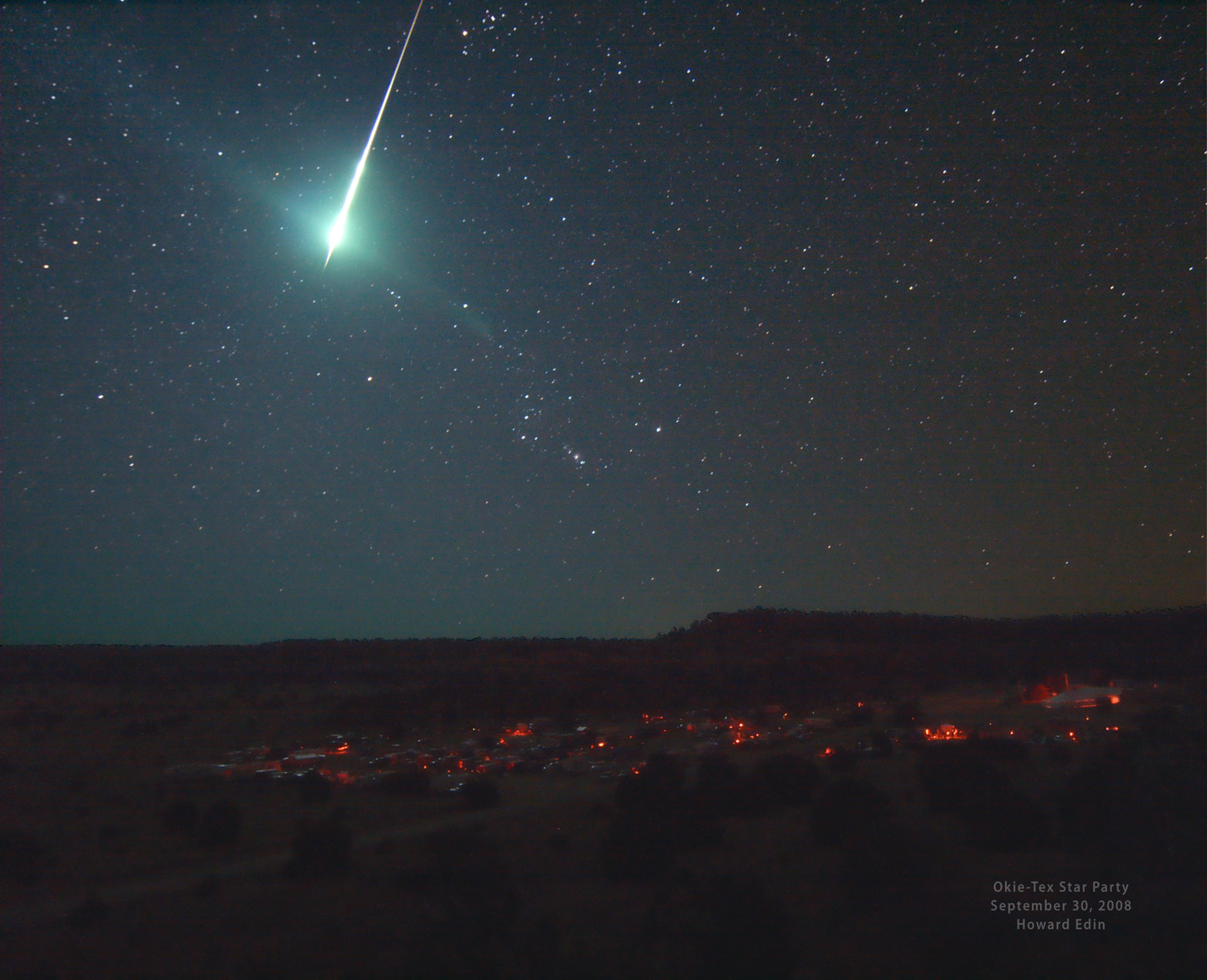
On September 30, a spectacular bolide or fireball meteor surprised a group of amateur astronomers enjoying dark night skies over the Oklahoma panhandle's Black Mesa State Park in the Midwestern US. Flashing past familiar constellations Taurus (top) and Orion, the extremely bright meteor was captured by a hillside camera overlooking the 2008 Okie-Tex Star Party. Astronomy enthusiast Howard Edin reports that he was looking in the opposite direction at the time, but saw the whole observing field light up and at first thought someone had turned on their car headlights. So far the sighting of a such a bright bolide meteor, produced as a space rock is vaporized hurtling through Earth's atmosphere, really is a matter of luck. But that could change. Earlier this week the discovery and follow-up tracking of tiny asteroid 2008 TC3 allowed astronomers to predict the time and location of its impact with the atmosphere. While no ground-based sightings of the fireball seem to have been reported, this first ever impact prediction was confirmed by at least some detections of an air burst and bright flash on October 7th over northern Sudan.
El 30 de septiembre, un espectacular bólido o meteoro de fuego sorprendió a un grupo de astrónomos aficionados que disfrutaban de los cielos oscuros sobre Black Mesa State Park en el panhandle de Oklahoma, en el Medio Oeste de Estados Unidos. Pasando rápidamente ante las constelaciones familiares de Tauro (arriba) y Orión, el meteoro extremadamente brillante fue capturado por una cámara ubicada en una colina que supervisaba la Okie-Tex Star Party de 2008. El entusiasta de la astronomía Howard Edin reporta que estaba mirando en la dirección opuesta en ese momento, pero vio todo el campo de observación iluminarse y al principio pensó que alguien había encendido los faros de un automóvil. Hasta ahora, la observación de un bólido meteórico tan brillante, producido cuando una roca espacial se vaporiza al atravesar la atmósfera terrestre, realmente es una cuestión de suerte. Pero eso podría cambiar. A principios de esta semana, el descubrimiento y seguimiento del pequeño asteroide 2008 TC3 permitieron a los astrónomos predecir la hora y el lugar de su impacto con la atmósfera. Aunque no parece haber reportes de avistamientos desde tierra del meteoro de fuego, esta primera predicción de impacto fue confirmada por al menos algunas detecciones de una onda de choque y un destello brillante el 7 de octubre sobre el norte de Sudán.